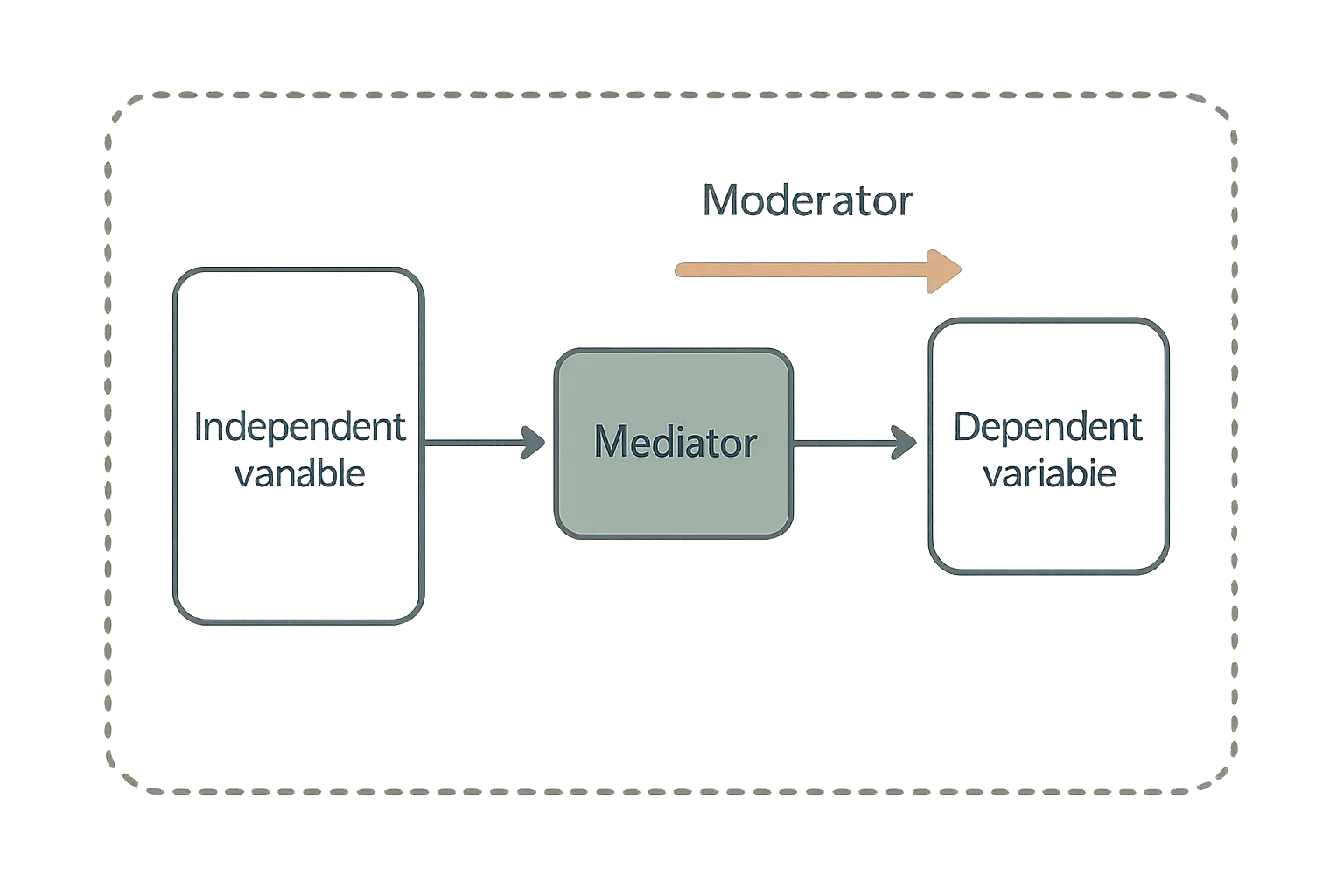
A conceptual framework is the part of a dissertation most often submitted as a diagram with no argument attached. The diagram is the easy half. The half that earns marks is the paragraph explaining why each arrow points the way it does, and where each construct came from.
This article gives you six worked frameworks across South African disciplines. For each one you get the diagram described in words, the propositions it commits you to, and the accompanying paragraph. They are shapes to adapt: constructs, populations and settings must become yours, and the places where your referenced evidence belongs are marked [cite].
Conceptual or theoretical: the distinction that matters here
The two terms are used loosely and your faculty may use them interchangeably, so the safest approach is to be explicit about what you mean rather than to argue about definitions.
The working distinction most South African supervisors apply is this. A theoretical framework is an existing theory you adopt, largely as its originators built it, to explain your phenomenon. A conceptual framework is the specific map of your constructs and the relationships you propose between them — often derived from one or more theories, but assembled by you for this study.

If you are still choosing the theory to derive from, this site already covers that choice for two fields: nine theoretical frameworks for a South African MBA research report and which theoretical framework a psychology master’s dissertation should use. This article assumes the theory is chosen and deals with turning it into your own map.
The four things every framework must state
- The constructs, each defined once, in the terms you will measure them.
- The direction of each proposed relationship, and whether it is causal, associative or definitional.
- The role of each construct: independent, dependent, mediating, moderating or control.
- The boundary — what the framework deliberately excludes, and why.
The fourth is the one most often missing and the one examiners ask about. A framework without a stated boundary implies you think it explains everything.
Six worked frameworks
1. Education: support structures and curriculum implementation
Diagram. Two independent constructs on the left — school-level support (mentoring access, dedicated planning time) and centralised professional development — each with an arrow to a mediator, teacher implementation self-efficacy, which in turn has an arrow to the dependent construct, reported implementation fidelity. A moderator, school resourcing level, sits above the mediator-to-outcome arrow with a vertical arrow onto it. A dashed boundary excludes learner outcomes.
Propositions.
- P1: School-level support is positively associated with implementation self-efficacy.
- P2: Centralised professional development is positively associated with implementation self-efficacy, but more weakly than P1
[cite]. - P3: Implementation self-efficacy is positively associated with reported implementation fidelity.
- P4: The strength of the P3 relationship varies with school resourcing level.
The paragraph. “The framework in Figure 2.1 proposes that support structures influence implementation indirectly, through teachers’ sense of their own capacity to implement, rather than directly. This ordering follows from [theory or literature] [cite], which holds that… The framework deliberately stops at reported implementation rather than extending to learner outcomes, because the design cannot attribute learner attainment to a single reform within one academic year.”
2. Nursing: scope interpretation under referral constraint
Diagram. A single independent construct, referral pathway availability, with an arrow to nurse scope interpretation, moderated by two constructs entering from above: protocol clarity and supervision access. Scope interpretation then has an arrow to reported clinical action. The boundary excludes patient outcome.
Propositions.
- P1: Lower referral availability is associated with broader scope interpretation.
- P2: Protocol clarity attenuates the P1 relationship.
- P3: Supervision access attenuates the P1 relationship independently of protocol clarity.
The paragraph. Explain why the moderators are moderators rather than independent variables — they do not push the nurse towards a decision, they change how strongly the constraint does. That sentence is the whole justification for the arrow placement, and it is what the examiner is checking.
3. Management: engagement and retention without an HR function
Diagram. Employee engagement to intention to remain, mediated by perceived organisational support. A boundary condition box, absence of a formal human resource function, is drawn around the whole model rather than as an arrow, indicating it defines the population rather than acting as a variable.
Propositions.
- P1: Engagement is positively associated with intention to remain.
- P2: Perceived organisational support mediates the P1 relationship.
- P3: In the absence of a formal HR function, perceived support derives from direct supervisory behaviour rather than from policy or process
[cite].
The paragraph. The drawing decision is the argument: a boundary drawn around the model says the condition is not something you vary but something that defines who is in the study. If you drew it as a moderator you would be claiming a comparison you are not making.
4. Public administration: capacity-controlled audit outcomes
Diagram. Three input constructs — financial management capacity, oversight structure functioning and political stability of the council — each with an arrow to audit outcome. Capacity is drawn with a dashed arrow and labelled as a control rather than a hypothesis, because the study matches on it.
Propositions. P1 and P2 concern oversight and stability. There is no proposition about capacity, and the framework says so explicitly — it is held constant by design.
The paragraph. “Capacity appears in the framework as a control rather than an explanatory construct, because the sampling strategy matches municipalities on it. Its inclusion in the diagram is therefore a statement about what the design removes, not about what the study tests.”
5. Information systems: artefact evaluation
Diagram. A cycle rather than a chain: identified requirements to artefact design to evaluation against criteria, with a feedback arrow from evaluation back to design. Two external constructs feed in: user context constraints into requirements, and evaluation criteria, drawn as entering from outside the cycle because they are set in advance.
The paragraph. Design-science frameworks are cyclical and the diagram should show that. What matters is that the criteria enter from outside the loop: criteria derived after seeing the artefact perform are not criteria, and drawing them outside is how you demonstrate you understand that.
6. Engineering: deterioration model recalibration
Diagram. Two parallel paths converging. Path one: measured exposure conditions and construction-era material practice into observed deterioration. Path two: published model parameters into predicted deterioration. Both converge on a comparison node, prediction error, which leads to recalibrated parameters.
The paragraph. A framework in a technical discipline still has to say which relationships are assumed and which are tested. Here the model’s internal relationships are assumed — you are not questioning the physics — and the tested relationship is between local conditions and prediction error. Saying so prevents the obvious examiner question about whether you are validating the model or the calibration.
A short explainer on the distinction
If the theoretical-versus-conceptual line is still blurred, an academic walkthrough helps more than another definition.
Drawing conventions that avoid an argument
- Solid arrows for tested relationships, dashed for assumed or controlled ones. State the convention in the caption; nobody will guess it.
- Moderators enter onto an arrow, not onto a box. A moderator changes a relationship. An arrow pointing at a construct is a main effect, which is a different claim.
- Mediators sit on the path. If your mediator is drawn beside the path rather than on it, the diagram says something other than what your propositions say.
- Boundaries as dashed enclosures. Anything outside the enclosure is explicitly out of scope, which saves a paragraph of defensive prose.
- Number the figure and refer to it in the text. “Figure 2.1 presents…” — a framework diagram that is never mentioned in the prose reads as decoration.
Five ways frameworks go wrong
- A diagram with no propositions. Arrows imply claims. Write them out as numbered propositions or hypotheses and the diagram becomes checkable.
- Constructs that never reappear. Every box must be measured in the methodology and reported in the results. An unmeasured construct is a promise you did not keep.
- The framework as a literature summary. Twelve boxes covering everything in your review. A framework is a selection; if nothing was left out, nothing was decided.
- Borrowed wholesale and called conceptual. If the diagram is someone else’s model unchanged, it is a theoretical framework and must be cited as theirs. Adapting it is fine; presenting it as yours is not.
- Arrows whose direction is never justified. Each direction needs either a reference or a stated logical reason. “Both directions are plausible and this study tests only one” is an acceptable answer; silence is not.
Where this fits in the chapter
The conceptual framework usually closes the literature review chapter or opens a short chapter of its own, sitting between the literature review and the methodology. It should follow directly from the gap and feed straight into your objectives, which in turn determine which statistical test you will use. If the framework and the objectives are describing different studies, one of them is wrong, and it is usually easier to fix the framework.
Frequently asked questions
What is the difference between a conceptual and a theoretical framework?
A theoretical framework is an existing theory adopted largely as built. A conceptual framework is your own map of the constructs and relationships in this specific study, often derived from theory but assembled by you.
Does a qualitative study need a conceptual framework?
Often yes, though it will look different: concepts and their proposed relations rather than variables and arrows. Some qualitative traditions deliberately avoid an a priori framework, in which case say so and explain why.
How many constructs should the framework have?
Few enough that every one is measured. Four to six is common at master’s level. If you cannot say how you will measure a box, take it out.
Can I adapt a published model?
Yes, and that is the normal route. Cite the original, state clearly what you changed, and explain why the change is needed for this population or setting.
Must the framework be a diagram?
Not strictly, but a diagram plus propositions communicates faster than prose alone and is what most examiners expect. The prose still has to be there.
Where does the framework go?
Usually at the end of the literature review chapter, or as a short separate chapter before the methodology. Your faculty template decides.
Can the framework change after data collection?
Refinement in light of findings is normal in exploratory work, provided you present the original framework and describe the revision explicitly. Silently replacing it is not acceptable.
What if my study tests only part of the framework?
That is fine and common. Mark the tested portion clearly on the diagram and say in the text which relationships are outside this study’s scope.
Do I need a South African source for my framework?
Not necessarily, but your justification for applying an imported model here should engage with the local condition that makes it interesting, which normally means at least one local reference.
How do I caption the figure?
Number it, describe what it shows, state your arrow convention, and give the source: your own construction, or adapted from a named author with the citation.
Build the framework and the argument together
A framework is quick to draw and slow to justify, which is why so many arrive at examination undefended. Tesify helps you draft the propositions and the paragraph alongside the diagram, with the thinking staying 100% written by you.