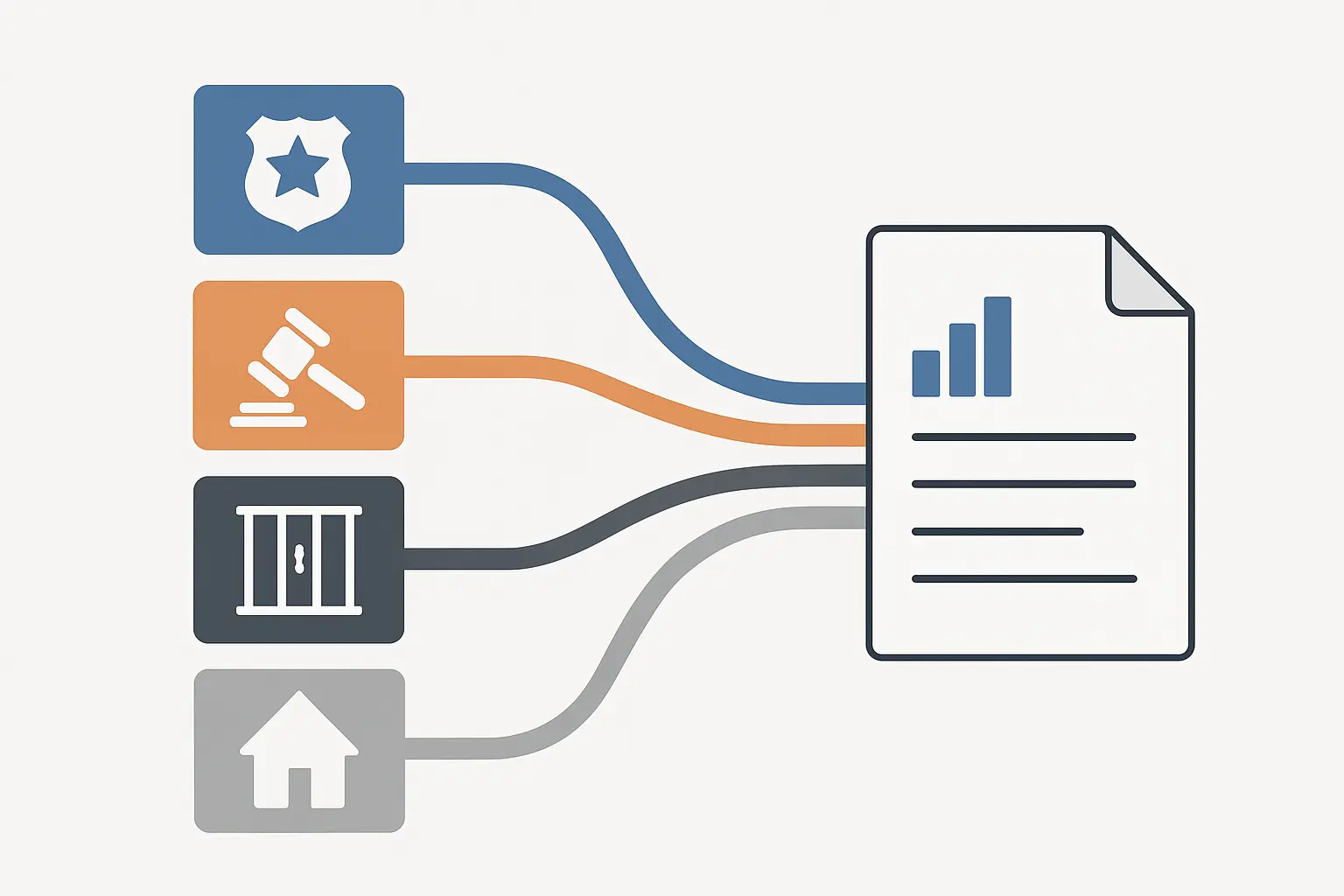
SAPS publishes recorded-crime statistics quarterly, and the Institute for Security Studies’ Crime Hub is the most complete public tool for turning those releases into usable tables and comparisons — but SAPS’s recorded-crime figures and Stats SA’s household victimisation survey measure two structurally different things, police-reported incidents against self-reported experience, and a dissertation that treats them as interchangeable will draw an examiner’s first question. Six sources cover what a South African criminology honours or master’s study is likely to need.
Six criminology data sources, at a glance
| Source | Custodian | What it gives you | Update cycle | Access |
|---|---|---|---|---|
| SAPS recorded crime statistics | South African Police Service | Recorded-crime counts by category, police station and province | Quarterly | saps.gov.za, free |
| ISS Crime Hub | Institute for Security Studies | SAPS data aggregated into a Crime Statistics Wizard for national, provincial and local comparison, plus expert analysis and commentary | Refreshed alongside each SAPS quarterly release | crimehub.org, free |
| Governance, Public Safety and Justice Survey (GPSJS) | Stats SA | Household-level victimisation and perception-of-safety survey data, independent of whether an incident was reported to police | Periodic household survey round | statssa.gov.za, free summary reports; microdata access follows the same registration process as other Stats SA releases |
| National Prosecuting Authority annual report | National Prosecuting Authority | Prosecution and conviction statistics by crime category and court level | Annual | npa.gov.za, free |
| Department of Correctional Services annual report | Department of Correctional Services | Sentenced offender and remand detainee population statistics, by facility and category | Annual | dcs.gov.za, free |
| Africa Check | Africa Check (independent fact-checking organisation) | Verification and methodology explainers for crime-statistics claims circulating in media and public debate | Ongoing, as claims arise | africacheck.org, free |
Read the “what it gives you” column before you commit to a source for your primary data chapter. A recorded-crime count and a victimisation-survey estimate answer different research questions, and a dissertation chapter that blends them without saying so is the single most common data-source error examiners in this field report.

1. SAPS recorded crime statistics, for what was reported to police
The South African Police Service releases recorded-crime statistics on a quarterly cycle, broken down by crime category, police station and province — the baseline dataset behind almost every South African crime-trend claim made in media and policy debate. Its central limitation for a dissertation is definitional and universal to police-recorded crime data anywhere: it counts incidents that were reported to and recorded by police, not incidents that occurred. Under-reporting varies systematically by crime type (sexual offences and certain property crimes are known internationally to be under-reported relative to more visible crimes like vehicle theft), so a dissertation using SAPS data as its sole source should state this limitation explicitly rather than treating recorded counts as a complete picture of crime incidence.
Who it suits
Studies of policing response, station-level or provincial comparison of recorded-crime trends, and any dissertation whose research question is specifically about what enters the criminal justice system rather than about the true incidence of an offence.
2. The ISS Crime Hub, for turning SAPS releases into usable comparisons
The Institute for Security Studies positions its Crime Hub as South Africa’s most complete public resource for ready-to-use crime and safety information, built around a Crime Statistics Wizard that lets a user query and compare SAPS data at national, provincial and local level without building the comparison tables from raw SAPS releases independently. For a dissertation with a limited timeline, this tool substantially cuts the data-preparation time a station-level or multi-province comparison would otherwise take, and the ISS’s own analysis and commentary, published alongside the data, is a legitimate secondary source for contextualising your findings against expert interpretation — provided you cite the analysis separately from the underlying SAPS data it interprets.
Who it suits
Any study needing a multi-station or multi-province comparison of recorded-crime trends, and students who need expert context for interpreting SAPS releases without building every comparison from scratch.

3. The Governance, Public Safety and Justice Survey, for what SAPS data cannot show
Stats SA’s Governance, Public Safety and Justice Survey (GPSJS) asks households directly about their experience of crime and their perception of safety, independent of whether any incident was reported to police — the structural counterpart to SAPS’s recorded-crime data, and the source that lets a dissertation address under-reporting rather than merely note it as a limitation. Household victimisation surveys are the standard international method for estimating the “dark figure” of unreported crime, and a dissertation comparing a specific crime category’s recorded rate against its survey-estimated victimisation rate is a well-established, examiner-recognised design in criminology.
Who it suits
Studies of under-reporting, fear of crime, perceived safety, or any research question that needs a measure of crime experience independent of police recording practices.
4. The National Prosecuting Authority annual report, for what happens after arrest
The NPA’s annual report reports prosecution and conviction statistics by crime category and court level, the data source for any dissertation whose research question sits downstream of policing — case attrition between charge and conviction, prosecutorial outcomes by offence type, or the throughput of specific court specialisations such as sexual offences courts. A dissertation studying “the criminal justice response” to a specific offence type usually needs this source alongside SAPS data, since recorded-crime counts alone say nothing about what happened to a case once it entered the court system.
Who it suits
Case-attrition studies, prosecutorial-outcome research, and any dissertation examining the criminal justice system’s response beyond the point of police recording.
5. The Department of Correctional Services annual report, for the sentenced and remand population
DCS’s annual report covers the sentenced offender and remand detainee population by facility, offence category and other demographic breakdowns the department publishes, the primary South African source for any dissertation studying incarceration, sentencing patterns, remand detention, or corrections-system capacity. Remand detainee data specifically is relevant to research on pre-trial detention and its relationship to case backlogs in the court system, a live policy question in South African criminal justice research.
Who it suits
Sentencing and incarceration research, remand-detention studies, and corrections-system capacity or rehabilitation-programme research.
6. Africa Check, for verifying a claim before you cite it
Africa Check is not a primary data source but an independent fact-checking organisation that regularly publishes methodology explainers and verification reports on crime-statistics claims circulating in South African media and public debate — a genuinely useful check before a dissertation’s literature review repeats a widely circulated figure that may not hold up to scrutiny. If your literature review cites a striking crime statistic from a news article rather than directly from SAPS, Stats SA, the NPA or DCS, searching Africa Check for a verification of that specific claim before you rely on it is a low-cost step that protects your credibility with an examiner who may recognise a debunked figure.
Match the source to your question before you register your topic
Three questions narrow six sources to the one or two your dissertation actually needs. Is your question about what was reported to police, what was actually experienced, or what happened after arrest — SAPS data, the GPSJS, and the NPA or DCS respectively answer at those different stages of the justice system, and mixing stages without saying so is the most common examiner objection in this field. Does your unit of analysis match your source’s level of aggregation — SAPS and the ISS Crime Hub report to station and provincial level, which supports a local comparison; the GPSJS reports at a broader level suited to national or provincial patterns rather than single-station analysis. And is a striking figure in your literature review from a primary source or a secondary retelling — trace any widely circulated statistic back to SAPS, Stats SA, the NPA or DCS directly, using Africa Check to flag anything that looks distorted in transmission.
Whichever source anchors your study, the same test-selection logic applies once you have the data in hand as in any other South African dissertation; the guide to choosing the right statistical test for a dissertation picks up from exactly this point. If your dissertation sits closer to social work or public administration than to policing specifically, the companion sourcing discipline in our guides to social work statistics for a background chapter and public administration research topics follows the same custodian-and-update-cycle logic.
Build the data chapter once you have chosen your source
Choosing between six data systems at different stages of the justice system, each with its own access process and citation convention, is exactly the kind of decision that stalls a criminology dissertation for weeks. Tesify drafts the data and methods section once you have picked your source, keeps the citation consistent with the custodian and reporting period you name, and flags where a recorded-crime figure needs an under-reporting limitation attached. Draft your criminology data chapter with Tesify, then run it past the similarity check before you submit.
Frequently asked questions
Why do SAPS crime statistics and Stats SA victimisation data sometimes disagree?
Because they measure different things: SAPS counts incidents reported to and recorded by police, while a victimisation survey asks households directly about their experience regardless of whether they reported it. A gap between the two for a specific crime type is itself a research finding about under-reporting, not a data error to be resolved.
Do I need ethics clearance to use these datasets?
Secondary analysis of aggregate, publicly released statistics such as SAPS quarterly releases or NPA and DCS annual reports usually needs a lighter ethics review than primary data collection, but every South African university still requires an application. Confirm with your faculty’s research ethics committee rather than assuming any dataset is exempt.
Which source should I use for a dissertation about a single police station or precinct?
SAPS station-level data, accessed directly or through the ISS Crime Hub’s wizard tool, is the appropriate level of aggregation; the GPSJS and the NPA and DCS annual reports do not report at station level.
Is the ISS Crime Hub an independent data source, or just a repackaging of SAPS data?
For the raw crime counts, it is a repackaging of SAPS data into a more usable comparison tool, and should be cited alongside SAPS as the original source. Its accompanying analysis and commentary, however, are the ISS’s own independent output and can be cited separately as expert interpretation.
Can I combine SAPS data with NPA or DCS data in one dissertation?
Yes, and it often produces a stronger study, tracing a specific offence category from recorded incident through prosecution to sentencing. State clearly which claims come from which stage of the justice system, since conflating a recorded-crime count with a conviction count is a common and avoidable examiner objection.
What if the crime statistic I want to cite only appears in a news article, not an official source?
Trace it back to the original SAPS, Stats SA, NPA or DCS release before citing it, and check Africa Check for an existing verification if you cannot locate the primary source quickly. A statistic cited only to a news article, with no traceable official source, is a common and avoidable weakness in a literature review.