Direct answer: Usually not. At most South African universities there is no public defence of a master’s dissertation — your work is examined in writing by external examiners. An oral examination (viva) exists at some institutions, mainly for doctorates: the CHE found most universities’ public documents do not require one, though Stellenbosch has used it for years, and a national review has recommended that all institutions adopt it.
Who actually examines a South African dissertation?
The South African model is built on independent examination rather than a public defence. Your dissertation goes to examiners appointed by the university, and the weight of the process sits with people who are deliberately outside it. The University of the Free State’s Policy on Master’s and Doctoral Studies is a well-documented example of how this is structured: for master’s by research and doctoral degrees, there are three examiners, and “external examiners must always form the majority”. External examiners must be recognised experts in their field with no association with the university — the UFS policy even excludes people who hold honorary appointments or recently left its employment. For a structured master’s mini-dissertation, the panel is at least one external and one internal examiner, and neither may be your supervisor or co-supervisor.
That last point surprises many students: the person who guided the work for two years does not mark it. The supervisor’s role ends at certifying the dissertation is ready for examination; judgement passes to independent experts. This is why polishing the document itself matters so much in South Africa — for most master’s candidates, the written dissertation is the only version of you the examiners ever meet.
Is there an oral examination (viva) in South Africa?
Sometimes — and this is where institutions genuinely differ. The Council on Higher Education examined the question directly in its Briefly Speaking No. 30 (August 2024), Viva Voce: The Oral Examination of a Thesis for a Doctoral Degree. Its finding: the viva “is standard practice across many countries, but it is unevenly used in South African higher education institutions”. More concretely: “Publicly available institutional documents for most of the universities in South Africa do not stipulate a requirement for an oral examination of a thesis for a doctoral degree. Those that do, include Stellenbosch University, which has used the viva for many years.” At the University of Pretoria, the CHE notes, the rules leave it to faculties. Among the six private higher education institutions offering doctoral qualifications at the time of the national review, three required a viva: STADIO Higher Education, Regent Business School and The DaVinci Institute.
The direction of travel matters if you are starting a doctorate now: the CHE’s national review of South African doctoral qualifications (2020–2021) recommended that all institutions offering doctoral qualifications include a viva in the examination process, to assess the graduate attributes in the CHE’s 2018 Standard for a Doctoral Degree. The CHE also reports discussions in many universities about implementing it consistently, “starting soon”. If your institution does not require an oral today, it may before you submit — read your faculty’s current examination rules, not last year’s.
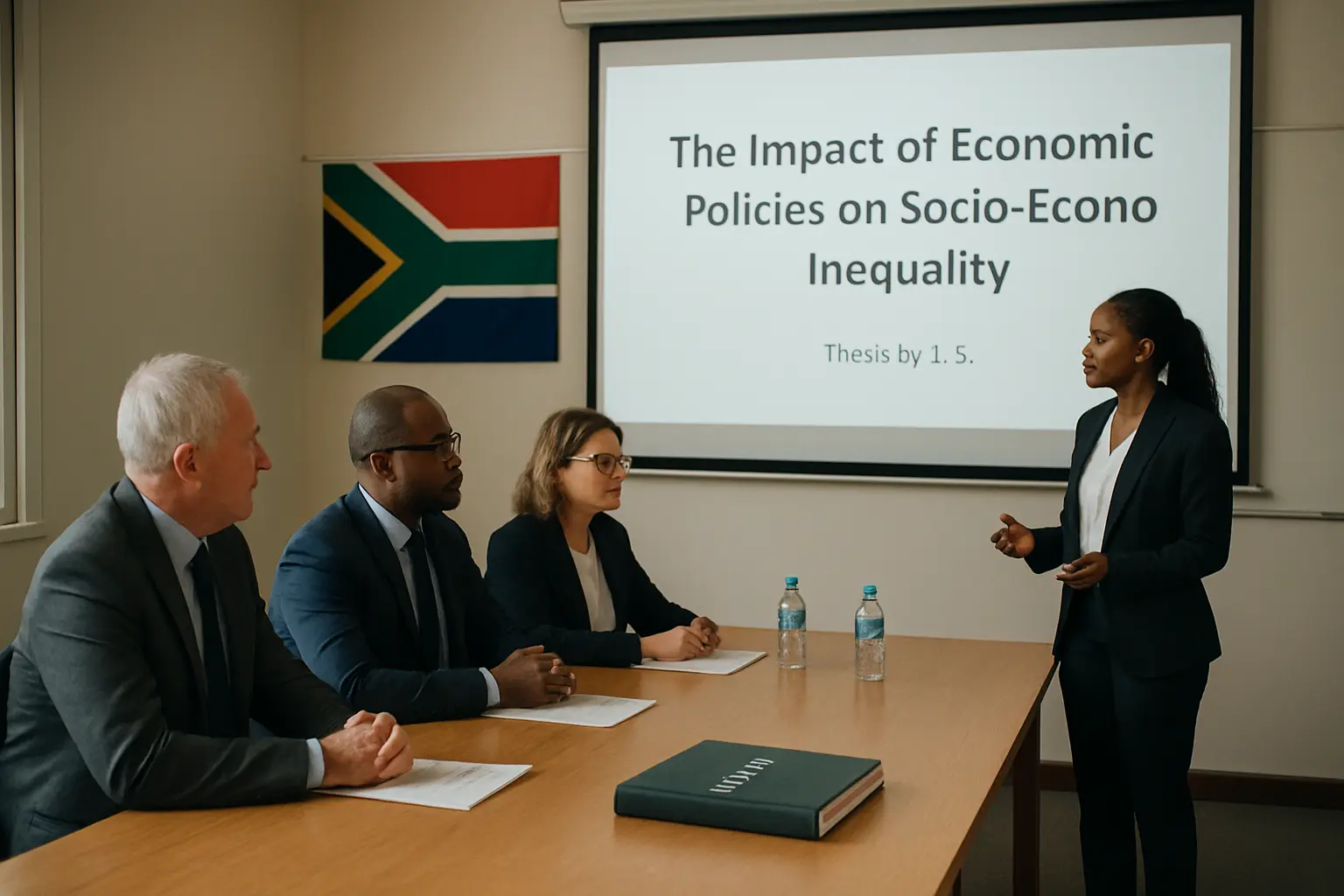
What is a viva actually for?
Where a viva exists, its purpose varies — and the CHE’s review is careful about this. In some designs it assesses graduate attributes such as reflection, autonomy and independent ownership of the work; in others it is “more of a celebratory presentation (a ‘rite of passage’), with no associated regulatory requirement”; in others still it is used to reach an agreed recommendation among examiners, either routinely or when their assessments conflict. One thing the CHE’s review is explicit about: while authenticity issues might surface during a viva, “ascertaining authenticity should not be its intention” — the oral is not designed as an integrity check, and universities have other processes for that.
Can you fail a master’s dissertation in South Africa?
Yes. Examination is real assessment, not a formality. Under the UFS policy, a master’s dissertation passes on “a final mark of at least 50% from each examiner” — note each: one examiner below the line is enough to stop an outright pass, which is why universities build in processes for discrepancies, including appointing an arbiter external examiner for borderline decisions or conflicting assessments. Doctorates at UFS are “awarded either a pass or a fail and are not graded” — there is no mark, and the degree is awarded when each examiner recommends it.
Between a clean pass and a fail sits the outcome most candidates actually experience: corrections. Examiners commonly recommend revisions — from typographical fixes to substantial rewriting — and the degree is awarded only once the revised dissertation satisfies the process. Treat examiner reports as the final supervision cycle of the degree, not as a verdict on you.
What is the minimum pass mark — and what does cum laude mean?
There is no national pass mark; it is set by each university’s policy. At UFS the master’s threshold is 50% from each examiner, and a distinction requires a final mark of at least 75%, calculated taking all examiners’ marks into account. Other universities publish their own thresholds and their own rules for how examiner marks combine, which is why the only safe procedure is the one this site keeps repeating: open your institution’s master’s and doctoral policy and read the examination section. If you are still choosing between qualification routes, our guide to the differences between an honours report, a master’s dissertation and a doctoral thesis maps which examination regime applies at each level.
How long does external examination take?
This is the question with no honest national answer: no sector-wide dataset of examination turnaround times exists in the public institutional documents, and any site that gives you one number for South Africa is inventing it. What determines your wait: how quickly examiners are appointed (this can start before submission — UFS requires students to give notice of intended submission precisely so appointment can begin), examiner availability in your field, the number of examiners who must report, and whether their recommendations agree or trigger an arbiter. Practical advice: ask your faculty officer for the faculty’s own target turnaround, submit the notice-of-submission forms early, and plan your registration year on the assumption that examination plus corrections takes months, not weeks. If the process stalls and nobody communicates, the same escalation discipline applies as with a silent supervisor — our escalation guide shows the order to raise it in.
The corrections cycle: the outcome nobody prepares you for
Because there is usually no oral where misunderstandings can be talked through, the examiner reports carry the whole weight of the exchange — and responding to them is a skill of its own. Read each report twice before touching the document: once to absorb the tone, once to build a task list. Then respond point by point, in a table if the faculty allows it: the examiner’s comment, what you changed, and where. Where two examiners pull in opposite directions — one wants the theory chapter expanded, the other wants the dissertation shortened — do not silently pick a side; flag the tension to your supervisor and let the response document explain the choice. Examiners who see their comments taken seriously sign off faster, and a disciplined response document is often the difference between one corrections round and two. Budget real time for this: corrections arrive when your momentum is coldest, months after submission, and the students who treat them as a quick admin task are the ones who end up re-registering for another year.
What should you do differently, knowing this?
Write for the reader you will never meet. An external examiner opens your dissertation cold: no memory of your proposal meetings, no context for your compromises, no affection for your topic. Everything must be on the page — the logic of the design, the honesty of the limitations, the match between claims and evidence, and a reference list that holds up under an expert’s eye. That is a drafting and revision problem, and it is exactly the work Tesify is built for: structuring chapters, tightening the argument, and keeping citations consistent so the version that reaches the examiners is the strongest version of your own work. It matters twice as much if you are writing around a full-time job and your revision windows are short.
FAQ: examination and defence in South Africa
Do you defend your master’s dissertation in South Africa?
At most universities, no — master’s dissertations are examined in writing by independent examiners. Where orals exist at master’s level they are institution- or faculty-specific; check your faculty’s rules.
Do you defend a PhD in South Africa?
It depends on the institution. Most universities’ public documents do not require a doctoral viva, per the CHE’s 2024 review — but Stellenbosch has long used one, some private institutions require one, and the CHE has recommended all institutions adopt it. The picture is actively changing.
Who marks a master’s dissertation?
Appointed examiners — at UFS, three for a master’s by research, with externals in the majority; at least one external plus one internal for a structured master’s mini-dissertation. Your supervisor is not one of them.
Can my supervisor be an examiner?
No — examination policies exclude the supervisor and co-supervisor from examining the work they supervised.
What marks do examiners give?
For master’s degrees, a mark against the university’s threshold — at UFS, 50% from each examiner to pass and 75% for a distinction. Doctorates are typically pass/fail without a mark.
What happens if examiners disagree?
Policies provide for it — UFS defines an arbiter external examiner for borderline decisions or discrepancies between examiners’ assessments. Disagreement extends the timeline; it does not automatically sink the dissertation.
Is the South African external examiner system unusual?
The reliance on written examination without a routine public defence distinguishes South Africa from viva-centred systems. The CHE’s review situates South Africa against countries where the doctoral viva is standard practice.
Should I prepare for a viva anyway?
If you are a doctoral candidate, yes — check your institution’s current rules first, and remember the sector is moving toward wider viva adoption following the CHE recommendation. Being able to explain and defend your choices aloud is also simply good preparation for corrections.