
It is 11pm, your theoretical framework section is due, and every nursing theory you half-remember from your undergraduate years suddenly sounds interchangeable. Orem’s Self-Care Deficit Nursing Theory is a natural framework for a South African nursing dissertation whenever the study is about a patient’s or a caregiver’s capacity to manage their own health — and once you see its three constructs and how they map onto a theoretical framework section, it stops being an abstract name and becomes a structure you can actually write inside tonight.
Who was Dorothea Orem, and what does her theory actually say?
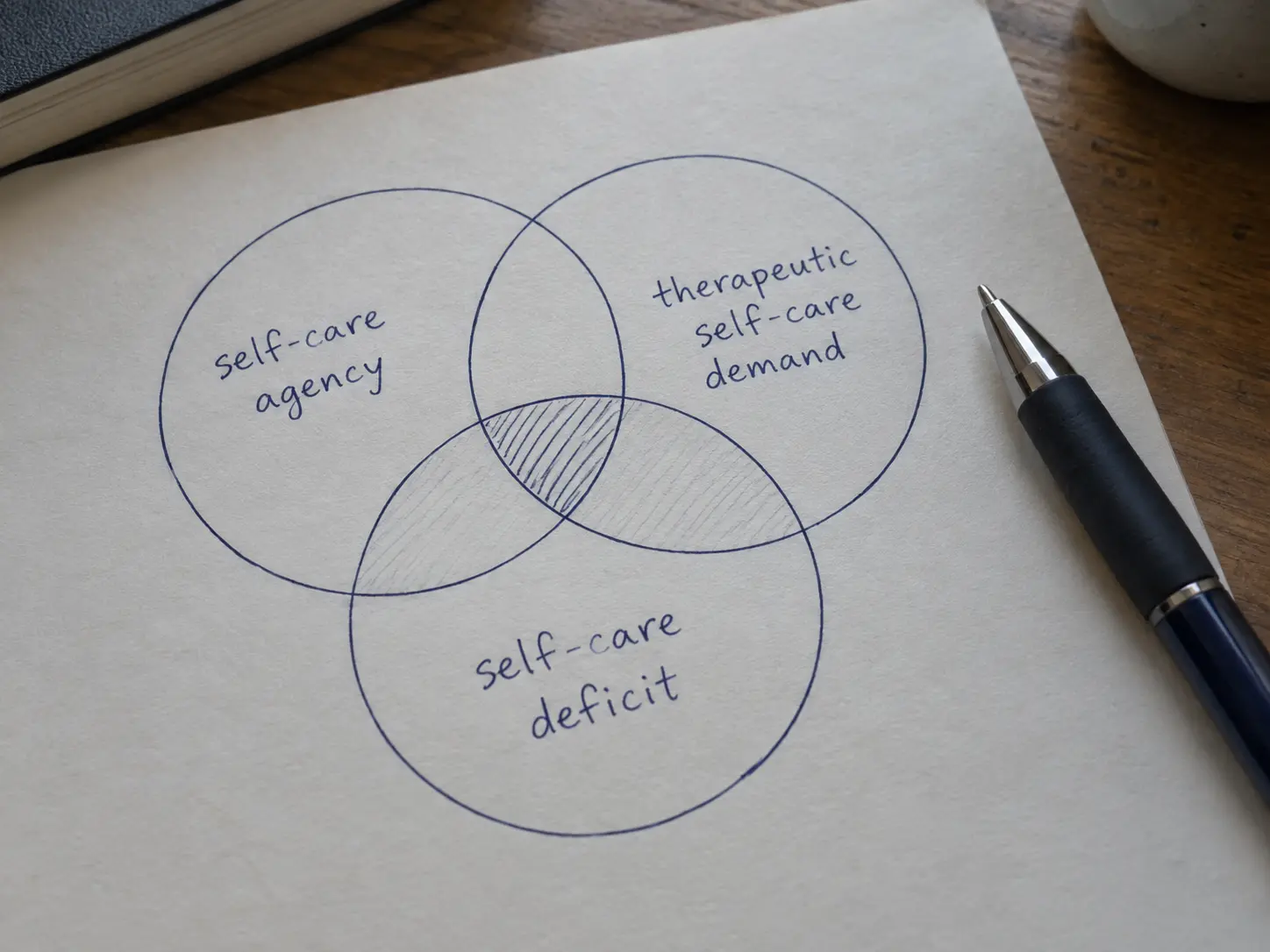
Dorothea Elizabeth Orem (15 June 1914 – 22 June 2007) was the nursing theorist who created the Self-Care Deficit Nursing Theory, also known as the Orem model of nursing. Her book Nursing: Concepts of Practice, first published in 1971 and revised through several later editions, is the primary source to cite; use the edition you actually consulted. The theory’s central claim, stated plainly, is that self-care is a human need, and nurses design interventions to provide or manage self-care actions for people to recover or maintain health. The theory becomes useful for a dissertation once you break it into its working parts: self-care agency (a person’s own ability to engage in self-care, conditioned by age, developmental state, life experience, socio-cultural orientation, health and available resources), therapeutic self-care demand (the total self-care actions to be performed over a specific period to meet a person’s self-care requisites), and self-care deficit (the gap between the two — when a person’s ability falls short of what their situation demands, and nursing becomes necessary).
What are the three nursing systems, and how do you use them in a chapter?
Orem’s theory names three nursing systems — wholly compensatory, partly compensatory and supportive-educative — and naming the correct one for your population is what turns a vague “Orem’s theory was applied” sentence into a specific, checkable methodological choice. The wholly compensatory system applies where the patient cannot perform self-care actions themselves (an unconscious patient, a severely disabled patient) and the nurse acts on their behalf. The partly compensatory system applies where both nurse and patient participate — a patient recovering from surgery who can manage some tasks but needs assistance with others. The supportive-educative system applies where the patient can perform self-care but needs guidance, teaching or support to do so effectively — the natural fit for dissertations on chronic-disease self-management (diabetes, hypertension, HIV treatment adherence), since the research question is usually about building the patient’s own capacity rather than replacing it.

How do you turn the theory into research questions and hypotheses?
Once you have named which nursing system your population and setting call for, the theory’s own constructs become your variables. A study on diabetes self-management education, for instance, can frame self-care agency as the outcome variable you are trying to strengthen, therapeutic self-care demand as the fixed set of tasks diabetes management requires (glucose monitoring, medication adherence, diet, foot care), and the self-care deficit as the gap your intervention or educational programme is designed to close. A research question follows directly: does a structured self-care education programme increase self-care agency (measured against the specific therapeutic self-care demand of the condition) among a defined patient group? A hypothesis follows the same logic: patients receiving the structured programme will show a significantly smaller self-care deficit at follow-up than patients receiving standard care alone. Building the question and hypothesis directly out of the theory’s own vocabulary, rather than importing generic outcome language, is what an examiner checks for when the framework section claims Orem specifically.
Which instruments align with Orem’s constructs?
An instrument choice should measure the specific construct your framework claims to use, not a generically related concept. Self-care agency is most directly measured by an instrument built around that construct specifically — check the current literature in your exact patient population (diabetes, cardiac, oncology, maternal health) for a scale purpose-built to measure self-care agency or self-care behaviour in that condition, since a generic quality-of-life or satisfaction scale measures a related but different thing. Confirm any instrument’s original author, publication year, subscale structure and reported reliability from a source you open yourself before naming it in your methodology chapter, following the same discipline the site’s guide to choosing a validated scale for a nursing research report sets out generally — do not assume an instrument fits your population just because its name mentions self-care, since scales validated for one condition or age group do not automatically transfer to another without a check.
What does a worked theoretical-framework paragraph look like?
Illustrative example, not a real study. “This study is grounded in Orem’s Self-Care Deficit Nursing Theory, specifically the supportive-educative nursing system, which applies where patients retain the physical capacity for self-care but require structured education and support to exercise it effectively. The therapeutic self-care demand for type 2 diabetes management, as defined by current clinical guidelines, comprises glucose self-monitoring, medication adherence, dietary management, physical activity and foot care. Self-care agency, the study’s primary outcome variable, is operationalised as a patient’s measured capacity to perform these five domains. The self-care deficit — the gap between therapeutic self-care demand and self-care agency — is hypothesised to narrow significantly among patients receiving the structured education intervention relative to those receiving standard care alone.” Notice what this paragraph does: it names the specific nursing system used and why, defines therapeutic self-care demand concretely for the condition studied, states the primary outcome variable in the theory’s own vocabulary, and turns the self-care deficit construct directly into a testable hypothesis — the same four-part structure an examiner checks for in any theory-grounded framework section, in any field.
How does Orem compare to other frameworks nursing dissertations might consider?
Orem is the strongest fit where your research question is genuinely about a patient’s or caregiver’s capacity for self-management. Where your question is instead about the care environment or system-level factors (staffing, unit culture, patient safety climate), a different framework fits better — Donabedian’s structure-process-outcome model or Watson’s theory of human caring are established alternatives, and forcing Orem onto a question it was not built to answer is a common framework-selection mistake. Before committing, state in one sentence what your research question is actually asking about (the patient’s own capacity, the care relationship, or the system), and choose the framework built for that specific job. A framework mismatch is one of the more damaging errors an examiner flags, because it suggests the theory section was chosen for familiarity rather than fit, and it tends to weaken every chapter that follows — the hypotheses no longer sit cleanly inside the theory’s own logic, and the discussion chapter has nothing coherent to interpret the findings against.
How is this different from the site’s existing content?
The site’s guides to choosing a theoretical framework for a psychology master’s dissertation and theoretical frameworks for an MBA research report cover framework selection for those fields specifically. Nursing has no equivalent piece on this site until now — this is the first article here to develop one named theory end to end for a nursing dissertation, distinct from the site’s existing nursing methodology chapter guide, which covers chapter structure generally without developing a specific theoretical framework.
Stuck on the framework section at midnight? Here is the fast, defensible path
Confirm your research question is genuinely about self-care capacity, name the correct nursing system for your population, build your research question and hypothesis directly from Orem’s own constructs, and choose an instrument that measures self-care agency specifically rather than a loosely related concept — four decisions, each traceable back to the theory itself, and each one an examiner can check. Drafting a framework section that keeps these four decisions consistent across your whole chapter is exactly the kind of structured writing Tesify handles well, while the reading and the judgement calls about your own study stay yours and the dissertation stays 100% written by you. More than 9,000 students have used Tesify, across 15,000+ chapters. Draft your theoretical framework with Tesify.
Frequently asked questions
Is Orem’s theory still considered current for a 2026 nursing dissertation?
Yes — it remains a widely taught and applied nursing theory, particularly for self-management research; check your specific faculty’s expectations, and cite the edition of Orem’s own work that you consulted.
Can I combine Orem’s theory with another framework in the same dissertation?
Yes, and it is common where your question has both a self-care dimension and a system-level dimension, but state clearly which construct each framework is doing the work of explaining, rather than blending them without a stated logic.
Do I need to use all three nursing systems, or just the one that fits my study?
Just the one that fits your specific population and setting; naming all three in your framework section without applying them is padding, not depth — an examiner wants to see the one relevant system worked through in detail.
Where do I find a South African validation study for a self-care agency scale?
Search your specific patient population and condition alongside the instrument’s name in the nursing databases the site’s guide to choosing a validated nursing scale covers; if no South African validation exists, say so explicitly rather than assuming an international validation transfers unchanged.
Is Orem’s theory only for chronic-disease research, or does it apply elsewhere?
Chronic-disease self-management is a natural application, but the theory applies anywhere self-care capacity is the genuine focus — maternal and newborn care, post-surgical recovery, mental health self-management — provided the research question is actually about capacity, not the care environment.
How long should the theoretical framework section be?
This varies by faculty; check your own department’s word-count guidance for the chapter, but a framework section developing one theory fully — its constructs, why it fits your question, and how it shapes your hypotheses and instrument — typically runs to several pages rather than a single paragraph.
What is the difference between self-care agency and self-care deficit?
Self-care agency is a person’s ability to perform self-care; self-care deficit is the gap between that ability and what their specific health situation actually demands. A study can measure either, but should be explicit about which one is the outcome variable.
Does Orem’s theory work for a qualitative nursing dissertation, or only a quantitative one?
It works for both — a qualitative study can explore how patients or caregivers experience a self-care deficit, or how a supportive-educative intervention is experienced, without needing to measure agency or deficit on a numeric scale; the theory’s constructs still structure the interview guide and the analysis, just without the hypothesis-testing step a quantitative design adds.
Should I cite Orem’s original work or a secondary source?
Cite the original work, Nursing: Concepts of Practice, in the edition you can access; where it is not accessible, a reputable nursing-theory reference that accurately represents the theory’s constructs is an acceptable secondary source, provided you state clearly which you used and do not attribute a specific claim to Orem that you have not verified against a source you opened.