
A qualitative psychology interview guide needs a question bank organised by research objective, planned probes for each main question, a pilot step before real data collection, and a clear plan for how transcripts will be coded. It is not a fixed script — it directs a conversation flexibly enough to follow what the participant actually says.
What structure does the guide need?
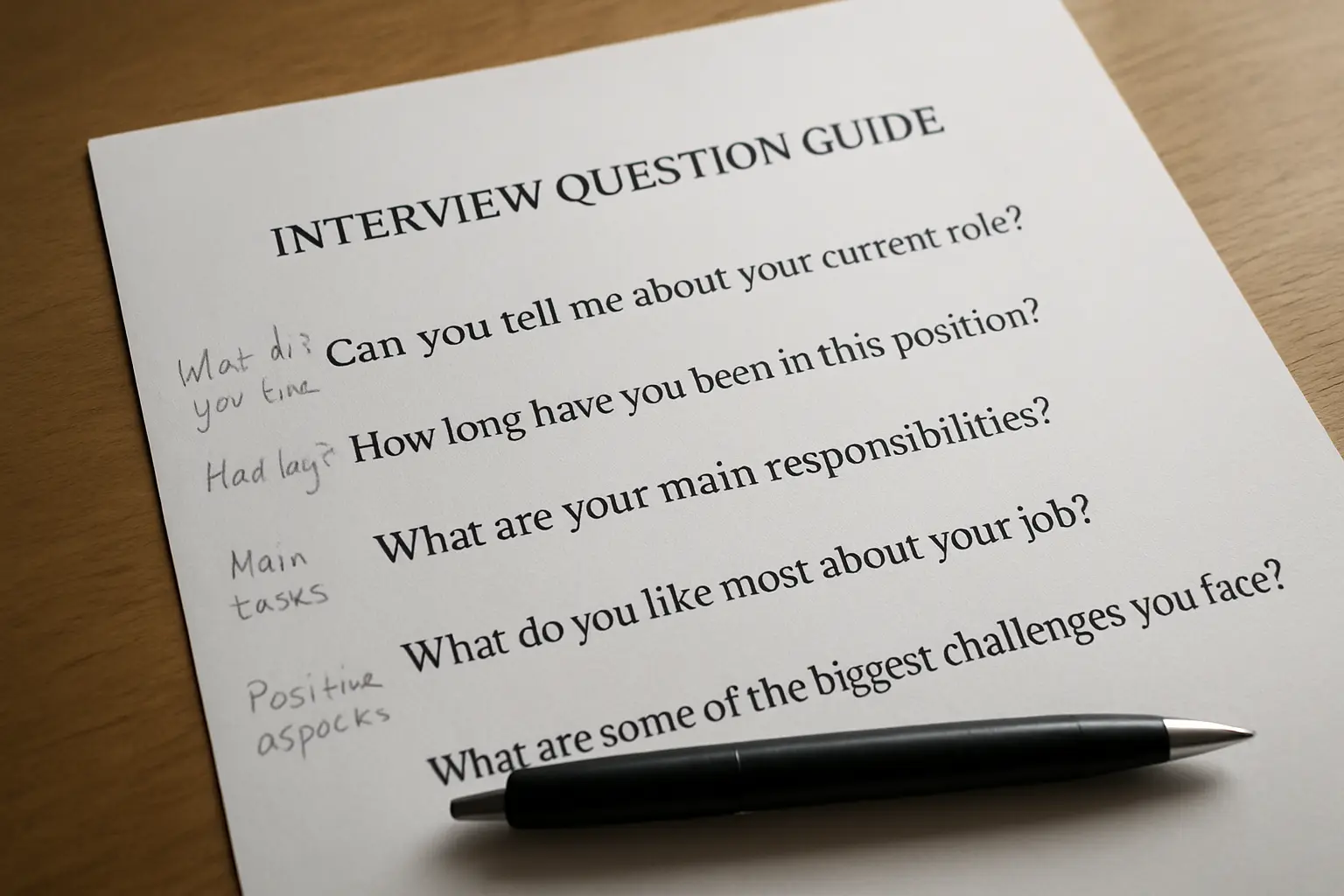
A workable structure has five parts: (1) a brief opening script establishing rapport, confidentiality and consent; (2) two or three broad, open opening questions that let the participant talk freely before narrowing; (3) core questions mapped explicitly to each research objective, with planned probes under each; (4) one or two closing questions inviting anything the participant feels was not covered; (5) a debrief script, especially important where the topic is sensitive. Each core question should trace back to a specific research question — if a question cannot be linked to one, it likely does not belong in the guide.
A worked example: first-generation students’ sense of belonging
This is a fictional, illustrative example — the topic and every question shown are built to demonstrate structure, not to be copied directly into a real study.
Research objective 1: to explore how first-generation university students describe their sense of belonging on campus.
Core question: “Can you tell me about a time you felt you belonged here, and a time you did not?”
Planned probes: “What was happening around you at that moment?” / “How did that make you think about your place here?”
Research objective 2: to understand what institutional or social factors shape that sense of belonging.
Core question: “What people, spaces or activities on campus have mattered most to how connected you feel here?”
Planned probes: “Can you say more about why that mattered?” / “Was there ever a moment that changed how you felt?”
Opening question (rapport-building, asked first): “Tell me a bit about your first weeks on campus — what was that like?”
Closing question: “Is there anything about your experience we haven’t talked about that you think is important?”
How many questions should the guide have?
There is no fixed national number — a guide with too few questions risks leaving objectives unexplored, while one padded with too many turns a 45–60 minute interview into a rushed checklist. A common working range for a single-session semi-structured interview is a small set of core questions (often somewhere between five and ten), each with its own probes, rather than a long flat list — check your own department’s expectations and pilot the guide to see how long it actually runs.
Why does piloting the guide matter?
Piloting with one or two people who resemble the real sample catches three things a guide read silently on paper cannot: questions that are unintentionally leading or double-barrelled, questions participants misunderstand in ways the researcher did not anticipate, and a realistic sense of how long the full interview actually takes. Revise the guide after the pilot — do not treat piloting as a formality if it surfaces a real problem, and note the revision in your methodology chapter as evidence the instrument was properly checked before use.
How does this differ from the education version of this guide?
The site’s own interview guide for a qualitative education dissertation covers the same underlying skill — a question bank organised by objective, with probes and a pilot step — but for a different job: education interviews are often with teachers, principals or parents about classroom or institutional practice, while a psychology interview guide like this one is built around eliciting a participant’s own lived experience, emotion and meaning-making, which changes both the phrasing of core questions and the ethical weight of the debrief step.
What ethics considerations are specific to psychology interview guides?
Because psychology interviews often ask participants to reflect on emotionally significant experiences, a debrief script and, where the topic is sensitive (trauma, mental health, identity), a referral pathway to campus counselling or a relevant support service should be built into the guide itself, not left as an afterthought — this is something ethics committees in psychology specifically check for, more so than in less personally exposed fields. State this referral pathway explicitly in the research ethics clearance section of the proposal, not only verbally at the interview.
How should recording and transcription be planned before the interview?

Decide the recording method (audio recorder, phone app, or the recording function of a video-call platform for remote interviews) and confirm participant consent to that specific method in writing, before the interview starts — consent to “be interviewed” is not the same as consent to be audio-recorded, and ethics committees expect this distinction to be explicit in the consent form. Plan the transcription approach too: verbatim transcription including pauses and false starts suits a discourse-focused analysis, while a cleaned-up transcript is usually sufficient for thematic analysis — decide this before data collection so the interview style (how much you let pauses and hesitations run) matches what the analysis will actually need.
What language and cultural considerations matter in a South African context?
Where participants are more comfortable in a language other than the one the dissertation will be written in, decide in advance whether interviews will be conducted in that language and translated afterward, or conducted in the dissertation’s language with an interpreter — both are legitimate choices, but each has implications for the guide (questions must be piloted in translation too, not only in the original) and for the methodology chapter, which should state the translation process and who performed it. A guide that reads naturally and respectfully in the participant’s own register, rather than a stiff translation of academic English, produces richer answers.
How does coding connect back to the guide?
A guide built with each core question tied to a specific objective makes the coding step easier later — codes can be organised first by objective, then refined inductively within each. A guide with no such structure forces the coder to reconstruct that organisation after the fact, which is slower and more error-prone. Building the link at guide-design stage, not after transcription, is the more efficient order.
Designing a guide this carefully — objective by objective, probe by probe — is exactly the kind of structuring work Tesify helps with, while every question and every word your participants say remains entirely your own.
What should the researcher avoid doing during the interview itself?
Four habits weaken interview data even with a well-built guide. Asking leading questions that suggest the expected answer (“wouldn’t you say the support was inadequate?” instead of “how did you experience the support available?”) shapes the response rather than eliciting it. Filling silences too quickly denies the participant time to think — a pause of a few seconds after a question, before offering a probe, often produces a fuller answer than jumping in immediately. Interrupting to redirect back to the guide too rigidly can cut off exactly the unexpected material qualitative interviews are designed to surface — a guide is a map, not a script to recite word for word. And reacting visibly to surprising or emotionally difficult answers, rather than maintaining a steady, attentive presence, can subtly signal judgement and make a participant less forthcoming for the rest of the interview.
How does the guide fit into the wider proposal?
The interview guide is usually developed alongside, not after, the rest of the proposal’s methodology section: the research paradigm and design — often built around the same theoretical framework that anchors the rest of the study — justify why a semi-structured interview is the right instrument in the first place, the sampling section explains who will be interviewed and how they will be recruited, and the guide itself operationalises the research objectives into an actual conversation. A proposal that names “semi-structured interviews” as the method but has not yet drafted even a sample question bank is generally not considered ready for ethics submission — committees expect to see the guide, even in draft form, alongside the proposal text, since it is the clearest evidence the researcher has actually thought through how the objectives translate into a real conversation.
Frequently asked questions
Is a semi-structured interview the right choice for every qualitative psychology study?
No — some designs call for unstructured or narrative interviews instead, with far fewer pre-set questions and more room for the participant to lead. Choose based on your research question and paradigm, not by default.
Can I change the guide after starting data collection?
Minor refinements are normal as early interviews reveal what works, but substantial changes should be discussed with your supervisor and, depending on your department’s ethics rules, may need a formal amendment if the changes are significant.
Should I share the guide with participants beforehand?
Sharing a general topic outline in the information sheet is common and supports informed consent; sharing the exact core questions in advance is a supervisor-level decision that depends on your design — it can support richer, more considered answers, or risk more rehearsed ones.
How long should a qualitative psychology interview last?
There is no single national standard — 45 to 60 minutes is a common range for a single-session semi-structured interview, but pilot your own guide to find a realistic length for your specific questions and population.
Do I need a separate guide for each participant group?
If your study includes genuinely different groups (for example, students and staff), yes — the core questions should be tailored to what each group can actually speak to, even if the underlying objectives stay the same.
What if a participant becomes distressed during the interview?
Your ethics protocol should specify a plan for this before data collection begins — pausing or stopping the interview, checking in with the participant, and offering the referral pathway named in your debrief script are standard steps.
Can I use the same interview guide for a focus group?
Not directly — a focus group guide needs different wording that invites group discussion and interaction between participants, plus a facilitation plan for managing dominant or quiet voices, which a one-to-one interview guide does not need. Ground rules for the group (confidentiality between participants, no single voice dominating) also need to be stated explicitly at the start, something a one-to-one guide has no equivalent for.
Does the guide need to be included as an appendix?
Most South African psychology departments expect the final interview guide as an appendix to the dissertation, alongside the information sheet and consent form — check your own department’s exact appendix requirements.
How does this compare to the site’s generic questionnaire and interview template?
The site’s questionnaire and interview templates guide builds one general-purpose cross-discipline template; this guide goes deeper into the psychology-specific job of eliciting lived experience, including the ethics, referral-pathway and debrief considerations that a generic cross-discipline template does not cover in the same depth, and which a psychology ethics committee will specifically look for.
Can a psychology interview guide include closed or yes/no questions?
Keep the core questions open-ended — closed questions tend to produce short, thin answers in qualitative interviews. Reserve closed follow-ups for confirming a specific detail after an open question has already generated rich material.