| Source | What it covers | SA-specific content | Access | DHET-accredited? |
|---|---|---|---|---|
| SciELO South Africa | Peer-reviewed South African journals across medicine, nursing, public health and allied fields | Entirely South African titles | Free, full text | Yes — one of the seven recognised indexes |
| African Journals Online (AJOL) | Peer-reviewed journals from across Africa, with a Health subject category | Substantial, alongside other African countries | Free to readers | Not itself an index in the DHET’s seven; individual titles may separately appear on one |
| PubMed / MEDLINE | The dominant international biomedical and life-sciences literature database | Includes some South African journals, such as the South African Medical Journal, alongside global literature | Free searching; some articles paywalled | Not an accreditation index; check each journal on the DHET list |
| Cochrane Library | Systematic reviews and clinical-trial evidence syntheses | Limited South African-specific primary research; strong for evidence synthesis | Abstracts free; full reviews often via institutional access | Not a journal index in the DHET sense; a specific evidence-synthesis resource |
| DHET/CREST ZA Publications Monitor | The master list of journals currently accredited for South African publication-subsidy purposes | The authoritative South African accreditation check | Free, downloadable list | This is the accreditation source itself |
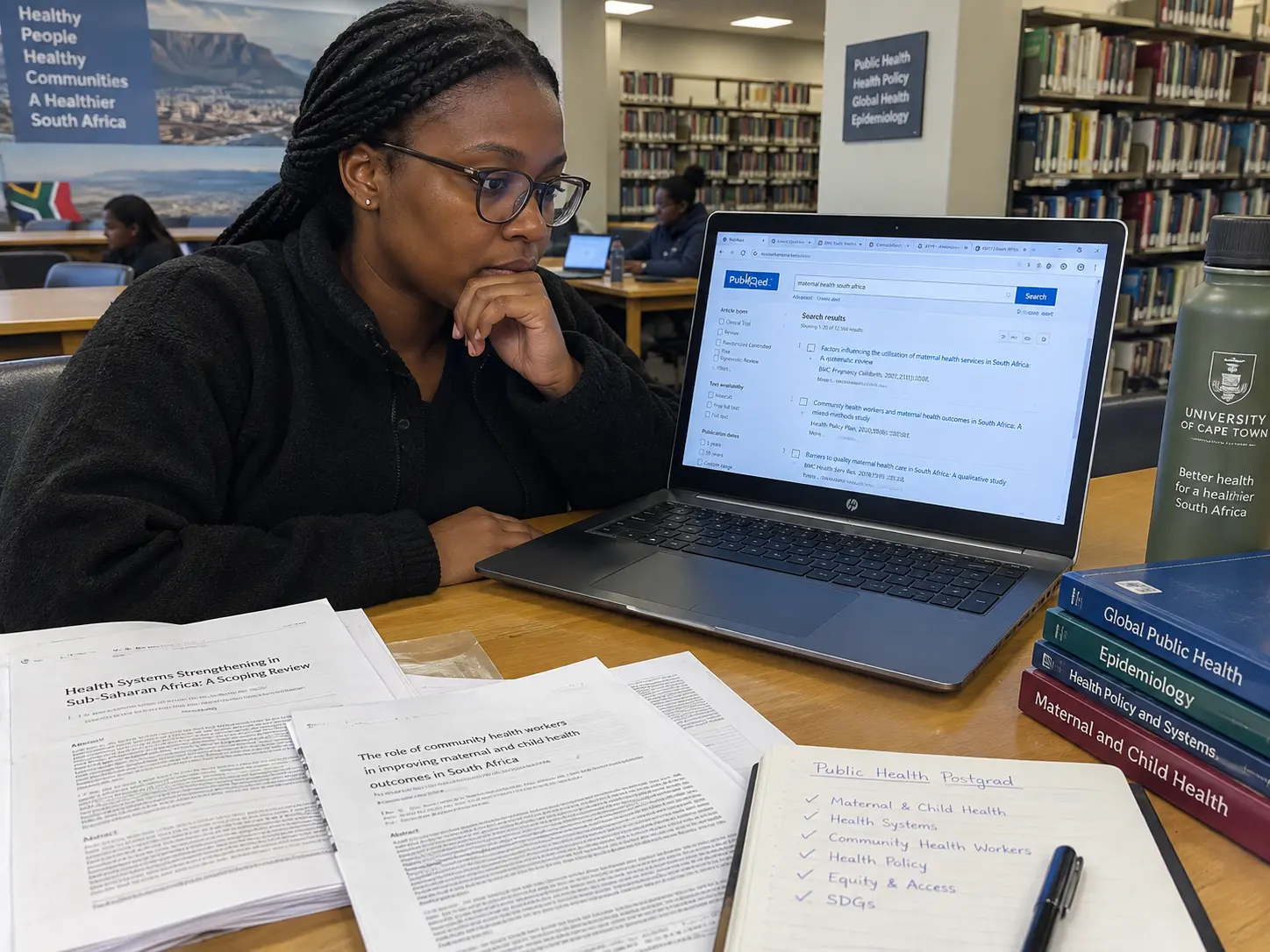
Public health dissertations that search only PubMed risk missing South African health-systems and policy literature published in smaller, nationally focused journals that SciELO South Africa and AJOL carry. Five sources, ranked for a South African public health postgraduate’s actual search and publication needs.
1. SciELO South Africa — start here for South African clinical and public health journals
SciELO South Africa carries several journals directly relevant to a public health dissertation: the South African Medical Journal (SAMJ), Curationis (nursing), Health SA Gesondheid, the African Journal of Primary Health Care & Family Medicine, and the South African Journal of Psychiatry, among others. Its titles are peer-reviewed, open access in full text, and specifically South African in scope, which makes it an efficient single starting point for a literature review grounded in the national context rather than international literature applied generically. It is also one of the seven indexes the Department of Higher Education and Training (DHET) recognises for South African publication-subsidy purposes, alongside Web of Science, Scopus, IBSS, the Norwegian List, DOAJ and the DHET’s own South African list.
2. African Journals Online (AJOL) — the broader continental layer SciELO does not cover
AJOL is a non-profit platform hosting peer-reviewed research journals published across the African continent, with a browsable Health subject category; its services are free to readers, and it describes itself as a non-profit organisation that relies on donations to function. AJOL’s value for a South African public health dissertation is coverage SciELO South Africa does not have — regional and continental public health literature, and African journals that are not indexed on SciELO South Africa. Not every AJOL-hosted title is DHET-accredited, so check a specific journal’s accreditation status separately (via the DHET list below) before relying on it as your own publication target, though this does not affect its usefulness as a literature source.
3. PubMed / MEDLINE — the international layer
PubMed indexes the major international biomedical and public health literature, and some South African journals are among its currently indexed MEDLINE titles — the South African Medical Journal is one — so a South African-authored study in such a journal is findable here too. PubMed is not an accreditation index, so do not read a journal’s presence in PubMed as proof that it is on the DHET list. Searching is free; full-text access depends on whether the specific journal is open access or your institution holds a subscription. Use PubMed for the international evidence base your literature review needs to sit inside, and cross-check any South African finding you rely on against a more nationally focused source (SciELO SA or AJOL) for local context PubMed’s international framing can miss.
4. Cochrane Library — for evidence synthesis, not primary South African data
The Cochrane Library’s systematic reviews and clinical-trial syntheses are a standard evidence-synthesis resource across public health and clinical fields, but South African-specific primary research is not what it is built to provide. Use it specifically where your dissertation needs an existing systematic review as a benchmark or starting point for your own literature review’s synthesis section, not as a primary source for South African-specific findings, which are more reliably found via SciELO SA, AJOL or a direct national data source such as the datasets covered in the site’s guide to public health data sources in South Africa.
5. The DHET/CREST ZA Publications Monitor — check accreditation before you plan to publish, not just to read
If your degree encourages or requires publishing from your dissertation, the master list published through the DHET/CREST ZA Publications Monitor is the authoritative, current list of journals accredited for South African publication-subsidy purposes, spanning Web of Science, Scopus, IBSS, the Norwegian List, SciELO South Africa, DOAJ and the DHET’s own South African list. The site’s guide to DHET accredited journals and research output units covers how the list works, when journal statuses are updated and what happens if a journal is later found to be predatory — check a candidate publication target against the current list before you submit anywhere, not against a remembered or secondhand assumption about whether a journal counts.
One recommendation
Start a South African public health literature search at SciELO South Africa for the national clinical and public health literature, layer in AJOL for continental context and titles SciELO does not carry, use PubMed to place your review inside the international evidence base, and reserve Cochrane specifically for systematic-review benchmarks rather than primary South African findings. Before you plan to publish anything from your own dissertation, check the specific target journal against the current DHET/CREST list rather than assuming a familiar-sounding journal is accredited.
A worked example of the search order. A dissertation on tuberculosis treatment adherence in a South African primary-care setting would open with SciELO South Africa, searching the African Journal of Primary Health Care & Family Medicine and SAMJ directly for South African adherence studies; move to AJOL for regional African adherence literature SciELO does not carry; search PubMed for the international adherence-intervention evidence base the discussion chapter will need to situate the South African findings within; and check Cochrane specifically for any existing systematic review of adherence interventions, which would anchor the literature review’s synthesis section rather than stand in for the South African primary studies found in the first two steps. This order is illustrative of the search logic, not a fixed sequence every topic must follow exactly.
How do I search across five different platforms without losing track of what I have found?
Run the same search terms across each platform in a consistent order — SciELO SA first for national grounding, then AJOL for continental context, then PubMed for the international evidence base, then Cochrane specifically for a systematic-review check — and log each result in a single spreadsheet or reference manager as you go, noting which platform surfaced it, rather than searching all five simultaneously and losing track of duplicates. A source found on both SciELO SA and PubMed is not a stronger source for having appeared twice; note the duplicate and move on rather than double-counting it in your review’s apparent breadth. Where your topic is narrow enough that a single platform returns very few results, that is itself useful information — it may indicate a genuine gap in the South African literature worth naming explicitly in your review, distinct from a search-strategy failure, which the site’s general guide to writing a literature review for a South African dissertation covers in more depth alongside the synthesis-matrix technique that turns a list of sources into an argued review.

What if my sub-field is nursing, psychiatry or primary care specifically?
Where your public health dissertation sits closer to a specific clinical discipline, go directly to that discipline’s own SciELO-indexed journal rather than searching the general public health literature and hoping it surfaces the right title: Curationis for nursing-specific public health research, the South African Journal of Psychiatry for mental-health-system topics, and the African Journal of Primary Health Care & Family Medicine for primary-care and community-health topics specifically. Each of these appears on SciELO South Africa, one of the DHET-recognised indexes, and each is more likely to carry directly relevant South African studies than a general search of PubMed alone, because it is edited for a South African and regional readership rather than an international general-medicine audience.
How does this differ from the site’s existing public health content?
The site’s guide to public health data sources in South Africa covers where to find datasets and surveillance systems — Thembisa, GERMS-SA, the District Health Barometer and others — for your own study’s data. This piece answers a different question: where the published literature that informs your literature review and situates your findings actually lives, which is a separate job from where your own primary or secondary data comes from.
Building a literature review across these sources without losing track of what you have read
Searching five different platforms, each with its own interface and its own coverage gaps, and keeping track of which sources actually support which claim in your literature review is exactly the kind of organisational work Tesify helps with — drafting the review section once you have gathered your sources, while every reading judgement stays yours and the dissertation stays 100% written by you. Draft your literature review with Tesify.
Frequently asked questions
Is SciELO South Africa the same as the DHET’s own accredited list?
No — SciELO South Africa is one of the seven indexes the DHET recognises for accreditation purposes, not the list itself. A journal can be on SciELO SA and still need checking against the current DHET/CREST master list for its accreditation status.
Do I need institutional access to use PubMed?
Searching PubMed itself is free and needs no institutional login; whether you can read a specific article’s full text depends on whether it is open access or your university holds a subscription to that journal.
Is AJOL a reliable source for a dissertation literature review?
Yes, for peer-reviewed journals it hosts — check the specific journal’s peer-review status and, if you plan to publish there yourself, its accreditation status separately, since not every AJOL-hosted title is DHET-accredited.
Should I rely on Cochrane reviews for South African-specific public health claims?
Use Cochrane for evidence-synthesis benchmarks and international context; check any South African-specific claim against a more nationally focused source such as SciELO SA, AJOL or a national dataset, since Cochrane is not built around South African primary research.
How often does the DHET accredited journal list change?
Journal statuses are updated periodically through the year, so check the current master list close to when you plan to submit for publication rather than relying on an earlier check.
What happens if I publish in a journal that turns out not to be accredited?
The article earns no publication-subsidy unit, and if the journal is found to be predatory, funding consequences can include units being withheld or withdrawn; check accreditation before you submit, not after.
Can I use Google Scholar instead of these sources?
Google Scholar is a useful discovery tool for finding where a paper is indexed, but it is not itself an accreditation index or a substitute for checking a specific journal against SciELO SA, PubMed or the DHET list directly.