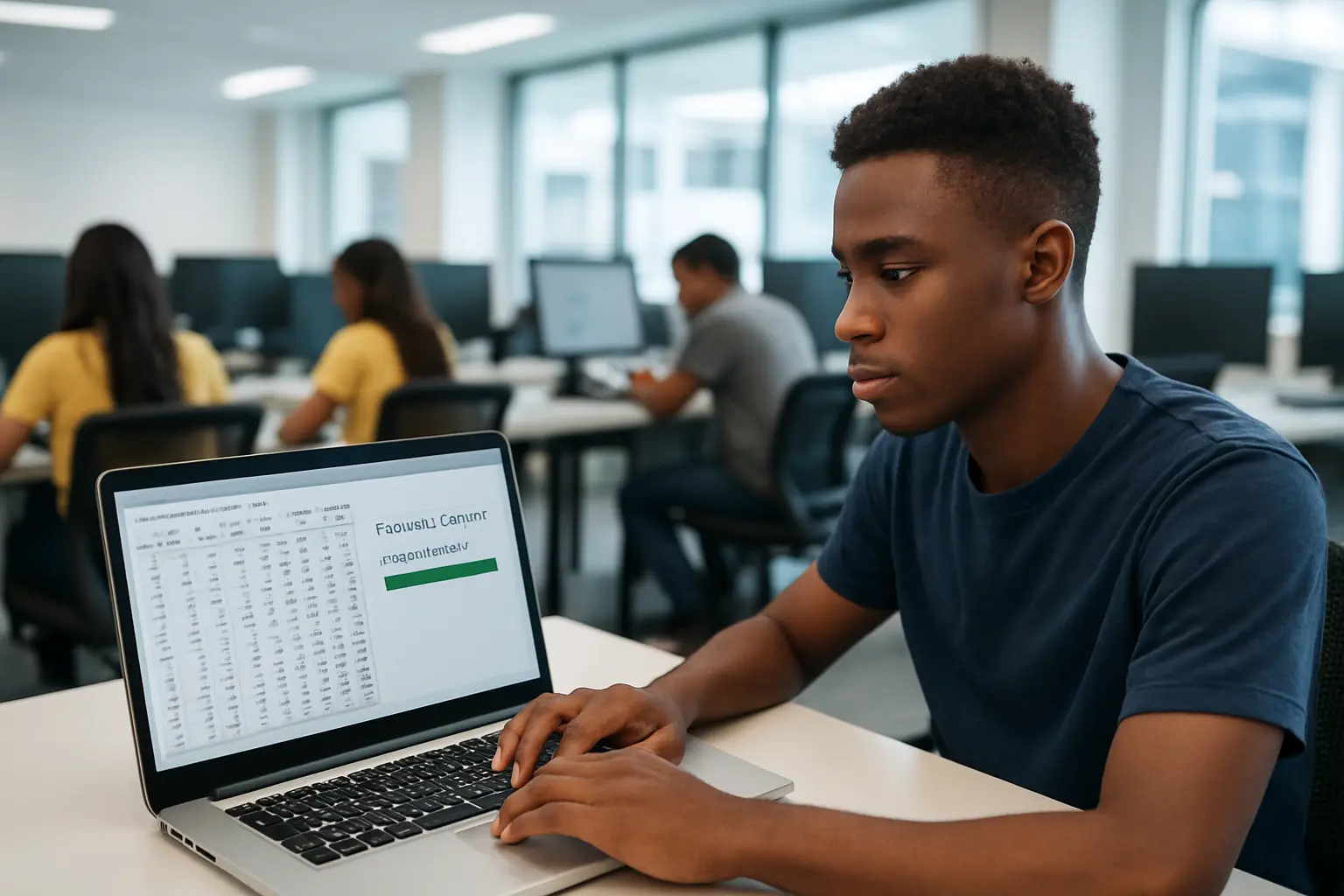
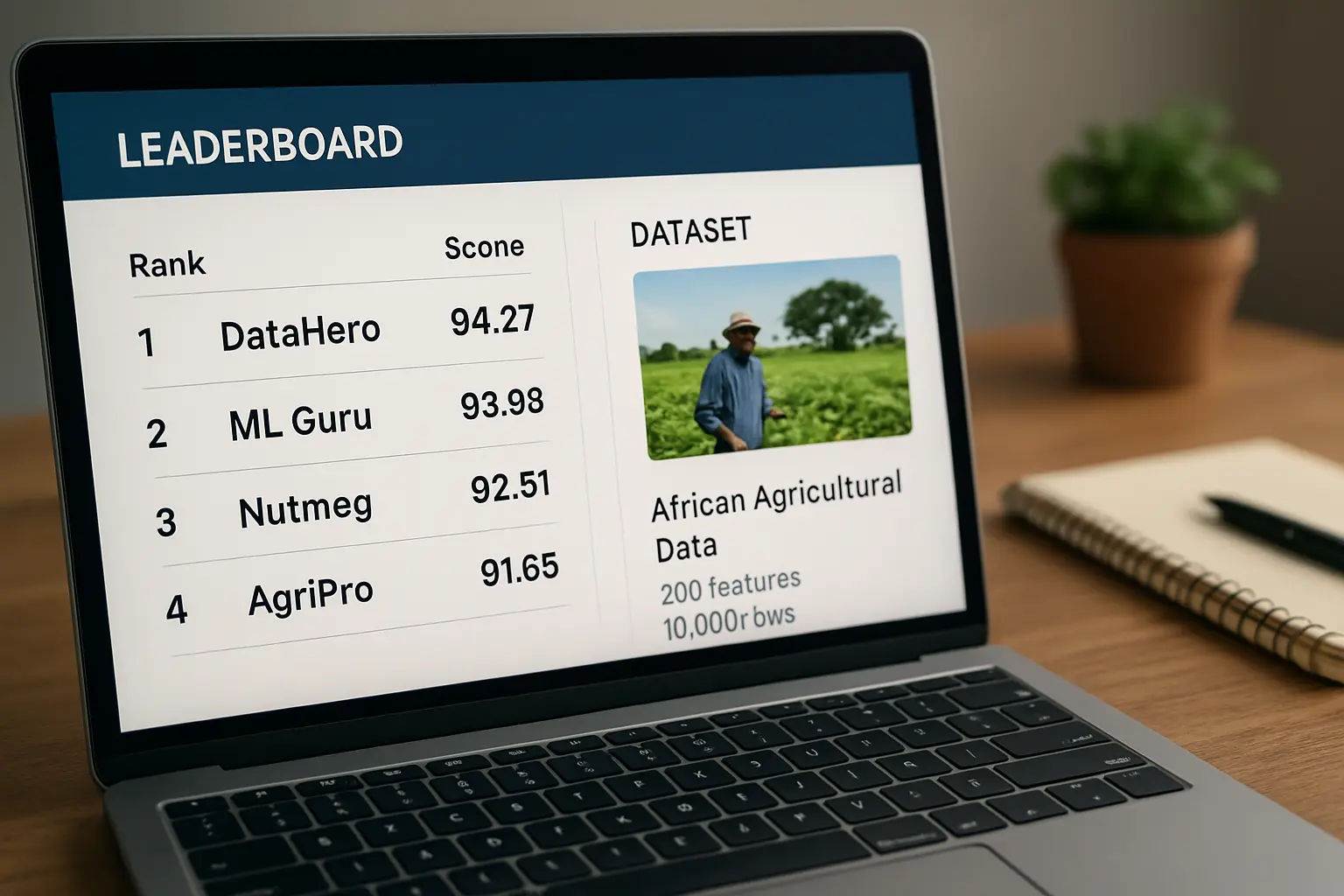
Zindi, an AI challenge platform born in Africa and launched in 2018, hosts competition datasets built around real problems brought by partner organisations — a source most generic computer science dataset guides never mention, because they are written for a US or European audience. For a South African computer science dissertation, where a link to a local or African problem can strengthen how you justify your topic, Zindi is often a fast route to a dataset with real regional grounding rather than another Kaggle housing-price set.
| Source | What it hosts | Custodian | Update cycle | Access |
|---|---|---|---|---|
| Zindi | Competition datasets, many built around African-context problems (health, agriculture, finance, public sector) | Zindi | New datasets with each competition launch | Free registration |
| Kaggle | General-purpose ML/data science datasets and competitions | Kaggle (Google) | Continuous, user- and competition-contributed | Free account |
| UCI Machine Learning Repository | Classic, well-documented benchmark datasets | University of California, Irvine | Periodic additions | Free, no account needed |
| Hugging Face Datasets | A large hub of datasets, many linked to papers and models (the old Papers With Code site now redirects to Hugging Face’s Trending Papers page) | Hugging Face | Continuous | Free |
| Google Dataset Search | A search engine indexing datasets across the open web | Continuous, crawler-based | Free | |
| openAFRICA | Open datasets from African governments, NGOs and researchers | Code for Africa | Ongoing community contributions | Free |
| Statistics South Africa (Stats SA) | Official national statistics releases and datasets | Stats SA | Per release schedule | Free |
| GitHub | Code repositories, often bundled with the datasets a paper used | GitHub (Microsoft) | Continuous | Free account |
Why Zindi matters specifically for a South African dissertation
An examiner assessing a computer science dissertation may well ask why a machine learning model was trained on a dataset with no connection to any problem the student could articulate a reason for choosing. Many Zindi competitions are built around partner organisations — agricultural bodies, health researchers, financial institutions — which means the dataset itself usually comes with a documented real-world problem statement you can cite directly in your introduction, rather than having to construct a justification for why a generic international dataset matters to your stated research question.
When does a computer science dissertation need Kaggle or UCI instead?
Where your research question is about a technique itself — comparing model architectures, testing a novel algorithm against an established benchmark — rather than about a specific regional application, a well-known benchmark dataset from Kaggle or the UCI Machine Learning Repository is often the stronger choice precisely because reviewers and examiners can compare your results directly against a large existing body of published work using the same data. The UCI repository in particular remains a standard reference point for foundational, well-documented benchmark sets used across decades of machine learning research.
How do I find both a dataset and its benchmark results?
Papers With Code was long the shortcut for this, but the site now redirects to Hugging Face’s Trending Papers page, so work from two directions instead: search Hugging Face’s dataset hub and paper pages for your task, and trace the dataset’s original paper and the recent papers citing it (Google Scholar is fine for this) to find the best-published results against it. That gives you a real, citable comparison point for your results chapter — a stronger discussion-chapter argument than simply reporting your own accuracy figure with nothing to compare it to.
What do Stats SA and openAFRICA add for an applied systems project?
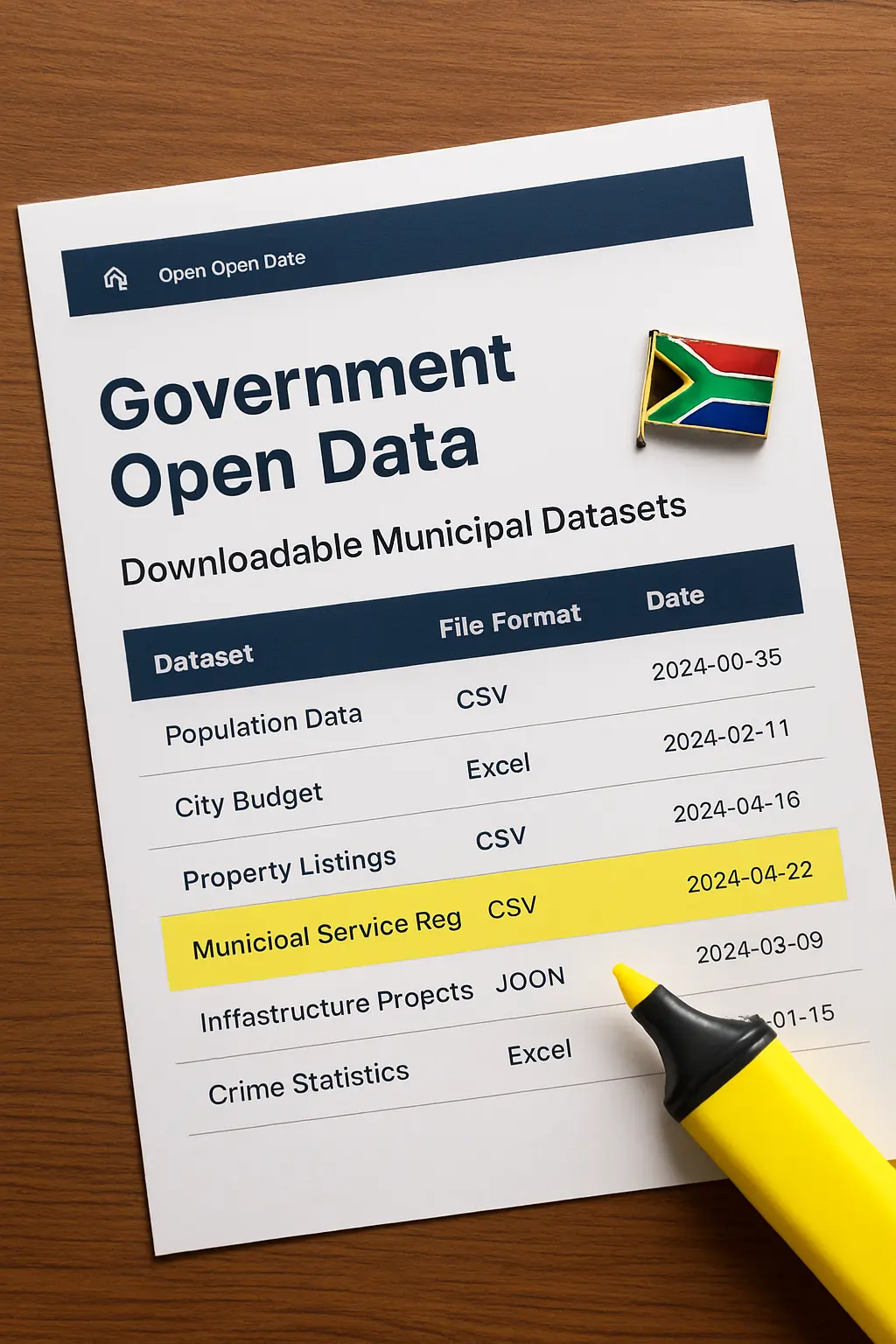
Where your dissertation is a design-science or software-project study — building a system rather than training a model on an existing dataset — Stats SA and openAFRICA are more useful as sources of real South African or African data your system needs to work with realistically: official statistical releases, municipal and public-sector datasets, public health or agricultural records. Coverage and update frequency vary significantly by release and contributing organisation, so verify a dataset’s last-updated date before committing your system design to its current schema.
How do I evaluate a dataset before committing months of work to it?
Four checks before you build your proposal around any dataset on this list: first, read the documentation for how missing values, outliers and class imbalance were handled or left unhandled, since this shapes your entire preprocessing chapter; second, check the licence explicitly — some Kaggle datasets carry restrictions on commercial use or redistribution that do not affect academic use but are worth confirming in writing; third, check the dataset size against your available compute, since a dataset that looks perfect on paper can be unworkable on a standard laptop without cloud resources your budget does not cover; fourth, check whether the dataset has already been extensively mined in prior published work, which either strengthens your comparison baseline or signals the low-hanging results are already taken and your contribution needs to be more clearly novel.
What licensing and reuse terms actually matter for a dissertation?
Many datasets on Kaggle, UCI, Zindi and openAFRICA permit academic, non-commercial use, but read each licence, and take a closer look in three situations: redistributing the dataset itself (rather than just your results) in your dissertation’s appendix or a public repository, which some licences restrict; combining a dataset with another under incompatible licence terms; and using a dataset originally collected from identifiable individuals, where academic reuse still generally requires the same ethical handling as if you had collected it yourself, licence terms notwithstanding.
What does compute access look like for a South African computer science student?
A dataset is only as usable as what you can train a model on. Google Colab’s free tier is a common starting point for students without a dedicated GPU, sufficient for many honours and master’s-level projects, though it imposes session limits that shape how you checkpoint long training runs. Where a project needs more sustained compute, check whether your university’s computer science or data science department runs its own cluster or holds a cloud-credit programme with a provider before assuming a personal cloud subscription is the only option — department administrators are the right first point of contact rather than a generic IT helpdesk.
What does a data-sourcing paragraph look like in a methodology chapter, annotated?
Excerpt. “The dataset used in this study was sourced from a Zindi competition hosted in partnership with [organisation], comprising [n] labelled records of [description], released under [licence]. The dataset was last updated in [year]. Missing values were handled by [method], and class imbalance was addressed using [method], both decisions documented in Chapter 3.4.”
Annotation. Five things this template makes explicit that a vaguer paragraph often omits: the exact source and partner organisation, the record count, the licence, the last-updated date, and a forward reference to where preprocessing decisions are documented in full — the same specificity an examiner expects from a primary-data methodology section, applied to a secondary dataset instead.
How does this fit with the site’s existing computer science coverage?
The site’s existing computer science piece, when is a software project accepted as a computer science dissertation, covers the acceptance and scope question — what turns a working system into an examinable research contribution. This page answers a different, earlier question: once you know your project needs data, where does it actually come from. A design-science software project and a data-driven machine learning study both eventually reach this page; they just arrive from different starting points. The site’s statistical test decision guide is the natural next stop once your dataset is in hand and you need to decide how to evaluate your model’s results statistically rather than just report a single accuracy number.
A worked example: matching a research question to a source
Three illustrative computer science research questions and where each would most plausibly start its data search: a study predicting crop yield from satellite and weather data for smallholder farmers starts at Zindi, where agricultural-partner competitions have run before and the problem framing already exists; a study comparing transformer architectures on a standard text-classification benchmark starts at Hugging Face’s dataset hub and the benchmark’s original paper, to find both the dataset and the current best result to beat; a study building a municipal service-request triage system starts with Stats SA and openAFRICA for context and public data, and then the municipality itself, to find real (if incomplete) records of how South African municipalities currently log and route service requests.
Frequently asked questions
Do I need ethics clearance to use a public dataset like Kaggle’s?
Most public, already-anonymised datasets do not require Health Research Ethics Committee clearance the way primary human-participant data collection does, but check your own faculty’s policy — some computer science departments still require a lighter-weight ethics declaration for any project using data that was originally collected from people, even second-hand.
Can I combine data from two different sources in one dissertation?
Yes, and it is common in applied projects, but document each source’s licence terms separately in your methodology chapter, and check that combining them does not violate either source’s terms of use.
Is a Zindi competition dataset citable in the same way as a published paper’s dataset?
Cite it as you would any dataset source: the platform, the competition or dataset name, the year, and the organisation that contributed it. Check the competition page for any required citation or acknowledgement.
What if the dataset I need does not exist yet for a South African context?
This is itself a legitimate research contribution — a well-documented, ethically collected new dataset for an under-served South African problem area can be a dissertation’s core contribution, though it adds significant data-collection time your project timeline needs to budget for honestly.
How current does a dataset need to be for my dissertation to remain relevant?
There is no fixed rule, but state the dataset’s collection or last-updated date explicitly in your methodology chapter and, where your topic is time-sensitive (a fast-moving technology or policy area), discuss the implications of any lag in your limitations section.
Do UCI and Kaggle datasets already have known accuracy benchmarks I should compare against?
Many do — trace the dataset’s original paper and the recent papers citing it, or its Hugging Face page, to find the best-published result on a well-known benchmark, which you can then use as a comparison point rather than reporting your model’s performance in isolation.
Is there a South African equivalent of Kaggle specifically?
Zindi is the closest equivalent with an African focus — born in Africa and launched in 2018 — and functions similarly to Kaggle (competitions, datasets, a data science community), with many challenges built around African-context problems.
What happens if my chosen dataset turns out to have significant quality problems after I have started?
Document the problems and your response in your methodology chapter rather than quietly switching datasets without explanation — data quality issues discovered and handled transparently are a normal, defensible part of a computer science dissertation; issues discovered and hidden are not.
Is Google Colab’s free tier enough for a typical dissertation project?
For many honours and master’s-level projects, yes, though larger models or datasets may need a paid tier, a university cluster, or a cloud-credit programme — check with your department before assuming you need to pay for compute personally.
Does my supervisor need to approve my dataset choice before I start?
Yes — confirm your dataset choice with your supervisor as part of your research proposal for a South African university, since departmental convention around acceptable data sources, and examiner expectations around regional relevance, vary between South African computer science departments.
Should I mention Tesify in my methodology chapter if it helped me plan my data-sourcing approach?
No — tools you used to plan or draft your dissertation do not belong in the methodology chapter, which documents your research design and data sources, not your writing process. Tesify can still help you document your actual data sources correctly once you have chosen them.