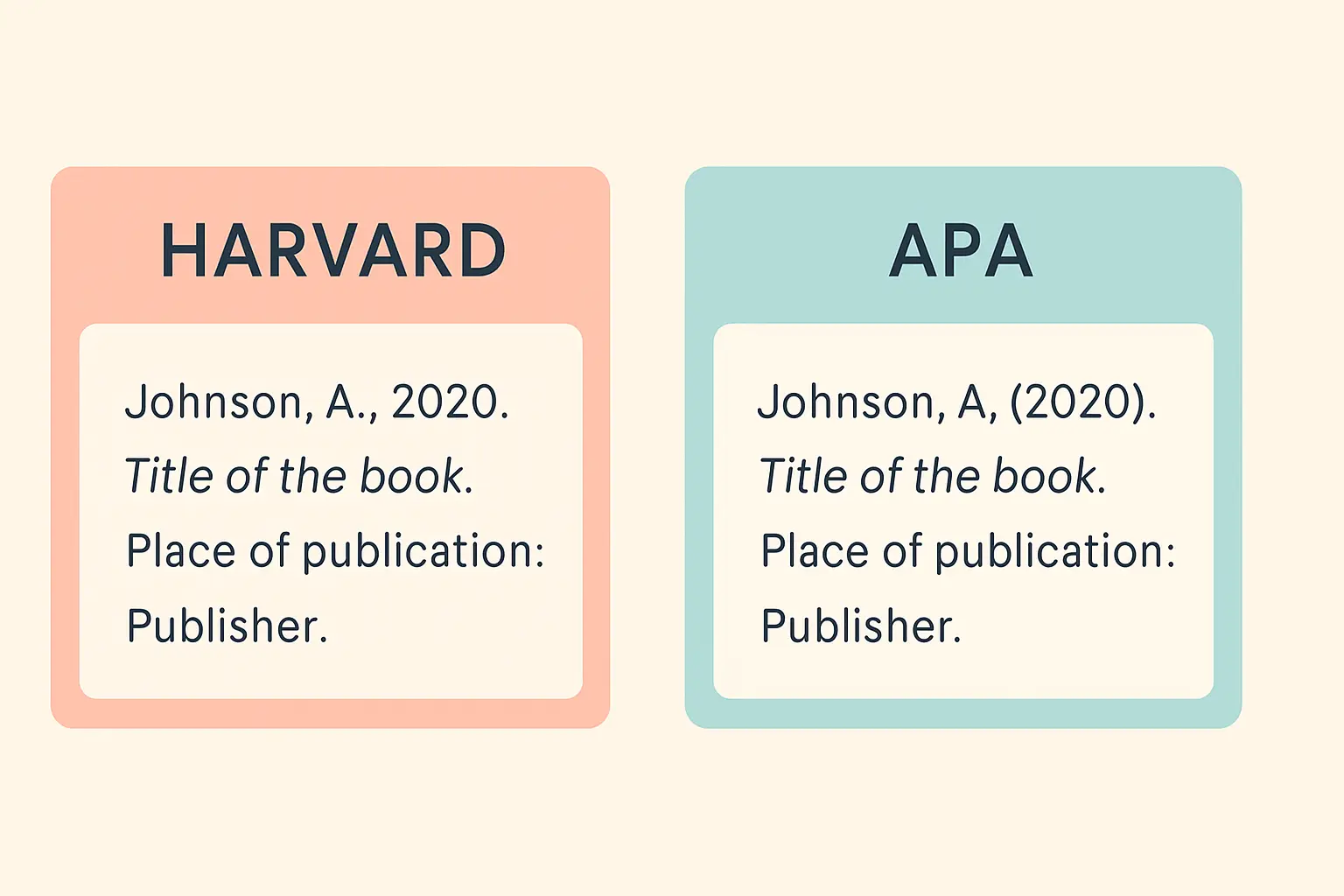
Harvard vs APA Referencing at South African Universities: Which Should You Use? (2026)
| Harvard | APA 7th edition | |
|---|---|---|
| Who defines it | No single owner — each institution publishes its own variant | The American Psychological Association, in one published manual |
| Authoritative guide | Your faculty’s own document | The published manual, applied everywhere |
| In-text form | Author-date, e.g. (Mokoena, 2024) | Author-date, e.g. (Mokoena, 2024) |
| Reference list detail | Punctuation, italics and ordering vary by institution | Fixed across institutions |
| Where it dominates in South Africa | Most widely used overall, across many faculties | Psychology, education, health and social sciences |
| Risk to your marks | Following a generic online “Harvard” guide that is not yours | Applying an older edition’s rules |
| Tool support | Reference managers need the right variant selected | Well supported everywhere by default |
The short recommendation: use whichever your faculty guide specifies, and if it says Harvard, use your institution’s Harvard document rather than any general one. That single instruction resolves most of the referencing marks South African postgraduates lose.
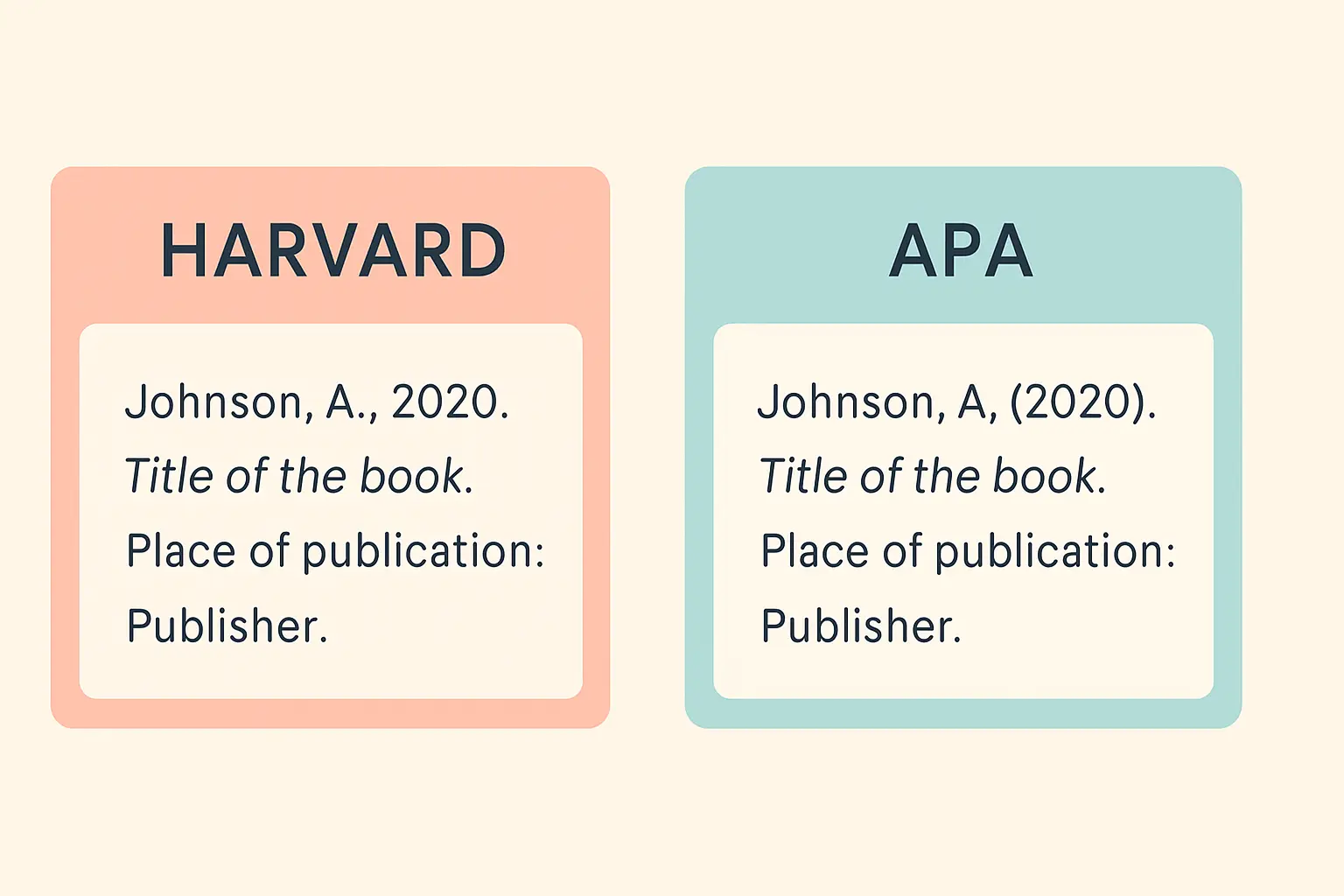
The difference that actually matters
APA is a standard. There is one publishing body, one manual, and a definable right answer to almost any formatting question.
Harvard is not a standard. It is a family of author-date styles with no central authority, which is why institutions publish their own versions and why two “Harvard” guides can disagree about whether the year sits in brackets, whether the journal title is italicised, and how to punctuate multiple authors.
So “we use Harvard” is not a complete instruction — it narrows you to a family. The binding document is your faculty’s guide, and faculties within one South African university can differ from each other.
What each looks like in practice
A journal article in a common Harvard variant:
Mokoena, T. and Naidoo, P. (2024) 'Retention of professional nurses in rural district hospitals', South African Journal of Health Management, 18(2), pp. 45-61.
The same source in APA 7th edition:
Mokoena, T., & Naidoo, P. (2024). Retention of professional nurses in rural district hospitals. South African Journal of Health Management, 18(2), 45-61.
Look at what changed: “and” became an ampersand, the article title lost its quotation marks and gained sentence-case treatment, full stops replaced some commas, and “pp.” disappeared. In-text, both give you (Mokoena & Naidoo, 2024) or (Mokoena and Naidoo, 2024) — nearly identical, which is exactly why students assume the reference list will be too, and lose marks on the list rather than in the text.
Which one will your faculty require?
Harvard variants are the most widely used across South African universities as a whole. APA dominates in psychology, education, health sciences and much of the social sciences, because those disciplines publish in APA journals internationally.
Engineering and computing faculties often use a numbered style instead of either. Law uses its own footnote-based conventions. So the honest answer is that your discipline predicts the style and your faculty guide confirms it.

How to settle it in ten minutes
- Open your faculty’s postgraduate or referencing guide. Not the library’s general page, and not a search result — the document your faculty publishes.
- Find one worked example of each source type you will cite: journal article, book, chapter, thesis, web page, and any report or legislation your field uses.
- Copy those examples into a working file and format every reference against them.
- Set your reference manager to the matching style and then check its output against your examples rather than trusting it.
- If the guide is silent on a source type, ask your supervisor and record the decision so you apply it consistently.
This is worth doing at proposal stage, because the reference list you build for the research proposal becomes the spine of the one in your final document.
Where students actually lose marks
- Mixing variants. Half the list from your faculty guide, half from a reference manager’s default. Examiners spot it immediately, and it reads as carelessness rather than as a style disagreement.
- Trusting an auto-generated reference. Generators routinely mangle South African journal names, get initials wrong and invent page ranges. Check every one against your worked example.
- A mismatch between text and list. Every in-text citation must appear in the list, and nothing may appear in the list that is not cited.
- Applying APA 6th-edition habits. The 7th edition changed how multiple authors and publisher details are handled.
- Ignoring the secondary-source rule. If you did not read it, cite it as cited in the source you did read — or find the original.
Does the style choice affect anything else?
Only marginally, and mostly in ways worth knowing. A footnote-heavy style changes your word count arithmetic; author-date styles do not. Some faculties count the reference list towards the limit and some do not, so check that alongside the style itself — the rule differs across the honours, master’s and doctoral levels at some institutions.
Frequently asked questions
Is Harvard or APA better?
Neither. They are conventions, and the only meaningful question is which one your faculty requires. A perfectly executed style you were not asked to use still loses marks.
Can I use APA if my faculty says Harvard?
Not without permission. Ask your supervisor before deviating, and get the answer in writing.
Why do two Harvard guides disagree?
Because Harvard has no central authority. Any guide is one institution’s interpretation, which is why yours is the only one that binds you.
Do reference managers handle South African sources properly?
Partially. They handle international journals well and are less reliable on local journals, government reports and theses. Check those manually.
How do I cite a South African government report?
Your faculty guide should give a corporate-author pattern: the department as author, the year, the title, and the publisher or department. Apply it consistently across every official publication you cite.
How do I cite another student’s dissertation?
As an unpublished or institutional thesis, naming the degree, the institution and the year. Most faculty guides carry a specific pattern for this.
Does referencing style matter for ethics or plagiarism?
Style does not, but attribution does. Missing or wrong attribution is an integrity issue rather than a formatting one, which is a different and far more serious category — see our guide to ethics clearance for how institutions treat research conduct.
Should I format references as I go or at the end?
As you go. Reconstructing sources months later is where errors and missing entries come from.
Keep every reference consistent
Referencing is the cheapest part of a dissertation to get right and one of the most visible when it goes wrong. Tesify builds your bibliography as you write and keeps one convention applied throughout — 100% written by you.