
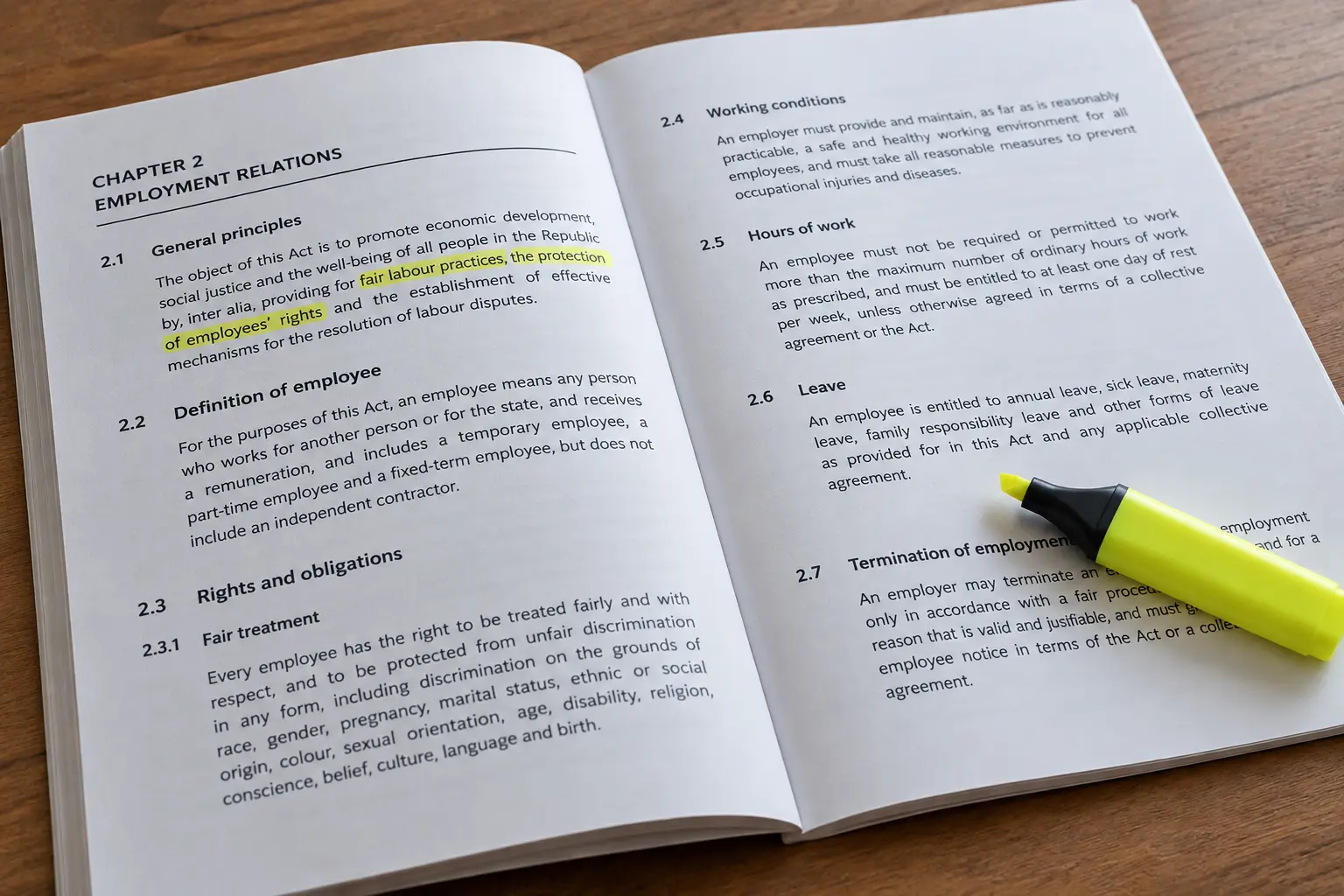
South African labour law dissertation topics that are actually researchable cluster around six themes: unfair dismissal and retrenchment, discrimination and equality at work, collective bargaining and strikes, the gig and platform economy, occupational health and safety, and trade union organisational rights. Each theme below includes several topics with a one-line research question, built around legislation and institutions — the Labour Relations Act, the CCMA, the Labour Court — that a student can actually access primary sources for.
Why does the theme matter more than the topic title?
A labour law topic is only researchable if it maps to a body of accessible law and case material — legislation, CCMA arbitration awards, Labour Court and Labour Appeal Court judgments, and academic commentary. Choosing a theme first, then narrowing to a specific unresolved question inside it, produces a topic an examiner recognises as properly scoped; starting from a broad idea like “labour law in South Africa” and trying to narrow it later usually produces a topic too wide to research inside a mini-dissertation or dissertation timeline.
Unfair dismissal and retrenchment
This remains the most litigated area of South African labour law, which means the largest body of case law to work with.
- How has the Labour Appeal Court’s approach to substantive fairness in misconduct dismissals evolved since Sidumo v Rustenburg Platinum Mines (2007)?
- Does section 189A of the Labour Relations Act 66 of 1995 provide adequate procedural protection for employees in large-scale retrenchments?
- How do CCMA commissioners assess whether dismissal was a fair sanction — applying their own judgment of fairness after Sidumo rather than deferring to the employer — in small-business disputes compared to large corporates?
- What is the current test for constructive dismissal under the LRA, and how consistently is it applied across recent Labour Court decisions?
Discrimination and equality at work
- How effective is the Employment Equity Act 55 of 1998 in addressing pay discrimination claims post the 2014 equal-pay amendments?
- What does the case law say about the boundary between fair discrimination based on inherent job requirements and unfair discrimination?
- How are pregnancy-related dismissal disputes resolved at the CCMA, and does the outcome differ from Labour Court review outcomes?
- What protection does South African labour law currently offer against discrimination based on HIV status, and how has this developed since the Employment Equity Act’s original enactment?
Collective bargaining and strikes
- How does South African law balance the constitutional right to strike against an employer’s right to conduct business, in recent essential-services disputes?
- What is the current legal status of picketing rules under section 69 of the LRA, and how have recent disputes tested their limits?
- How do bargaining councils extend collective agreements to non-parties under section 32 of the LRA, and what disputes has this generated?
- Does the current legal framework for protected strikes adequately balance worker protection with the economic cost of prolonged industrial action?
The gig and platform economy
This is the fastest-growing, least-settled area of the field, which makes it attractive for a dissertation but also means fewer settled precedents to build on — a student choosing this theme should expect to argue from first principles and comparative law more than from a long line of local case law.
- Does the current statutory definition of “employee” under the LRA adequately capture platform-based gig workers such as ride-hailing and delivery drivers?
- How have other jurisdictions’ “worker” or intermediate-category classifications been used, or could be used, to address the South African gig-economy classification gap?
- What social security and occupational health and safety protections, if any, currently apply to platform workers classified as independent contractors?
- How could South African labour law be reformed to extend basic conditions of employment protections to app-based gig workers without eliminating the flexibility that attracts workers to the model?
Occupational health and safety
- How effectively does the Occupational Health and Safety Act 85 of 1993 (as amended) protect workers in high-risk sectors such as mining and construction, compared to the specialised Mine Health and Safety Act 29 of 1996?
- What liability gaps remain for employers where an employee’s mental health, rather than physical injury, is the occupational harm claimed?
- How has compensation under the Compensation for Occupational Injuries and Diseases Act 130 of 1993 been applied in cases involving occupational stress or burnout?
- Does current South African law provide adequate remedies for employees exposed to workplace harassment as an occupational health issue, separate from discrimination claims?
Trade union organisational rights
- How has the threshold for trade union organisational rights under section 21 of the LRA been interpreted in recent disputes involving minority unions?
- What is the current legal position on agency shop and closed shop agreements, and how do they interact with a worker’s constitutional right to freedom of association?
- How do disputes over trade union access to the workplace get resolved where employers dispute a union’s claimed representivity?
- What remedies exist under the LRA for victimisation of shop stewards, and how consistently are they enforced?
How do I turn one of these into a full research question?
Take the theme’s topic and add three things: a time frame (a specific period of case law, or “since” a named amendment or judgment), a specific legal instrument or provision (a section number, not just “the LRA” generally), and a stated angle — is the research doctrinal (what does the law say and how has it been interpreted), comparative (how does another jurisdiction handle the same issue), or evaluative (does the current law achieve its stated purpose)? A topic like “the right to strike” is not yet a research question; “how has the Labour Court balanced essential-services designations against the constitutional right to strike since 2019” is.
Worked example, before and after. Before: “gig economy workers and labour law” — a topic, not yet a question, and far too broad to research in one dissertation. After: “does the LRA’s current definition of ’employee’ under section 213 adequately capture app-based delivery drivers, and how have Constitutional Court dicta on the purposive interpretation of labour statutes been applied, or could be applied, to extend that definition?” The second version names the specific provision, gives the analytical angle (purposive interpretation), and points to a specific, findable body of case law and commentary — exactly what an examiner needs to see in a Chapter 1 problem statement.
What does a properly scoped title actually look like, compared to one that is too broad?

Three more before-and-after pairs make the pattern clear. Too broad: “discrimination in the South African workplace.” Properly scoped: “has the 2014 equal-pay amendment to the Employment Equity Act closed the gender pay gap in the private sector, based on reported CCMA and Labour Court outcomes since 2015?” Too broad: “trade unions and the Constitution.” Properly scoped: “how has the constitutional right to freedom of association been balanced against employer property rights in recent workplace-access disputes under section 21 of the LRA?” Too broad: “health and safety law in South Africa.” Properly scoped: “does the Compensation for Occupational Injuries and Diseases Act adequately compensate claims involving occupational stress, compared to claims involving physical injury, in reported case outcomes since 2018?” Each properly scoped version names an Act or section, a time frame, and a specific comparison or test — the three elements that make a topic researchable rather than aspirational.
How does this differ from the LLM topics already on the site?
The site’s 40 LLM dissertation topics piece spans the whole field of South African law at master’s level — constitutional law, commercial law, criminal law and more — with only a handful of labour-specific entries among them. This piece goes deeper into one field only, with enough topics inside each labour-law theme that a student does not need to look elsewhere to find a properly scoped, current option.
How do I write the research problem and questions once I’ve chosen a topic?
Once a topic is narrowed using the three elements above, the next step is building it into a formal research problem, questions and hypotheses — the site’s guide to writing the research problem and questions for a law dissertation walks through that structure using an LLB example; the same structure applies whether the underlying topic is drawn from labour law or any other field of South African law.
How do I cite the Labour Relations Act and Labour Court judgments correctly?
Labour law topics lean more heavily on legislation and case law than most other dissertation fields, which makes correct citation form worth settling early rather than at the final proofread. The site’s guide to citing South African Acts and case law in Harvard and APA covers the published university form for an Act (Republic of South Africa, year, short title, Act number) and the anatomy of a Labour Court or Labour Appeal Court judgment citation, both of which apply directly to a labour law dissertation. If your faculty allows a choice between referencing systems, the site’s Harvard vs APA comparison covers how UCT, Wits and Stellenbosch each publish their own variant.
What sources should I use to check whether a topic is still current?
Legislation amendments, new Labour Court and Labour Appeal Court judgments, and CCMA arbitration awards move faster than most other areas of law reviewed on this site. Before committing to a topic, check SAFLII for the most recent judgments citing the relevant section, and check whether the specific Act provision has been amended since the case law you plan to rely on was decided — a topic built entirely around a since-superseded provision is a preventable, examiner-visible error.
Narrowing a broad theme like these into a properly scoped, current research question — with the legislation, case law and structure an examiner expects — is exactly the kind of work Tesify helps you do faster, while the argument and the writing stay entirely yours.
Frequently asked questions
Is labour law a good choice for an LLB mini-dissertation, or only for LLM level?
Both — the themes above scale down to a narrower, more descriptive doctrinal question at LLB mini-dissertation level, and scale up to a more comparative or evaluative question at LLM level. The theme is the same; the depth and originality expected differ by degree level.
Can I combine two themes, such as gig-economy classification and occupational health and safety?
Yes, and it can produce a strong, genuinely under-researched topic — but confirm with your supervisor that the combined scope is still achievable inside your timeline, since combined topics often require reviewing two separate bodies of case law.
Do I need access to a law library, or can SAFLII cover my case law needs?
SAFLII covers Labour Court, Labour Appeal Court and Constitutional Court judgments and is normally sufficient for a dissertation’s primary case law; a university library’s subscription databases add secondary academic commentary, which strengthens the literature review but is not strictly required to access the case law itself.
Is a purely comparative labour law topic, with no South African case law, acceptable?
Some programmes allow purely comparative work, but most South African law faculties expect at least a substantial South African law component even in a comparative dissertation — check your own department’s requirements before committing to an entirely comparative design.
How many topics from one theme should I read before choosing?
Read enough recent case law and commentary on at least two or three candidate topics within your chosen theme before committing — this surfaces which ones already have a settled answer (making the topic less researchable) and which remain genuinely contested.
Are gig-economy topics riskier because the law is still unsettled?
They carry a different kind of risk: less local case law to draw on, but more room for original argument. If your programme values originality highly and you’re comfortable arguing from comparative law and first principles, this can work in your favour rather than against it.
Should my topic focus on the CCMA or the Labour Court?
This depends on the research question — CCMA arbitration awards are useful for volume and for seeing how a rule plays out in ordinary disputes, while Labour Court and Labour Appeal Court judgments carry more precedential weight for a doctrinal argument about how the law should be interpreted.
Can I write about a Bill that hasn’t been passed yet, such as a proposed LRA amendment?
You can discuss a Bill as part of the context or future-direction section, but building the entire dissertation around unpassed legislation is risky — the Bill could change substantially or fail to pass before you submit, undermining the topic’s currency.