
The proposal for a marketing dissertation fails at one place more than any other: the page where the research problem, the objectives, the research questions, the hypotheses and the variables are supposed to line up, and do not. A committee reads that page in two minutes and can see whether the study is one study or three. This guide takes a South African honours or master’s marketing student through the eight steps that produce that page, with one worked example carried from the first step to the last and the expected output stated at each step.
How to write the research problem, questions and hypotheses for a marketing dissertation, step by step
Step 1: Start from a marketing problem, not a marketing topic
“Social media marketing” is a topic. A research problem is a specific thing a marketer cannot currently decide because the evidence does not exist for their market. South African business faculties expect a problem statement in three moves: what is known, usually from international literature; what is not known for the South African context, or for a particular segment, channel or category; and why the gap matters to a named decision-maker. The third move is where a marketing problem earns its place, because marketing is an applied discipline and the committee wants to know who acts on the answer.
Worked example, carried through every step below: brands are moving budget to creator content on TikTok, but the studies on whether creator credibility drives purchase intention were run on American and Chinese samples, and nothing tests the mechanism among Generation Z consumers in Gauteng, where the platform’s growth has outrun the evidence. The decision-maker is a brand manager allocating a creator budget. That is a research problem.
Expected output: a problem statement of 250 to 400 words that ends with one sentence beginning “The research problem is”. The full eight-section proposal it sits in is set out in the guide to writing a research proposal for a South African university.
Step 2: Anchor the problem in one theory the field actually cites
Marketing examiners expect hypotheses to be derived from a named theory, not assembled from whatever seemed plausible. The theories below recur in South African marketing dissertations and in the domestic journals a supervisor will expect you to have read: Acta Commercii, the South African Journal of Business Management and the South African Journal of Economic and Management Sciences, all open access, and The Retail and Marketing Review, published by the IMM.
| Theory | Originator | Where South African marketing dissertations use it | Typical dependent variable |
|---|---|---|---|
| Theory of planned behaviour | Ajzen (1991) | Green purchasing, healthy food choice, insurance uptake, township retail patronage | Behavioural intention |
| Technology acceptance model and UTAUT2 | Davis (1989); Venkatesh, Thong and Xu (2012) | Mobile payments, banking apps, e-commerce, ride-hailing adoption | Use intention, use behaviour |
| Stimulus–organism–response | Mehrabian and Russell (1974) | Store atmospherics, website design, social media content, live-stream commerce | Approach or purchase behaviour |
| Customer-based brand equity | Keller (1993); Aaker (1991) | Brand loyalty, brand love, sponsorship, private-label brands | Brand loyalty, willingness to pay |
| Service quality gap model (SERVQUAL) | Parasuraman, Zeithaml and Berry (1988) | Banking, healthcare, higher education, municipal services | Satisfaction, loyalty |
| Commitment–trust theory | Morgan and Hunt (1994) | Relationship marketing, business-to-business loyalty, loyalty programmes | Commitment, retention |
| Source credibility model | Ohanian (1990) | Influencer and creator marketing, celebrity endorsement | Attitude, purchase intention |
For the worked example the natural anchor is the source credibility model, with the stimulus–organism–response framework supplying the mediating structure: creator characteristics are the stimulus, attitude toward the brand is the organism, purchase intention is the response. The chain from theory to hypothesis is the same one described for another discipline in the article on choosing a theoretical framework for a psychology dissertation; marketing simply has its own list of theories.
Expected output: one primary theory named with its founding citation, and one sentence stating which constructs in the theory become which variables in your study.
Step 3: Write the primary and secondary objectives
Most South African business faculties ask for one primary objective and three to five secondary objectives, and they mark the secondary objectives against the hypotheses later in the document. Write the primary objective as the study in one sentence, and each secondary objective as one relationship you will test.
Worked example. Primary objective: to determine the effect of creator credibility on Generation Z consumers’ purchase intention for fashion brands promoted on TikTok in Gauteng, and whether attitude toward the brand mediates that effect. Secondary objectives: to determine the effect of perceived expertise on attitude toward the brand; to determine the effect of perceived trustworthiness on attitude toward the brand; to determine the effect of perceived attractiveness on attitude toward the brand; to determine the effect of attitude toward the brand on purchase intention; to establish whether product involvement moderates the relationship between attitude and purchase intention.
Expected output: one primary objective and three to five secondary objectives, each naming two variables and a direction.
Step 4: Convert each objective into a research question
A research question is an objective turned into a question a reader can imagine being answered. Committees notice when questions and objectives have drifted apart, so derive one from the other mechanically. Descriptive questions (“what is the level of”) are legitimate but do not carry hypotheses; relational questions (“does X affect Y”) do. A marketing dissertation at master’s level normally has one descriptive question and three to five relational ones.
Worked example: RQ1, what is the level of purchase intention for TikTok-promoted fashion brands among Generation Z consumers in Gauteng? RQ2, does perceived creator expertise affect attitude toward the brand? RQ3, does perceived creator trustworthiness affect attitude toward the brand? RQ4, does perceived creator attractiveness affect attitude toward the brand? RQ5, does attitude toward the brand affect purchase intention? RQ6, does product involvement moderate the effect of attitude on purchase intention?
Expected output: a numbered list of research questions that maps one-to-one onto the secondary objectives.
Step 5: Name and classify every variable
This is the step marketing students skip, and it is the one that decides whether the analysis chapter can be written at all. Every construct in your questions must be classified and operationalised: what role it plays in the model, and which validated scale measures it. Where a scale was developed elsewhere, adaptation to a South African sample must be documented, and the article on how to prove your questionnaire is valid sets out the evidence examiners expect.
| Variable | Role | Measured by | Items |
|---|---|---|---|
| Perceived expertise | Independent | Ohanian (1990) source credibility scale, expertise dimension | 5 |
| Perceived trustworthiness | Independent | Ohanian (1990), trustworthiness dimension | 5 |
| Perceived attractiveness | Independent | Ohanian (1990), attractiveness dimension | 5 |
| Attitude toward the brand | Mediator | Semantic differential attitude scale, adapted | 4 |
| Purchase intention | Dependent | Three-item purchase intention scale, adapted | 3 |
| Product involvement | Moderator | Zaichkowsky (1985) Personal Involvement Inventory, short form | 10 |
| Age, income, daily TikTok use | Control | Single items | 3 |
Draw the conceptual model as a figure: independent variables on the left, mediator in the middle, dependent variable on the right, moderator below the arrow it moderates, controls listed beneath. Every arrow in the figure will become one hypothesis, so count the arrows before you write Step 6.
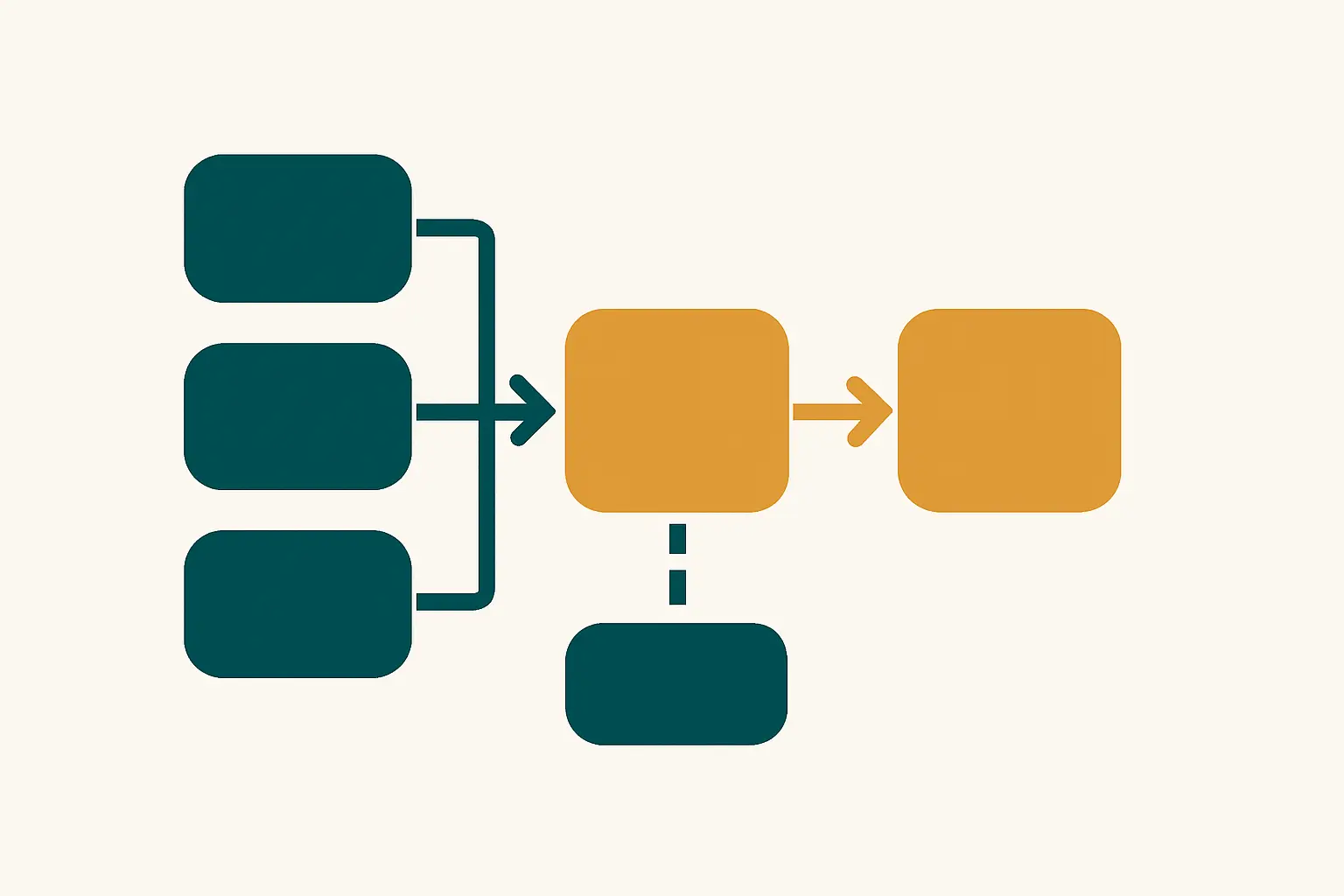
Expected output: a variable table with role, scale source and item count, and a conceptual model figure.
Step 6: Write the hypotheses, one per arrow
A hypothesis in a marketing dissertation is a directional statement about two named variables that a statistical test can confirm or reject. Number them to match the arrows, state the direction, and keep the variable names identical to the table in Step 5. Mediation and moderation get their own hypotheses. Null hypotheses are written out only if your faculty guide asks for them; most South African business faculties now accept the alternative form alone.
Worked example. H1: perceived expertise has a positive effect on attitude toward the brand. H2: perceived trustworthiness has a positive effect on attitude toward the brand. H3: perceived attractiveness has a positive effect on attitude toward the brand. H4: attitude toward the brand has a positive effect on purchase intention. H5: attitude toward the brand mediates the effect of creator credibility on purchase intention. H6: product involvement moderates the effect of attitude toward the brand on purchase intention, such that the effect is stronger at higher involvement.
Each hypothesis already implies its test. H1 to H4 are regression paths; H5 is a mediation model tested with bootstrapped indirect effects; H6 is an interaction term. The decision table in the guide to which statistical test to use for your dissertation takes it from there.
Expected output: a numbered hypothesis list whose count equals the number of arrows in your conceptual model.
Step 7: Build the alignment matrix
Before the proposal leaves your desk, build a table with one row per secondary objective and seven columns: objective, research question, hypothesis, variables, scale, statistical test, and the results-chapter section where the answer will appear. If any cell is empty, the study has a hole in it. If any row has a hypothesis but no test, or a test but no scale, the committee will find it. The matrix takes an hour and it is the single document most likely to get a marketing proposal through the committee at the first sitting.
The same matrix becomes the spine of Chapter 4. The analysis workflow that answers each row, from codebook to inferential test, is set out step by step in the guide to analysing questionnaire data in SPSS.
Expected output: a one-page alignment matrix, included in the proposal as a table or an appendix.
Step 8: Reference the theory and the scales in your faculty’s Harvard variant
Every theory in Step 2 and every scale in Step 5 must appear in the reference list with its founding citation, not a textbook summary. A journal article in a typical South African Harvard variant, using a 2026 South African marketing study on the same platform as the worked example:
Marumbwa, J. 2026. Generation Z consumers’ attitude towards TikTok marketing: The role of social influence, perceived enjoyment, content relevance and digital burnout. Acta Commercii, 26(1):a1547. https://doi.org/10.4102/ac.v26i1.1547
And the theory anchor: Ajzen, I. 1991. The theory of planned behavior. Organizational Behavior and Human Decision Processes, 50(2):179–211.
UCT, Wits and Stellenbosch each publish their own Harvard variant, and the punctuation between author, year and journal differs, so check the exact form against your faculty guide. Tesify’s automatic bibliography builds the entry in the variant you select from the DOI or the details you supply, which is faster than retyping thirty scale citations by hand.
Expected output: a reference list in one consistent variant containing every theory and every scale named in Steps 2 and 5.
Where South African marketing students lose marks on this page
Hypotheses without a theory. Six hypotheses that all seem reasonable but cite no founding theory read as a fishing expedition, and the committee will ask where they came from.
More hypotheses than arrows. A conceptual model with four arrows and nine hypotheses means five hypotheses have no place in the model. Either the model is incomplete or the hypotheses are padding.
Variables that change name. “Creator credibility” in the objectives, “influencer trust” in the hypotheses and “source trustworthiness” in the questionnaire are three names for a construct the examiner cannot follow. Fix the names in Step 5 and never vary them.
A South African problem tested on nobody in particular. The problem statement names Generation Z consumers in Gauteng and the sample is a convenience sample of anyone who clicked a link. Say who the population is, how the sample reaches it, and what that limits.
Questions that cannot be answered in the word count. A 25 000-word coursework dissertation carries one model with four to six hypotheses. Two models, or a comparison across three provinces, is a research master’s.
Get the proposal page written this week
The problem, objectives, questions, variables and hypotheses are one page, and it is the page that decides whether the proposal passes at the first committee sitting or comes back for a term. Tesify takes the problem you have defined and the theory you have chosen and drafts the chain in the order committees expect, with every citation bound to the source you supplied and the reference list built in your faculty’s Harvard variant. The model and the argument stay yours, which is what your university’s integrity policy requires. Draft your marketing proposal with Tesify and take an aligned page, not a list of topics, to your supervisor.
Frequently asked questions
How many hypotheses should a marketing master’s dissertation have?
As many as the conceptual model has arrows, which for a coursework dissertation is usually four to six. Fewer than three suggests the model is too thin; more than eight suggests two studies.
Do I need hypotheses if my marketing study is qualitative?
No. Qualitative marketing studies, such as interviews with brand managers or netnography of a brand community, carry research questions and propositions rather than hypotheses. State that explicitly so the examiner does not look for tests that were never planned.
Should I write null hypotheses as well as alternative hypotheses?
Only if your faculty guide asks for them. Most South African business faculties accept directional alternative hypotheses alone; some still require the H0 and H1 pair. Read two recently passed dissertations in your department and follow their form.
Can I use a scale developed in another country?
Yes, with permission from the author where required, and with documented adaptation and re-established content validity if you change any item for the South African context. Report the original validation and your own reliability.
What is the difference between a mediator and a moderator?
A mediator explains how an effect happens: expertise raises attitude, and attitude raises intention. A moderator changes how strong an effect is: the attitude-to-intention link is stronger for involved consumers. Each gets its own hypothesis and its own test.
How specific should the population be?
Specific enough that a reader knows who the finding applies to: a generation, a province or metro, a product category and a platform. “South African consumers” is a market, not a population.
Can Tesify write my hypotheses?
It can draft them from the theory, variables and model you have defined, in the numbered, directional form committees expect, and keep the names consistent across the objectives, questions and hypotheses. The choice of theory and the model remain yours, because that is what the examiner is assessing.