
Your MBA research report is due, your day job did not pause for it, and the literature synthesis for Chapter 2 alone represents forty hours you do not have this month. Reach for AI carelessly and you risk an academic-integrity finding that can cost you the MBA you registered to earn in the first place. Reach for it correctly, and it is one of the fastest ways to protect the hours you do have — the difference is entirely in what you disclose and how you use it. Tesify is meant to be used inside exactly that disclosed, accountable workflow.
What a real South African university’s AI guidelines actually say
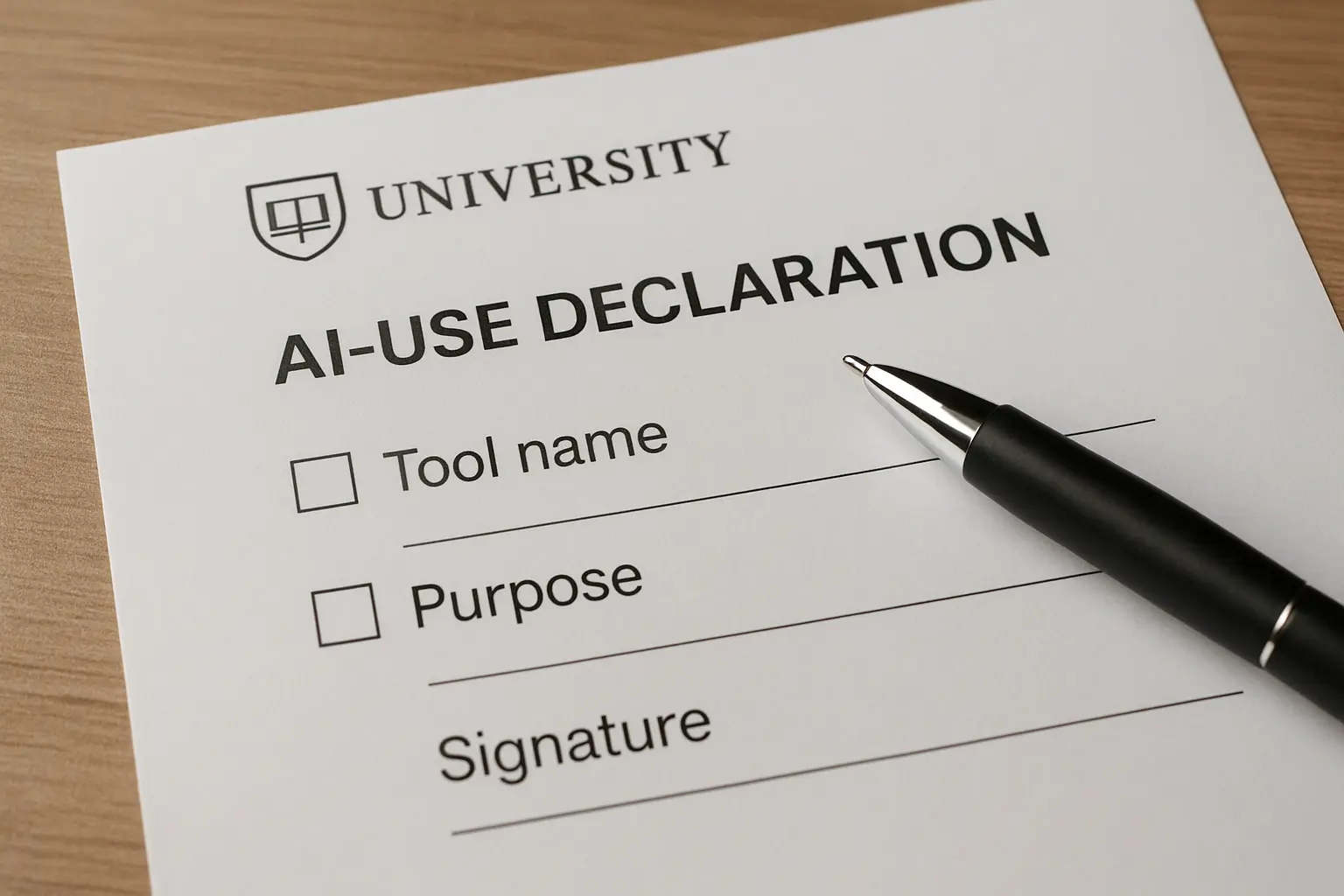
Stellenbosch University’s draft interim guidelines on AI use in assessment name four governing principles: accountability, authenticity, fairness and transparency. On accountability, the guidelines state plainly: “AI tools don’t have accountability” and that it is “the user’s responsibility to a) analyse and verify the AI-generated content and b) cite the original authors, as per the referencing convention.” The guidelines set out three possible scenarios a university or supervisor can apply to any piece of assessed work: AI use may be allowed and encouraged, disallowed entirely for sound pedagogical reasons, or required with an accompanying declaration. Whichever scenario your own MBA programme has adopted, the guidelines recommend that “AI use be declared, both by lecturers and students,” with a declaration that states which tools were used, where and what they were used for, and a justification for the claim that the submitted work is still the student’s own. The guidelines put the student’s own responsibility directly: “You are responsible for what you create and how it impacts others and society.”
What this means for your specific MBA research report
Three things follow directly from those four principles, applied to a business research report specifically. First, accountability means an AI tool can never be listed as a source or co-author of an idea — if a model suggests a theoretical framework or summarises a source, you still have to verify that summary against the original text and cite the original author, not the tool. Second, authenticity means the argument, the interpretation of your case data, and the conclusions have to be recognisably your own thinking, even where AI assisted with structure, language or a first-pass synthesis. Third, transparency means declaring your use explicitly — many MBA programmes now expect this declaration inside the report itself or as a separate signed form, and the safest default, in the absence of an explicit institutional policy either way, is to declare more than you think is required rather than less.
What does fairness mean for an MBA case study specifically?
The fourth principle, fairness, is easy to overlook in a business context but matters for two specific MBA situations. First, if your research uses a language model to help analyse interview transcripts from company staff, an ungrounded AI summary can flatten or misrepresent what a participant actually said in ways that are unfair to their intended meaning — the fix is the same accountability check as everywhere else, verifying any AI-assisted summary against the original transcript before it becomes a finding. Second, where classmates in the same cohort have unequal access to paid AI tools, a programme applying the fairness principle may set a common baseline of what tools are permitted for assessed work specifically to avoid an access-based advantage — check whether your programme has done this before assuming a more capable paid tool is automatically an advantage you are entitled to use.
A safe workflow for the parts of an MBA report where AI genuinely helps
Four uses that fit inside the accountability-authenticity-fairness-transparency frame, done correctly: (1) literature synthesis drafting — use AI to produce a first-pass structure from sources you have already read and verified, then rewrite the argument in your own words and check every citation against the original text; (2) case-study data organisation — use AI to help structure interview notes or financial data into a workable outline, never to invent or embellish the underlying data; (3) language editing — use AI to tighten grammar and flow on a draft you wrote, which some institutions treat closer to human editing than to content generation, though it still needs disclosure where your programme requires it; (4) outline and chapter-structure checks — use AI to sense-check whether your chapter structure matches what your business school expects, a low-risk use since it touches structure rather than content.
What to never do, and why it is worse than a shorter chapter
Never let AI generate your case analysis or your conclusions from a prompt describing your topic — this fails the authenticity principle outright, regardless of how well it is disclosed, because the argument itself is no longer yours. Never accept an AI-suggested citation, statistic or company fact without verifying it against a real, opened source — language models fabricate plausible-sounding references and figures with genuine confidence, and a single fabricated citation discovered by an examiner damages the credibility of your entire report, not just that one page. Never submit AI-assisted work without the disclosure your programme requires, even where you believe the assistance was minor — an undisclosed use discovered later is treated as a transparency failure regardless of how the content itself would have been judged if declared honestly.
What does the real cost of getting this wrong look like?
An academic-integrity finding at MBA level is not a resubmission inconvenience — depending on your institution’s rules it can mean a formal disciplinary process, a failed module that delays your graduation, and a note on your academic record that a future employer or professional body can ask about. Set against that, the honest declaration Stellenbosch’s guidelines describe costs you one paragraph and a few minutes — a genuinely small price for removing the entire risk, provided the underlying work still meets the authenticity principle.
What does a disclosed-use declaration actually look like on the page?
Most of the friction around AI declarations comes from not knowing what the sentence itself should say. A defensible declaration names three things: which tool, which specific task, and what verification step followed. A worked example for the preface or methodology chapter: “An AI writing assistant was used during the preparation of this research report for two limited purposes: (1) generating a first-pass structural outline for the literature synthesis in Chapter 2, based on sources the author had already read and selected; and (2) checking grammar and sentence-level clarity on drafts written by the author. All AI-assisted text was rewritten in the author’s own words, all citations were verified against their original sources, and the case analysis, interpretation and conclusions in this report are the author’s own work.” Notice what the declaration deliberately does not claim: it does not say AI was used for “writing help” in general terms, and it does not omit the verification step. A vague declaration (“AI tools were used to assist with this report”) satisfies the letter of a transparency requirement but not its spirit, and a supervisor reading it is likely to ask exactly the follow-up questions a specific declaration would have already answered.
How does this differ from the generic AI-permission pages already on this site?
The site’s is AI allowed for dissertations at South African universities answers the permission question in general across disciplines, and how to cite ChatGPT and AI covers the referencing mechanics once you have decided to cite a tool. Neither walks through a field-specific safe workflow for the actual work of an MBA or business research report — the four safe uses, the never-do list, and how they map onto a business case study’s literature synthesis, data organisation and case analysis chapters specifically. This page is that missing middle step.
Frequently asked questions
Will my MBA programme automatically fail me for any AI use?
Not automatically — many South African institutions, Stellenbosch’s draft interim guidelines among them, allow disclosed, accountable AI use in many contexts. The risk is undisclosed use or AI-generated analysis presented as your own original thinking, not AI assistance itself; check your own programme’s rules.
Do I need to declare AI use even for something as small as a grammar check?
Check your specific programme’s policy, since practice varies — some treat basic grammar checking similarly to traditional proofreading and do not require declaration, while others want any AI tool use disclosed regardless of scope. When uncertain, disclose.
Can I use AI to help me choose my theoretical framework?
You can use it to help you compare candidate frameworks you have already identified from real reading, but the final choice and the justification for it need to be your own reasoning, verified against the original theoretical sources — see the site’s nine theoretical frameworks for a South African MBA research report for the frameworks themselves.
What happens if an AI tool gives me a fabricated statistic or citation?
This is your responsibility to catch, per the accountability principle — verify every number and every citation against a real, opened source before it goes in your report. A fabricated citation discovered by an examiner is treated as a serious integrity issue, not an innocent tool error.
What does Tesify cost, and is it worth it against the risk described above?
Check the current plans and pricing on Tesify’s own site before you sign up, since plans change. Whatever tool you choose, weigh its cost against the far larger cost of an integrity finding — and remember the tool only helps if you use it in the disclosed, accountable way described above.
Does Tesify store or share my dissertation data?
Check Tesify’s current privacy policy directly for the specifics of data handling and retention — as a general principle for any AI writing tool, avoid uploading personally identifiable participant data or confidential company case information without first confirming the tool’s data-handling terms meet your ethics approval’s confidentiality requirements.
Is Tesify itself considered an AI writing tool my university would flag?
Treat it as an AI writing tool: it can help structure and draft, so disclose its use according to whatever policy your specific programme has adopted, the same as you would any AI assistance, and make sure the analysis and conclusions you submit are your own.
Does the declaration requirement apply differently to a part-time, working MBA student?
No — the declaration and accountability requirements apply the same way regardless of your study mode; being time-pressed by a full-time job is a reason to use a disclosed, accountable workflow efficiently, not a reason to skip disclosure.
Where can I find my own university’s specific AI policy if it differs from Stellenbosch’s?
Check your faculty or graduate school of business’s own teaching-and-learning or assessment policy pages, or ask your MBA programme coordinator directly — policies vary by institution and sometimes by faculty within the same university, and Stellenbosch’s guidelines above are illustrative of the kind of framework in use, not a universal South African standard.
Can I use AI to translate a source that is not in English?
Yes, with the same accountability principle applying — verify the translation’s accuracy against the original where the source is central to your argument, and disclose the translation step in your methodology if your programme requires it.