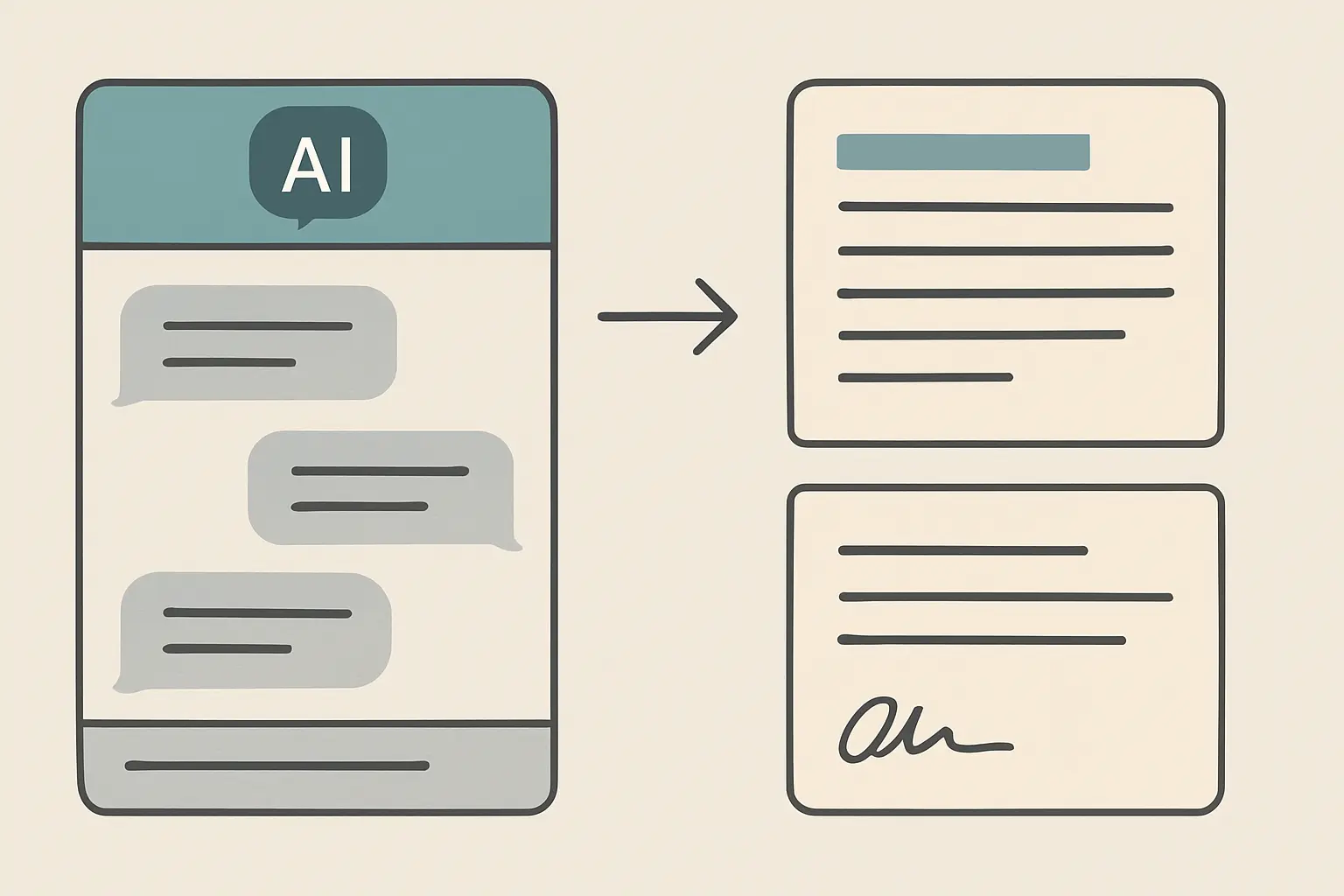
The answer most students expect is a reference-list template. The answer at least one South African university actually gives, in writing, is different: do not cite the AI tool at all. Reference the original sources behind what it told you, and declare your use of the tool separately.
That is not our opinion. It is what Stellenbosch University’s institutional guidelines on AI use say, in a document you can download, and it changes what you should do with your reference list. This guide sets out that rule and the reasoning behind it, gives the APA 7 form for the narrow case where referencing the tool is appropriate, and ends with a declaration you can adapt.
The rule, as a South African university states it
Stellenbosch University’s Draft interim SU guidelines on allowable AI use and academic integrity in assessment contains a quick-reference table for AI use in student work. Its row on referencing and citation reads, in the document’s own words:
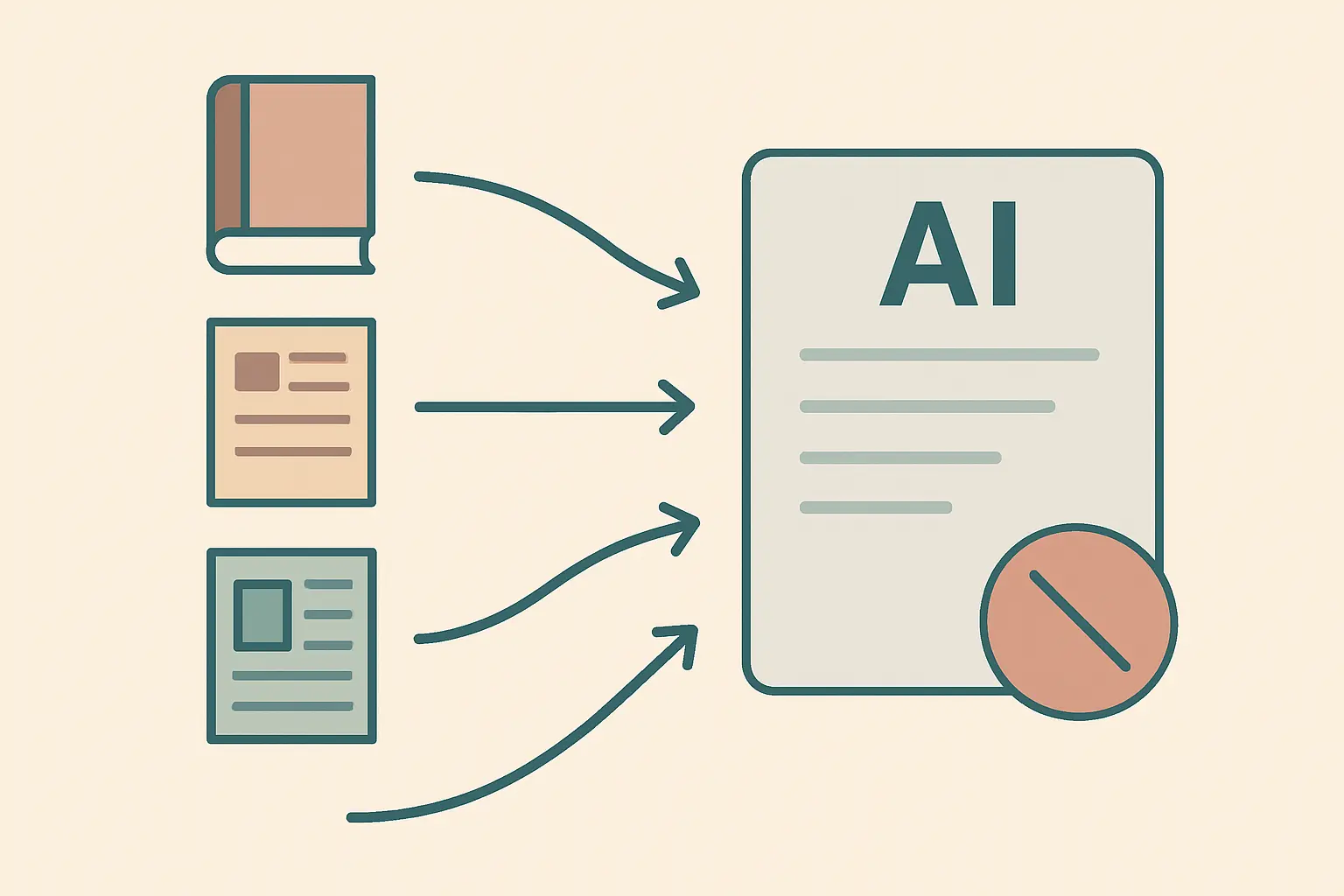
“Since the ideas of AI tools, such as ChatGPT, BING, Bard, etc, originally belong to other authors, and often cannot be retrieved (similar to personal communications). We do not suggest citing these tools in in-text references or the reference list. As far as possible, the work of the original authors should be sought out and fact-checking should be carried out. These original authors and sources of facts should be referenced.”
The same document’s principle of accountability puts the reasoning more bluntly still:
“AI tools don’t have unique ideas of their own, as they make use of existing datasets to generate their information/responses. Therefore, AI tools can not be referenced as the content author or creator. Instead, it is the user’s responsibility to a) analyse and verify the AI-generated content and b) cite the original authors, as per the referencing convention.”
On authorship it quotes Nature’s guidelines: “Any attribution of authorship carries with it accountability for the work, and AI tools cannot take such responsibility.”
So the default for a South African dissertation is: trace the claim back, verify it, and cite what it came from. A reference-list entry for ChatGPT is not the compliant answer; it is usually a signal that the tracing was not done.
Why the reasoning holds regardless of your style
The argument turns on retrievability, which is a referencing principle rather than a style rule. The purpose of a reference list is to let your reader find the source. A private chat session cannot be found by your examiner, which is why the Stellenbosch guidance places AI output in the same category as personal communications.
That has a useful consequence: the rule does not change when your faculty changes style. Whether you are on Harvard or APA, the questions are the same — can my reader retrieve this, and whose idea was it originally? If you are still deciding between the two systems, our comparison of Harvard and APA referencing at South African universities covers the choice itself.
One honest caveat on Harvard specifically. There is no single Harvard standard, and we did not find a South African university Harvard guide that publishes an AI reference form. Where your faculty’s Harvard variant is silent, the retrievability logic above is the defensible position, and your supervisor’s written instruction beats anything on this page.
When you genuinely do reference the tool, and how
There is a narrow case where the AI output is not a shortcut to someone else’s idea but is itself your object of study. If your research analyses model outputs — comparing responses, examining bias, documenting what a tool produced on a given date — then the output is data, and it gets referenced.
For APA 7, the University of Queensland Library’s referencing guide sets out the current form. Two cases, both taken from that guide.
An individual AI chat. Reference list format:
Author or company of AI tool. (Year, Month Day). Title of the chat. [Description of the chat type]. AI tool or model. Web address of the chat.
Its worked example:
OpenAI. (2026, January 10). Methods of providing alternative text for accessibility on websites. [Generative AI chat]. ChatGPT-5. https://chatgpt.com/share/...
In text: (OpenAI, 2026) or OpenAI (2026).
The tool in general. Reference list format:
Author or company of AI tool. (Year). Name of AI tool [Description of AI model used]. Web address of AI tool
Its worked example:
Microsoft. (2026). Copilot [Large language model]. https://copilot.cloud.microsoft/
In text: (Microsoft, 2026).
Note the element students get wrong most often: the author is the company, not the model. It is OpenAI, not ChatGPT; Microsoft, not Copilot. The model name sits later in the entry.
The same guide adds two instructions that point the same way as the South African rule: where no specific guideline exists, use the rule for personal communication; and where the AI output includes sources, cite those directly rather than citing the output itself.
A limitation worth stating. We could not read this form from APA directly. On the day this article was written, apastyle.apa.org returned a 212-byte page containing a single visible character to an automated request — it is a JavaScript application that serves nothing to a plain fetch. The forms above are therefore quoted from a university library’s published APA 7 guide rather than from APA itself, and a departmental instruction overrides both.
Watch the decision made once
The question of when a citation is required at all is the part that trips people up, and a library explains it better in three minutes than a page of rules does.
The declaration is the part that is actually required
If the tool usually does not go in your reference list, the transparency obligation has to be met somewhere else, and that somewhere is a declaration.
Stellenbosch’s Postgraduate Office publishes an Internal Declaration on AI Use, described on the university library’s AI guide as a document that “guides discussions between students and their supervisors by establishing an agreement on the responsible use of AI tools during the preparation of research assignments, theses or dissertations”. Two details from that guidance matter practically:
- The timing is early, not at submission. The guide says these discussions “should ideally take place at the outset of the study, such as during the proposal preparation, creating the workplan or in the Student–Supervisor Memorandum of Understanding discussion, and can be reviewed regularly throughout the research journey.”
- Your faculty may have its own form. The guide tells students to consult their faculty in case a faculty-specific internal declaration must be used instead of the generic template.
The institutional guidelines describe a student declaration form requiring an indication of the AI tools used, where and what they were used for, and a justification for the claim that the work is the student’s own. They also set out four principles for responsible use — accountability, authenticity, fairness and transparency — of which the operative one here is transparency: you should “clearly and honestly declare the use of AI tools and their outputs as well as the extent of the use”.
The same document, quoting Gimpel and colleagues, warns that declarations should not be binary. “I used ChatGPT” is not a declaration. It should say which steps of the research and writing process the tool was used for, and it advises keeping a record of your interactions — prompts and outputs, by screenshot — to submit with the work, plus a statement of your own responsibility for any errors the tool introduced.
A declaration you can adapt
DECLARATION ON THE USE OF ARTIFICIAL INTELLIGENCE
In preparing this [dissertation / research report / thesis] I used the following generative AI tools: [tool name and version, e.g. ChatGPT‑5 (OpenAI)].
I used them for the following tasks, and no others: [e.g. generating candidate chapter outlines during planning; suggesting alternative phrasings of passages I had already written; checking the internal consistency of my reference list]. I did not use them to generate any passage of argument, analysis or interpretation presented here as my own.
All factual claims that originated in an AI output were traced to their original sources, verified against those sources, and are referenced to those sources in the text. No AI tool is cited as an author.
I did not enter raw participant data, personally identifying information or unpublished material belonging to third parties into any AI tool.
I retain a log of the prompts used and the outputs received, dated, and can produce it on request.
I accept full responsibility for the content of this work, including any error introduced through the use of these tools.
Signature: ______________________ Date: ______________
Where your faculty provides a template, use the faculty template instead of this one and treat the paragraphs above only as a checklist of what a good declaration covers. The declaration usually sits with the other preliminary pages; our guide to the title page, declaration and layout of a South African dissertation covers where it goes and what else belongs there.
What you probably do not have to declare
The Stellenbosch guidelines note that journals asking authors to disclose AI use are generally asking about large language models, and explicitly not about spelling or grammar checkers and reference managers. That is a sensible line to carry into a dissertation: a spellchecker and a reference manager are not the subject of this obligation, while a tool that produced prose or restructured your argument is.
Where a tool sits ambiguously — a grammar checker that now rewrites whole sentences, for instance — declare it. Nobody has been penalised for declaring too much. On whether your reference manager counts, our guide to reference managers for South African postgraduates takes the same view.
Five mistakes
- Putting ChatGPT in the reference list to look transparent. Under the Stellenbosch guidance this is not transparency, it is a missing trace. Find the original source and cite that.
- Citing a source the AI gave you without opening it. The guidance is explicit that sources offered by AI tools still need to be verified. A reference to a paper you have not read is a fabricated citation, whatever produced it.
- Naming the model as the author. If you do reference a tool, the author element is the company — OpenAI, Microsoft, Google — not the product.
- A one-line declaration. “AI was used for editing” fails the not-binary test. Name the tool, the tasks, the stages and what remained yours.
- Declaring at submission rather than agreeing at proposal stage. The Stellenbosch process puts the conversation with your supervisor at the start of the study. Retrofitting a declaration months later is both harder and less credible.
Where the permission question is settled
This article deals with mechanics: what goes in the reference list and what goes in the declaration. The separate and prior question — whether you are allowed to use these tools at all, and what the major South African universities say about it — is covered in our guide to whether using AI for a dissertation is allowed at South African universities. If you are curious how common this is becoming, we counted what the data actually shows about South African student AI use. And legal sources follow rules of their own, set out in citing South African Acts and case law.
Frequently asked questions
Do I have to cite ChatGPT in my dissertation?
Usually not. Stellenbosch University’s institutional guidelines state that they do not suggest citing such tools in in-text references or the reference list, and that the original authors behind the content should be referenced instead. Check your own faculty’s instruction, which governs.
Then how do I acknowledge that I used it?
In a declaration, naming the tools, the tasks, the stages of the work and what remained your own. That is the mechanism the transparency obligation runs through.
What if the AI gave me a reference?
Open it, read it, confirm it exists and says what you were told it says, then cite it normally. AI tools generate plausible references that do not exist, and an examiner who checks one will check the rest.
When should I reference the tool itself?
When the output is your data rather than a route to someone else’s work — for example if your study analyses what models produce. Then use the APA form above, with the company as author.
Is the author OpenAI or ChatGPT?
OpenAI. The company is the author element; the model name appears later in the entry, as in the worked examples above.
Does Harvard have an AI reference format?
There is no single Harvard standard, and we did not find a South African university Harvard guide publishing one. Where your variant is silent, follow the retrievability logic and your supervisor’s written instruction.
Do I need to declare Grammarly or my reference manager?
The Stellenbosch guidelines distinguish large language models from spelling and grammar checkers and reference managers. If a tool has started rewriting your sentences rather than correcting them, declare it.
Can I put my interview transcripts into an AI tool?
Not without checking. Participant data carries ethics and legal obligations, and your ethics clearance almost certainly did not contemplate uploading identifiable data to a third-party service. Ask your ethics committee before, not after.
Should I keep my prompts?
Yes. The Stellenbosch document advises keeping a record of the interaction, including screenshots, to submit with the work. A dated log written as you go is far more credible than a reconstruction.
Will declaring AI use count against me?
Declaring permitted use in the terms your institution asks for is compliance, not confession. The students who get into difficulty are consistently the ones who did not declare.
Use the tools the way your university expects
The integrity question is not whether you used software. It is whether the argument is yours and whether you were straight about how you worked. Tesify is built for exactly that position: it helps you structure and draft while the thinking and the final wording stay 100% written by you.