A South African Act and a South African judgment are the two sources most likely to be formatted wrongly in an otherwise clean reference list. They do not behave like books or journal articles, most Harvard guides give them a single line, and APA openly hands the problem to a different system entirely. This guide gives you the form a South African university library actually publishes, the anatomy of a judgment citation so you can read one before you write it, and the honest position on what APA 7 does outside the United States.
It is written for the non-law reader as much as the law reader. An education dissertation citing the schools legislation, a nursing research report citing the health statutes, a public administration mini-dissertation citing a municipal by-law and an LLM dissertation all face the same mechanical problem.
Why legal sources break an otherwise clean reference list
Three things make legislation and judgments different from every other source you will cite.
- There is no author in the ordinary sense. An Act is made by Parliament; a judgment is delivered by a court. Harvard variants solve this by treating the state as the author, and they do not all solve it the same way.
- The citation is already a citation. A judgment arrives with a formal reference attached to it. Your job is to transcribe it accurately, not to build one from scratch.
- The rules are jurisdictional. Legal citation is a national system, not an international one. This is the point at which imported style guidance quietly stops applying to you.
The practical consequence is that you cannot settle this from a generic referencing handout. You settle it from your own faculty’s guide, and where that guide is silent, from a published South African guide that states its form explicitly.
How to cite an Act of Parliament in Harvard
The Stellenbosch University Library and Information Service publishes a Law guide that gives the Harvard form for South African legislation outright. Its example, reproduced exactly as the guide prints it:
Republic of South Africa. 2000. National Youth Commission Amendment Act 19 of 2000. Pretoria: Government Printer.
Read the pattern off that line and it is straightforward: Republic of South Africa. Year. Short title Act number of year. Place: Publisher. The state is the author, the year appears twice because the second occurrence is part of the Act’s own name, and the Government Printer is the publisher.
Applied to three Acts that turn up constantly in South African dissertations, each short title taken from the Act’s own page on the government’s website:
Republic of South Africa. 1997. Higher Education Act 101 of 1997. Pretoria: Government Printer.Republic of South Africa. 2003. National Health Act 61 of 2003. Pretoria: Government Printer.Republic of South Africa. 2013. Protection of Personal Information Act 4 of 2013. Pretoria: Government Printer.
In text, cite it the way you cite any corporate author: (Republic of South Africa, 2013), or narratively, The Protection of Personal Information Act 4 of 2013 requires…. Many South African supervisors prefer the narrative form for statutes because the Act’s name carries more information than the bracket does.
Government notices, White Papers and commission reports
The same guide gives forms for the neighbouring document types, which is useful because policy-heavy dissertations cite these more often than they cite Acts. A White Paper, as the guide prints it:
Republic of South Africa. Department of Education. 1995. White Paper on education and training. Government Gazette no. 16312, 15 March.
And a commission report, where a named chairperson takes the author position:
Katz, M.M., chair. 1994. Interim report of the Commission of Inquiry into Certain Aspects of the Tax Structure of South Africa. Pretoria: Government Printer.
Note what changes: the department becomes part of the author element for a departmental publication, and the Gazette number and date replace the publisher for anything gazetted.
How to read a judgment citation before you write it
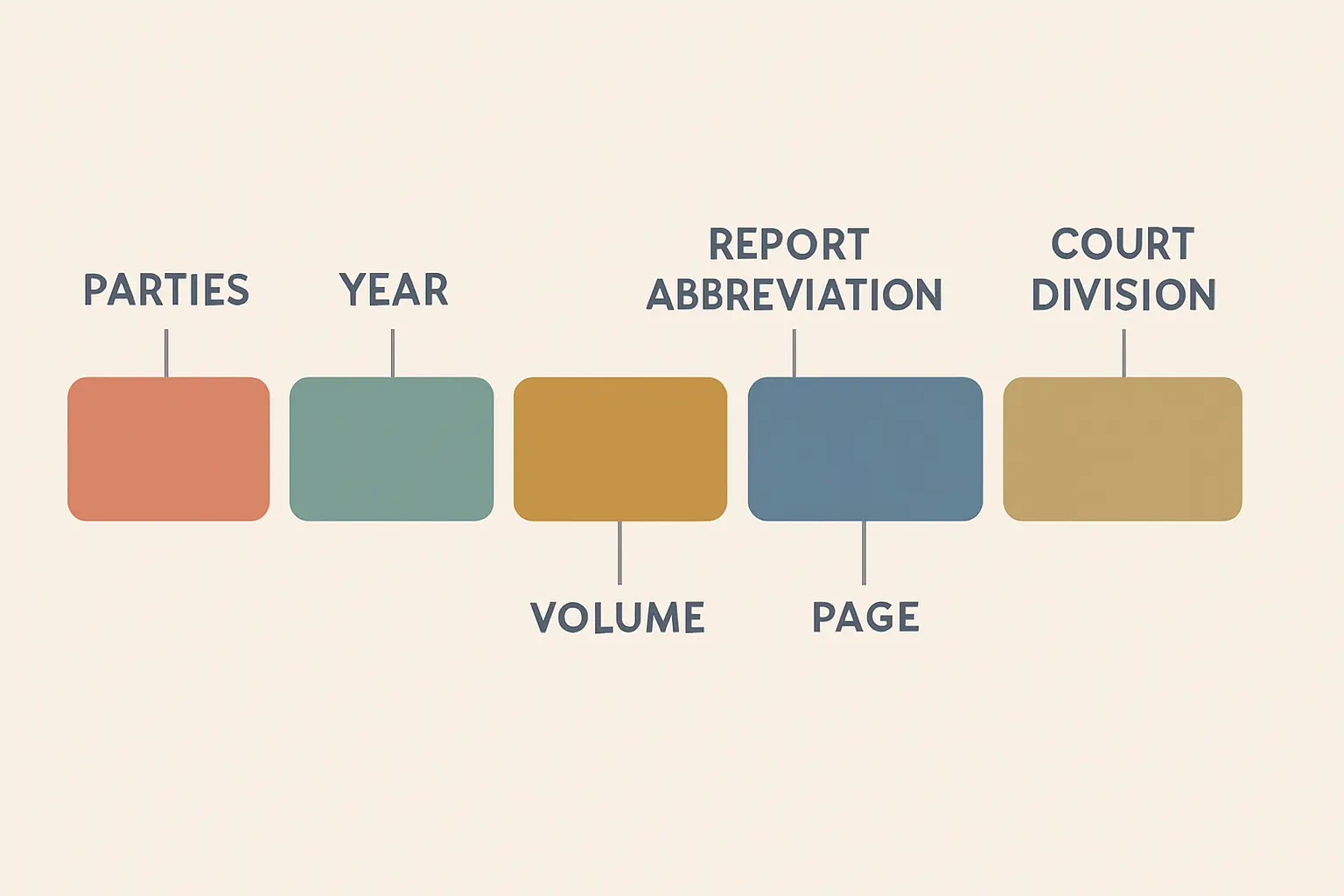
A judgment does not need a reference built for it. It already has one, printed at the head of the document, and your only real task is to transcribe it without dropping an element. The Stellenbosch Law guide sets out the anatomy using a reported South African case:
Prince v Minister of Justice and Constitutional Development and others and related matters [2017] 2 All SA 864 (WCC)
The guide labels the parts as follows.
| Element | In the example |
|---|---|
| Parties / case name | Prince v Minister of Justice and Constitutional Development and others and related matters |
| Case year | 2017 |
| Volume number | (2) |
| Law report abbreviation | All SA |
| Starting page | 864 |
| Court / division | (WCC) |
Once you can see those six slots, a law report citation stops being intimidating. The two elements students most often mangle are the law report abbreviation, which is a fixed abbreviation and not something you shorten yourself, and the court division in the final bracket, which is not optional.
Neutral citations, and why you will meet them more often
Reported citations point into a printed law report series. A great many South African judgments are never reported in that sense, and courts now issue a neutral citation instead: a court-assigned reference that identifies the judgment independently of any publisher. Two judgments listed on LawLibrary, the free South African legal collection run by the African Legal Information Institute, on the day this article was written:
Dombo Community and Others v Tshakhuma Community Trust and Others (795/2024) [2026] ZASCA 118 (11 September 2026)N M N v N N (2025/177461) [2026] ZAGPJHC 1440 (10 September 2026)
The shape is: parties, court case number in round brackets, year in square brackets, a court code, a sequential judgment number, and the date of delivery in round brackets. The court code is the part that varies — ZASCA is the Supreme Court of Appeal and ZAGPJHC the Gauteng Division sitting in Johannesburg in the two above. Do not try to reconstruct a court code from memory. Copy it from the face of the judgment, which is where the court put it.
In a reference list, a judgment normally stands as its citation with no added publication data, and in text you cite the case name and year: (Dombo Community v Tshakhuma Community Trust, 2026). If your faculty guide asks for a database and access date as well, add them — but only if it asks.
Watch the mechanics once before you do it yourself
North-West University’s library publishes a short series on referencing legal sources in a house Harvard style. The legislation instalment is a useful sanity check on everything above, and it is South African rather than imported.
What APA 7 actually does with legal sources
This is where most students get quietly misled, so it is worth stating plainly. APA does not have its own legal citation system. The Purdue OWL’s APA 7 guidance on legal references puts it in one sentence: most legal materials are cited using Bluebook style, and APA defers to Bluebook style for legal materials, using those templates and patterns in bibliographies. The same page adds the caveat that matters most to you: legal conventions may differ outside the US.
Bluebook is the American legal citation manual. Its templates are built around American reporters — the United States Code, the Federal Reporter, Federal Supplement — none of which has a South African equivalent you can slot in. The canonical APA example on that page is Brown v. Board of Education, 347 U.S. 483 (1954)., which tells you the volume and page of a United States reporter and nothing at all about how to handle a judgment of a South African High Court.
So the honest answer for an APA-referenced South African dissertation is this: take from APA the things that genuinely transfer, and take the citation itself from South African practice.
- Transfers: the element order (case name, then citation, then court and date in brackets); the rule that a case name is italicised in the in-text citation, unlike every other source type; the optional URL.
- Does not transfer: any American reporter abbreviation, and the assumption that a statute lives in a numbered code title.
Written out, an APA-styled South African entry keeps the local citation intact and simply presents it in APA’s element order:
Protection of Personal Information Act 4 of 2013 (S. Afr.). https://www.gov.za/documents/protection-personal-information-act
Tell your supervisor in one sentence what you have done and why. A methods-chapter footnote saying that legal sources follow South African citation practice because APA defers to a jurisdiction-specific system is a stronger position than a reference list that silently invents an American-looking form. The broader choice between the two systems is covered separately in our comparison of Harvard and APA referencing at South African universities.
A worked reference list mixing legal and ordinary sources
Alphabetical by the first element, with legal sources interfiled rather than exiled to an appendix, which is the default unless your faculty guide says otherwise:
Dombo Community and Others v Tshakhuma Community Trust and Others (795/2024) [2026] ZASCA 118 (11 September 2026).
Katz, M.M., chair. 1994. Interim report of the Commission of Inquiry into Certain Aspects of the Tax Structure of South Africa. Pretoria: Government Printer.
Prince v Minister of Justice and Constitutional Development and others and related matters [2017] 2 All SA 864 (WCC).
Republic of South Africa. 1997. Higher Education Act 101 of 1997. Pretoria: Government Printer.
Republic of South Africa. 2013. Protection of Personal Information Act 4 of 2013. Pretoria: Government Printer.
Some faculties, particularly law faculties, ask for a separate table of statutes and table of cases before the bibliography. That is a faculty instruction, not a Harvard rule, and it overrides the interfiled default above.
Where to get the full text without paying
You cannot cite accurately from a summary. Three free routes, all of which give you the document itself:
- gov.za carries the Acts of Parliament with their official short titles. Its own page headings are the safest place to confirm the exact wording and the number-of-year pairing before you type it into a reference.
- LawLibrary (lawlibrary.org.za), run by the African Legal Information Institute, describes itself as the most comprehensive free collection of South African legal information and covers judgments, national and provincial legislation, municipal by-laws and Gazettes.
- SAFLII is the long-standing free judgment repository South African researchers have used for years. One honest note: on the day this article was written, SAFLII was serving an automated browser challenge and we could not read a judgment page directly to verify anything from it. Everything asserted above about neutral citations was read on LawLibrary instead. If SAFLII loads normally for you, it is the same judgments.
If your topic is law rather than a law-adjacent social science question, our guide to LLM dissertation topics you can actually research in South Africa covers which primary-source collections carry what, and how to write the research problem and questions for a law dissertation deals with framing.
Five mistakes that cost marks
- Citing the Act without its number and year. “The National Health Act” is ambiguous; “National Health Act 61 of 2003” is the Act. The number-and-year pair is part of the name, not an optional extra.
- Re-abbreviating a law report.
All SA,SAandBCLRare fixed abbreviations. Shortening or expanding them breaks the citation’s function, which is to let a reader find the document. - Dropping the court division. The bracket at the end of a reported citation, and the court code in a neutral citation, identify which court decided the matter. A citation without it does not locate anything.
- Citing an amended Act from an unamended copy. South African Acts are amended frequently. Check whether the section you rely on is still in the form you quote, and say which version you consulted if it matters to your argument.
- Applying an American template because your guide says APA. APA itself says legal conventions differ outside the United States. Following the American template is not compliance with APA; it is a misreading of it.
The last of these is worth a sanity check against your own document before submission. If your reference list already disagrees with your faculty guide in other places, our fix-it guide on a reference list that does not match the faculty guide works through the repair in order, and a reference manager will handle the ordinary sources so you can spend your attention on the legal ones, which it will not handle well.
Frequently asked questions
Do I italicise the name of an Act?
In the Harvard form published by the Stellenbosch guide, the Act’s title is not italicised in the example given. Practice varies between faculties, so follow your own guide; the one thing that is never acceptable is italicising some Acts and not others.
Do I italicise a case name?
In APA, yes, and unusually so: APA italicises the case title in the in-text citation, which it does not do for any other source type. South African Harvard variants commonly italicise case names too. Pick one and hold it throughout.
What is the difference between a reported and an unreported judgment?
A reported judgment has been published in a law report series and carries a citation pointing to a volume and page in that series. An unreported judgment has not, and is identified by its neutral citation instead. Both are perfectly citable.
Do I need a separate table of cases?
Law faculties frequently require one, along with a table of statutes, placed before the bibliography. Most non-law faculties do not. This is a faculty instruction and it overrides any general referencing rule.
How do I cite a specific section of an Act?
Name it in your sentence rather than trying to encode it in the reference: “section 11 of the Protection of Personal Information Act 4 of 2013 requires…”. The reference list entry remains the whole Act.
How do I cite a provincial Act or a municipal by-law?
The same pattern, with the correct legislature or municipality in the author position rather than the Republic. LawLibrary carries provincial legislation and municipal by-laws as separate collections, so you can confirm the exact title before you cite it.
Can I cite a news report of a judgment instead of the judgment?
Not for the holding. A news report is a secondary source about the case; if you are making a claim about what the court decided, cite the judgment. The full text is free, so there is no good reason not to.
My faculty guide says nothing about legislation. What do I do?
Adopt one published South African form, apply it consistently, and state in a methods note which guide you followed. Examiners penalise inconsistency far more reliably than they penalise a defensible choice of variant.
Does a reference manager handle South African legal sources?
Poorly, in most cases. Reference managers are built around journal articles and books. Expect to correct legal entries by hand, and check every one of them before submission.
Is a Government Gazette notice cited like an Act?
No. A gazetted document takes the Gazette number and date in place of the publisher, as in the White Paper example above. The Gazette number is the locator.
Get the mechanics off your desk
Legal sources are the part of a reference list that rewards care and punishes guesswork, and they are also the part you should be spending the least time on. Tesify keeps your citations consistent across a whole dissertation while the argument stays 100% written by you.