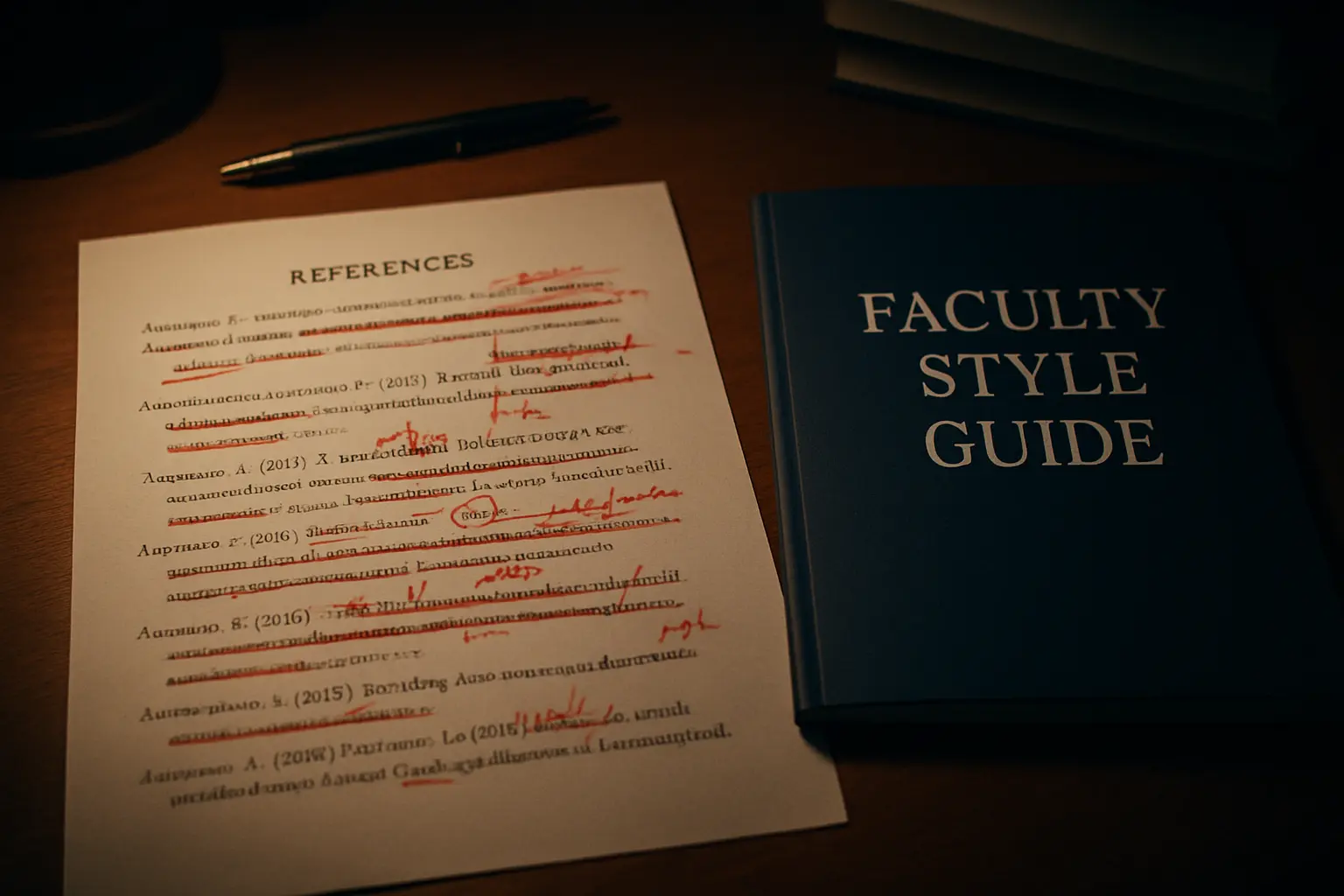
Your dissertation is written. The argument holds, the chapters are done — and then your supervisor returns the draft with one comment that undoes your evening: “References do not follow the faculty guide. Please correct throughout.” Fifty-plus entries, three different formats, in-text citations that do not match the list, and a submission date that has not moved. This is the single most common last-mile failure in South African dissertations, and the cost of leaving it is real: a dissertation sent back for corrections is a dissertation that has not been examined, and if the delay pushes you past the academic year, next year’s registration fees are yours to pay.
Fix your reference list with Tesify’s Automatic Bibliography →
Why your list does not match the guide — even though you were careful
Almost nobody types a wrong reference on purpose. The mismatch creeps in through four honest routes. First, “Harvard” is not one style: it is a family, and South African faculties publish their own variants — UCT, Wits and Stellenbosch each maintain their own guides, and the same journal article is punctuated differently under each; our Harvard vs APA comparison maps the terrain. Second, tools imported errors that formatting cannot fix: a reference manager faithfully reproduces whatever metadata it captured, so a wrong year from a repository PDF lands in your bibliography in perfect Harvard form. Third, the list and the text drifted apart: sources cut from chapters stayed in the list, sources added late never made it in. Fourth, you wrote across three years — and your own habits changed midway through, so your first chapter cites one way and your last another.
The audit: find every mismatch in one evening
Run these four passes in order; each catches a different failure class.
- The reconciliation pass. Read the in-text citations chapter by chapter, ticking each against the list. Anything cited but not listed gets added; anything listed but never cited gets removed (unless your faculty distinguishes a bibliography from a reference list — check which one your guide requires, because they are different objects).
- The entry-type pass. Group your entries: journal articles, books, chapters, theses, websites, datasets, legislation. Take your faculty guide’s example for each type and compare one of yours character by character — commas, italics, initials, the year’s position. Fix the first entry of each type, then propagate the pattern to its siblings.
- The metadata pass. For every entry that came from a repository PDF or an older source, verify the five load-bearing fields against the source itself: author spelling, year, title, journal or publisher, volume and pages. This is the pass that catches errors formatting can never see.
- The internal-consistency pass. Same author cited two ways? “Van der Merwe” and “van der Merwe”? “&” in one entry, “and” in another? Pick the guide’s rule and enforce it everywhere.
Or let the tool do the propagation
The audit above is honest work, but passes two and four are mechanical — exactly the kind of work software should carry. Tesify’s Automatic Bibliography builds the reference list from the sources actually cited in your draft, formatted in the style your faculty requires, so the reconciliation and formatting passes collapse into review rather than reconstruction. You stay responsible for the metadata — the tool formats what is true, you verify that it is true — which is precisely the division of labour every South African university’s academic integrity framework expects from writing tools. The worked example, the way your faculty guide shows it in Harvard:
Dlamini, S. 2023. Access to justice in rural KwaZulu-Natal. 2nd ed. Pretoria: Juta.
One entry like that is five minutes of checking. Fifty of them, hand-formatted twice — once wrong, once corrected — is the weekend you did not have. Start your project in Tesify and the list grows correctly as you cite, instead of becoming a rescue job at the end.
The submission-week protocol
If you are days from submission with a suspect list, triage in this order. Reconcile first — a cited-but-missing source is the error examiners flag hardest, because it looks like sloppy scholarship rather than sloppy punctuation. Then fix the entry types with the most members, usually journal articles, where one corrected pattern fixes the most entries. Then handle the exotic types — legislation, datasets, theses — one by one against the guide. Leave cosmetic italics disputes for last; they are the least likely to be noticed and the cheapest to fix in corrections if they are. And keep the final PDF’s list and text frozen together: the classic own-goal is regenerating the bibliography after the final proofread and submitting a list that no longer matches the text everyone signed off.
If the pressure behind the panic is really about time — the job, the family, the two hours a night that have to cover everything — the referencing fix is only part of the answer; our system for writing a dissertation while working full-time is the other part. And remember why the stakes are structural in South Africa: your examiners assess the document without you in the room, as our guide to external examination explains — a reference list that ignores the faculty guide is one of the few errors every examiner can see in thirty seconds, and first impressions in a written-only examination are made on exactly this kind of surface.
Prevention: the habit that makes the rescue unnecessary
Every submission-week bibliography crisis was preventable at capture time, and the preventing habit costs seconds. When a source enters your project, complete its record immediately — author, year, title, container, publisher, pages — while the source is open in front of you and checking takes one glance. When you cite it in text, cite from the record, not from memory; the “I’ll fix the year later” citation is the one that ships wrong. And once a month, run a five-minute mini-reconciliation on the chapter you just finished: citations against list, list against citations. A dissertation written this way arrives at submission week with a reference list that needs proofreading, not surgery — and the student who built it spends that week on the abstract and the acknowledgements instead of on fifty entries at midnight. The deeper payoff is psychological: examiners read a clean scholarly apparatus as a proxy for careful research, because in their experience the two travel together. You cannot buy that impression at the end; you accumulate it, one correctly captured source at a time — or you let the tooling accumulate it for you while you write.
Objections, answered honestly
What does Tesify cost in rand?
Pricing is listed on the Tesify site at sign-up, charged in your app store or card currency. Start free, see the current plans before paying anything, and treat any third-party site quoting a rand price as out of date — including this one, which is why we do not quote numbers here.
Will my university see AI-formatted references as misconduct?
Reference formatting is standard scholarly tooling — the same category as EndNote or Zotero, which university libraries themselves license and teach. South African AI policies target generative writing, and even there require disclosure rather than abstinence; formatting your own verified sources is not the activity those policies police. If in doubt, ask your supervisor — our guide to AI policies at South African universities shows what each institution actually says.
Is my dissertation safe if I upload it?
Your work stays your own — Tesify’s model is that everything submitted for your degree is written by you, and your project is not sold on or published. Under POPIA you retain rights over your personal information; check the privacy policy at sign-up for the specifics, the same diligence you would apply to any tool that touches your unpublished research.
My list is only slightly wrong. Is it worth fixing?
Yes, and cheaply — the entry-type pass on a nearly-right list takes an hour, not a weekend. “Slightly wrong throughout” reads to an examiner as carelessness applied consistently, which is a worse signal than one honest mistake.
FAQ
Which referencing style do South African universities use?
Most faculties use a Harvard variant; several disciplines — psychology among them — use APA. The governing document is always your own faculty’s guide, not a generic style site.
What is the difference between a reference list and a bibliography?
A reference list contains only sources cited in the text; a bibliography can include everything consulted. Faculties specify which they want — check before you prune.
Can Tesify format references it did not generate?
Yes — the bibliography is built from the sources cited in your project, whether you added them while drafting in Tesify or brought them in during the fix-up.
How do I cite South African legislation in Harvard?
By the act’s short title, number and year, following your faculty guide’s legislation example exactly — legislation formats vary more between guides than any other entry type, so this is the one to copy character for character.
Will fixing references change my similarity score?
Properly cited quotations remain visible matches, correctly attributed — which is what the human reading the report wants to see. See our similarity checker comparison for how those reports are actually read.
My supervisor and the faculty guide disagree. Who wins?
Raise it explicitly and get the answer in writing. Usually the faculty guide governs at examination, but your supervisor may know a discipline-specific exception — the dangerous option is silently picking one.