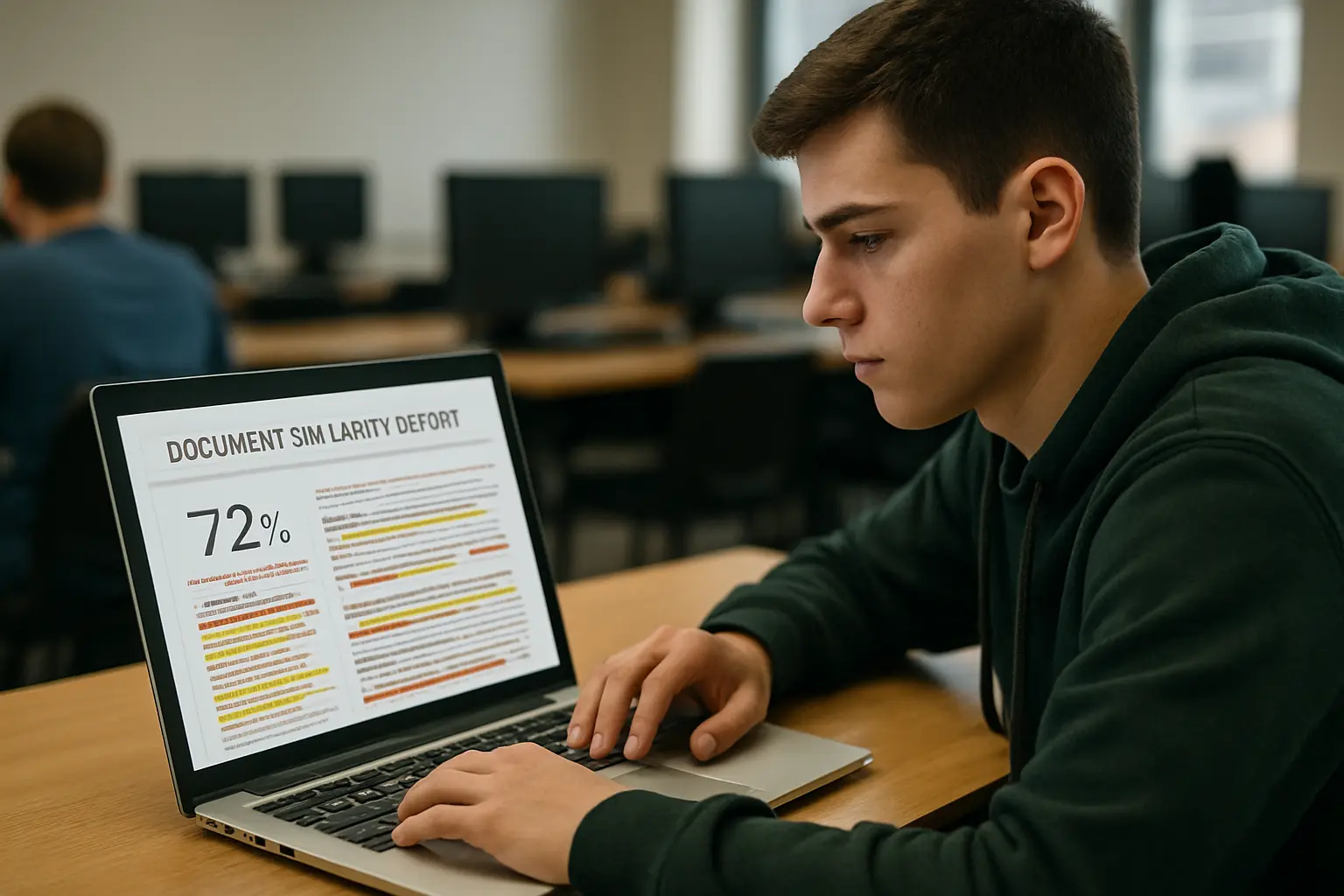
The comparison every South African postgraduate wants is “which checker gives the same score as my university’s Turnitin?” — and the honest answer is: none can, because no consumer tool sees what Turnitin sees. Here is the comparison that actually helps, built on what the tools’ own documentation says, with the framing that keeps you safe: a pre-check is for fixing your own citation habits before the faculty runs the real thing, not for beating it.
| Option | What it checks against (per its own documentation) | Cost to you | What it is for |
|---|---|---|---|
| Turnitin (via your university) | Student papers (global and institutional repositories), current and archived web pages, premium publisher articles — across 170 languages | Run by your institution, not sold to individuals | The actual examination-stage similarity report your faculty sees |
| Tesify Plagiarism Checker | Web and academic sources, integrated with your draft inside Tesify | Part of Tesify | Pre-submission self-check while you still have time to fix citations |
| Consumer checkers (Grammarly, QuillBot and similar) | Internet sources; Grammarly’s documentation also names ProQuest database content | Free tiers with limits; paid upgrades | Rough early-draft screening |
| Free web checkers (various) | Undisclosed, typically a web search layer | Free, often with paste-size limits and ads | Spot-checking a paragraph, at most |
What Turnitin says about itself — read this before you panic about a number
Turnitin’s own product documentation is unusually direct, and two of its sentences settle most student anxieties better than any explainer. First: Turnitin Similarity “is a tool to support the detection of plagiarism by flagging instances of text similarity that may constitute plagiarism; however, it does not determine whether plagiarism has occurred.” Second: the Similarity Report and its score exist “to equip educators with powerful insights to make their own, informed judgment call on whether a student’s content is plagiarized and if it was likely intentional or inadvertent and borne from a skill gap.”
Translation: there is no magic percentage that equals guilt or innocence. A properly quoted, properly cited dissertation can carry a meaningful similarity score; a ghost-written one can score near zero. The score is an input to a human academic judgement — at South African universities, usually your faculty’s — and the judgement looks at what matched, not just how much. Our companion article on AI policies at South African universities covers the adjacent question of AI detection, where UCT’s 2025 decision shows institutions themselves treat automated scores with caution.
Why a clean pre-check does not guarantee a clean Turnitin report
This is the section that saves students from a nasty surprise, and it comes straight from the repository descriptions. Turnitin compares your work against “an unparalleled repository of student papers, current and archived web pages, and premium subscription articles from top publishers across 170 languages”. The student-paper repository is the decisive difference: no consumer checker has it. If a previous student at any institution submitted work with passages resembling yours — a shared template, a recycled assignment, a “study pack” circulating on WhatsApp, a paid “model answer” that was also sold to someone else — Turnitin can match it. Your consumer pre-check, which sees only the open web, cannot.
Settings create a second gap: institutions can exclude templates (cover sheets, instructions, questions and tables) via Turnitin’s exclusion options, and can route submissions to institutional repositories — so the same document can produce different percentages under two departments’ configurations. A third gap: manipulation detection. Turnitin’s Flags Panel highlights “potentially manipulated text such as replaced or hidden characters” — white text, swapped characters and similar tricks. Aside from being misconduct in itself at every South African university, the manipulation route is specifically instrumented against.
The ranked shortlist for a pre-submission check
1. Tesify Plagiarism Checker — the integrated pre-check
Who it suits: students writing in Tesify who want the check where the fixing happens. The point of a pre-check is not the score; it is the list of passages you still need to quote, paraphrase properly or cite — and doing that inside the editor, with your reference list on hand, is the shortest path from “flagged” to “fixed”. Where it falls short: like every non-Turnitin tool, it cannot see student-paper repositories, so treat its result as a citation audit, not a prediction of your faculty’s report.
2. Grammarly’s checker — decent early-draft screening
Who it suits: students already paying for Grammarly. Its plagiarism checker compares against internet sources and, per its own documentation, ProQuest database content — real coverage that catches sloppy paraphrasing early. Where it falls short: the academic-database layer is not the same as publisher-subscription and student-paper repositories, and the checker sits behind the paid tier.
3. QuillBot and similar free checkers — spot checks only
Who it suits: a student who wants a quick second opinion on a chapter. Free tiers exist with word-count limits. Where it falls short: word limits make full-dissertation checks tedious, and coverage is the open web.
4. Anonymous free web checkers — use with real caution
Where they fall short: undisclosed coverage, aggressive upselling, and — the serious risk — some services retain or resell submitted text. Uploading your unpublished dissertation to an unknown service is a confidentiality risk no free check justifies. If a tool will not say what happens to your upload, do not upload.
The recommendation, stated plainly
Use your own university’s Turnitin access where it is offered to students — many South African institutions provide a draft-check route through the LMS — and use an integrated checker like Tesify’s for the fixing work between drafts. No consumer tool can replicate the faculty report, so stop shopping for score-parity and start using pre-checks for what they are: a disciplined way to find every quotation you forgot to cite while there is still time to fix it. Tesify pairs the checker with the bibliography tools, which is where most flagged passages actually get resolved — and if your flagged passages are referencing-format problems rather than missing citations, our Harvard vs APA guide sorts the style question first.
Similarity is not plagiarism — and plagiarism is not always similarity
The distinction is worth spelling out because both failure modes are common in South African postgraduate work. Similarity without plagiarism: your literature review is full of established terminology — standard scale items, statutory definitions, standard method descriptions — and each match is quoted or cited correctly. That similarity is the sound of scholarship working. Plagiarism without similarity: you read a colleague’s unpublished thesis, absorbed its argument structure, and reproduced the analysis in your own words without attribution. No checker on this page flags it, and it is still misconduct — attribution obligations attach to ideas, not just to strings of words. This is why every university’s integrity process runs on academic judgement rather than on a number, and why the sensible use of any checker is inward-facing: it audits your own citation discipline, it does not certify your ethics. If you internalise one sentence from this comparison, make it Turnitin’s own: the tool “does not determine whether plagiarism has occurred”. Neither does any competitor. People do.
How to run a pre-check that actually protects you
Run it at the right moment: after the full draft exists, before the language-polish pass. Read the matches, not the score — a 12% made of properly quoted definitions is healthy; a 4% containing one uncited paragraph from a journal article is a problem. Fix by category: missing quotation marks get quotation marks; close paraphrase gets rewritten from your own notes; missing citations get added to the text and the reference list together, so the two stay synchronised. Then run the final faculty check through the official route your department prescribes, and keep the report. The students who get into trouble at examination are rarely the ones with a high score; they are the ones who never read their matches.
FAQ
What similarity percentage is acceptable for a South African dissertation?
There is no national threshold, and Turnitin itself says the score does not determine whether plagiarism occurred. Faculties judge the matches in context. Ask your department whether it publishes guidance, and never treat a number as a pass mark.
Can any free checker give me my university’s Turnitin score?
No. Turnitin checks student-paper repositories and publisher content that consumer tools cannot access, and institutional settings change the score. Parity is technically impossible.
Is it safe to upload my dissertation to a free checker?
Only if the service clearly states what happens to your text. Retention or resale of uploads is a real risk with anonymous free tools — your unpublished dissertation is confidential work.
Does Turnitin detect paraphrasing?
It flags similarity, including close paraphrase that tracks a source’s wording. Deep paraphrase may not match — but undisclosed use of someone else’s ideas is still plagiarism under university policy, matched or not.
Will quotes count against me?
Quotes appear in similarity but are legitimate when marked and cited. Instructors can configure exclusions; the human reading the report distinguishes quotation from copying.
Can Turnitin see work my classmate submitted last year?
Turnitin describes a repository of student papers spanning global and institutional collections — that is precisely its distinguishing feature, and why recycled campus material is high-risk.
Does a 0% score prove my work is original?
No — it proves no matches were found in the checked sources. Judgement about originality and honest attribution remains human, which is Turnitin’s own stated position.
Does Tesify’s checker replace the faculty check?
No, and nothing does. It is a pre-submission audit that helps you fix citation problems early; the faculty’s own process produces the report that counts.