
If you are writing an honours research report, a master’s dissertation or a doctoral thesis, the most important sentence about NSFAS is one on its own website, and it is not the one most people expect. This article sets out what the two schemes actually say, in their own words, and flags the places where the official sources do not agree with each other.
Every figure and date below was read on a government page on 13 September 2026. Where something is not published, we say so rather than filling the gap.
The headline: NSFAS does not fund postgraduate study
The NSFAS Postgraduate Qualifications page states it directly:
“As of the 2021 academic year, NSFAS will no longer provide funding for postgraduate courses. This includes postgraduate certificates, postgraduate diplomas, honours degrees, masters and PhD degrees.”
Read the list carefully, because the item that surprises people is the first part: honours degrees are inside the exclusion. If you are writing an honours research report, you are in the excluded category, not the funded one.
The same page directs postgraduate applicants elsewhere: “Students seeking funding for postgraduate qualifications are encouraged to contact and apply through the National Research Foundation (NRF).”
That is the whole of the postgraduate position, and it has been stable for five academic years. Any bursary listing telling you to apply to NSFAS for a master’s is either out of date or not reading the scheme’s own page.
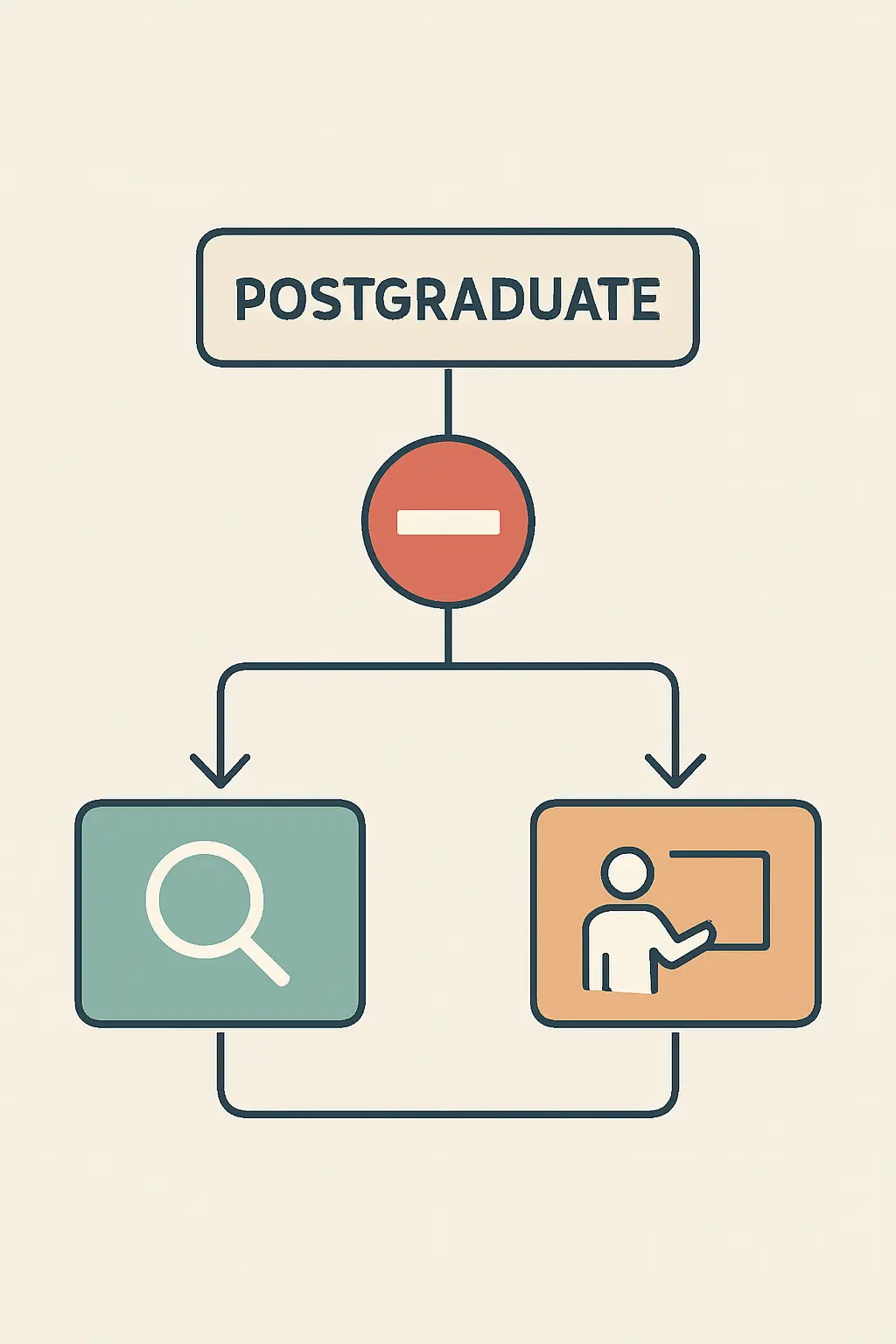
Because the NRF is where postgraduate applicants are sent, that is the application worth putting real effort into. Our step-by-step guide to applying for NRF postgraduate funding covers the thresholds, tiers and the NRF Connect process, and what NRF funding actually pays and who gets it covers the numbers.
What NSFAS does fund, and on what terms
NSFAS administers the DHET Bursary Scheme for undergraduate study at public universities and TVET colleges. Its own description of who qualifies:
- All South African citizens.
- All SASSA grant recipients qualify for funding.
- Applicants whose combined household income is not more than R350 000 per annum.
- Persons with a disability: combined household income must not be more than R600 000 per annum.
- Students who started studying before 2018 whose household income is not more than R122 000 per annum.
And who should not apply, in the scheme’s words: students who have completed a previous qualification; students with a combined household income of more than R350 000 per annum; and students who have already applied, qualified and received funding, who “are automatically funded for the duration of their studies provided they pass their modules”.
That first exclusion is worth pausing on if you are considering a second undergraduate degree: having completed a previous qualification is itself a bar.
The allowances, with the caveat the page carries
The bursary scheme page sets out allowance amounts, prefaced by its own qualification that the amounts “need to be aligned with the approved latest DHET guidelines”. The page is not dated and parts of its navigation are visibly legacy, so treat the table below as what the page states rather than as a confirmed 2026 schedule, and confirm current values with your institution’s financial aid office.
| Allowance (university) | As stated on the NSFAS bursary scheme page |
|---|---|
| Accommodation | As per the actual costs charged by the university; private accommodation must not exceed the cost of university residence |
| Transport (up to 40 km from institution) | R7 500 per annum |
| Living allowance | R15 000 per annum |
| Book allowance | R5 200 per annum |
| Incidental / personal care allowance | R2 900 per annum for students in catered residences |
| Allowance (TVET) | As stated on the NSFAS bursary scheme page |
|---|---|
| Accommodation, urban | R24 000 per annum |
| Accommodation, peri-urban | R18 900 per annum |
| Accommodation, rural | R15 750 per annum |
| Transport (up to 40 km from institution) | R7 350 per annum |
| Incidental / personal care allowance | R2 900 per annum |
Where the 2026 and 2027 cycles stand
NSFAS states that it has “officially closed applications for 2026 funding”, and that it began communicating application results through the myNSFAS portal from 15 December 2025.
For the following cycle, the position as published is: the 2027 national application cycle dates have not yet been released. NSFAS Notice 2 of 2026, issued 21 July 2026, moved the 2026 TVET Trimester 3 window forward to 14–23 August 2026 — explicitly withdrawing the previously communicated 3–14 September 2026 dates, and instructing colleges to remove them from every notice board, website and social channel — precisely so that Trimester 3 would not overlap the 2027 national cycle. That notice closes by saying the “2027 national cycle dates follow soon”.
So if you are looking for the 2027 opening date today, it does not yet exist as an official figure. Watch myNSFAS rather than a third-party bursary listing, several of which publish dates the scheme has not announced.
Funza Lushaka: the teaching route
Funza Lushaka is a separate bursary programme for initial teacher education, run by the Department of Basic Education in collaboration with the Department of Higher Education and Training and NSFAS. It is not means-tested in the NSFAS sense; it is tied to teaching in the public sector afterwards and to subjects the school system is short of.
The Department of Basic Education page lists what the bursary covers:
- Tuition fees
- Accommodation, or transport for those staying at home or with relatives
- Daily meals
- Learning materials
- A personal care allowance
- Teaching practice support
On who it is for, the department’s page points to subjects “needed by the education sector”, naming Mathematics, Science, Technology, Engineering and South African Indigenous languages among them, and publishes a Subject Priority Areas document alongside the application notes. The priority list is revised: in the department’s own words, “each year, the programme is refined to meet the ever-evolving needs of our education system”.
One hard eligibility rule is stated outright on the Funza Lushaka application portal: all first-time applicants must be 30 years or younger. That single line disqualifies a large share of the career-changing adults who consider this route, and it is worth checking before anything else.
Applications are made through the national e-Government portal at eservices.gov.za rather than on the bursary website itself: you register on the portal, select the Funza Lushaka Bursary Scheme from the e-Services menu, verify with a one-time PIN, accept the terms, and complete the application from the dashboard.
The 2026 dates, and a discrepancy worth knowing about
Both official pages agree that applications for the 2026 bursary opened on 7 October 2025 and that re-applications for existing or returning bursars closed on 30 November 2025.
They do not agree on the closing date for new applicants.
| Source | New-applicant closing date for 2026 |
|---|---|
| Funza Lushaka application portal (funzalushaka.doe.gov.za) | 1 February 2026 |
| Department of Basic Education (education.gov.za) | 24 January 2026 |
We are not going to pick one. Both are current government pages, read on the same day, and they differ by eight days. The practical lesson for the next cycle is to treat the earlier of any two published dates as your deadline and to confirm with the department directly — the Funza Lushaka enquiries address and the departmental switchboard are both published on the DBE page.
As with NSFAS, no 2027 Funza Lushaka cycle appears on either official page at the time of writing.
A quick orientation video
The University of the Free State publishes a short institutional explainer on how the NSFAS process works from a student’s side.
What we could not verify, and why we are saying so
Three things a reader might reasonably want that are not stated on the pages we read, and which we are therefore not asserting:
- Whether a Postgraduate Certificate in Education is fundable through Funza Lushaka. The programme is for initial teacher education, and the PGCE is a common route into teaching, but neither official page we read states the qualification routes explicitly. The Subject Priority Areas and application notes documents on the DBE page are the place to settle it for your intended qualification.
- Current 2026 NSFAS allowance values. The figures above appear on an undated page that itself defers to “the approved latest DHET guidelines”. We have reproduced them as published and labelled them as such rather than presenting them as a confirmed 2026 schedule.
- Any 2027 dates for either scheme. Not published as at 13 September 2026.
If you are already registered and the money is the problem
For a postgraduate student mid-dissertation, the funding question usually is not a new application but a deadline: another year of registration fees if you do not submit. That is a different problem from a bursary application, and it is the one our guides on writing a dissertation while working full-time and submitting for examination are built around. If you are still choosing where to register, the cost profile differs sharply between Unisa and a contact university.
Frequently asked questions
Can NSFAS fund my master’s dissertation?
No. NSFAS’s own page states that since the 2021 academic year it no longer funds postgraduate courses, and lists master’s degrees among them. It refers postgraduate applicants to the NRF.
Does NSFAS fund an honours degree?
No. Honours degrees are named in the excluded list alongside postgraduate certificates, postgraduate diplomas, master’s and PhD degrees.
What is the NSFAS household income threshold?
R350 000 per annum combined household income, or R600 000 for a person with a disability. SASSA grant recipients qualify.
Can I get NSFAS for a second qualification?
The scheme lists students who have completed a previous qualification under who should not apply.
Is there an age limit for Funza Lushaka?
Yes. The application portal states that all first-time applicants must be 30 years or younger.
What does Funza Lushaka pay for?
Tuition, accommodation or transport where you live at home, daily meals, learning materials, a personal care allowance and teaching practice support, as listed by the Department of Basic Education.
When do Funza Lushaka applications open?
For the 2026 cycle they opened on 7 October 2025. The 2027 cycle is not published on either official page at the time of writing.
Why do two government pages give different Funza Lushaka closing dates?
We do not know, and we are not going to guess. The portal says 1 February 2026 and the department says 24 January 2026 for new applicants. Work to the earlier date and confirm with the department.
Where do I actually apply for Funza Lushaka?
On the national e-Government portal at eservices.gov.za, selecting the Funza Lushaka Bursary Scheme from the e-Services menu after registering.
How should I cite these figures in my dissertation?
As government publications, with the body as author and the date you accessed the page, because these pages change. The mechanics are in our guide to citing South African official sources.
Funding pressure is usually deadline pressure
For most postgraduates the money problem is really a time problem: every month the dissertation is not finished is another month of fees. Tesify helps you draft and structure faster so the submission date moves closer, with the work staying 100% written by you.