
JSE-listed companies generally publish their integrated annual reports free on their own investor relations pages — an under-used data source in South African accounting dissertations, because students searching for “accounting data South Africa” often land on a paid financial-data terminal before they realise many of the primary documents themselves are already public. Eight sources for a South African accounting dissertation, compared on custodian, update cycle and access.
| Source | What it provides | Custodian | Update cycle | Access |
|---|---|---|---|---|
| JSE company disclosures & SENS | Listed-company announcements, results, integrated annual reports | Johannesburg Stock Exchange | Real-time (SENS), annual (reports) | Free |
| Company investor relations pages | Integrated annual reports, usually with an archive of several years (varies by company) | Individual listed companies | Annual | Free |
| IRESS and similar financial-data terminals | Consolidated financial data, historical ratios, screening | Commercial data providers | Continuous | Subscription; check university library access first |
| SARS tax statistics | Aggregate tax collection, taxpayer and revenue data by year | South African Revenue Service | Annual | Free |
| SAICA | Professional standards, member surveys, CA(SA) profession data | South African Institute of Chartered Accountants | Ongoing | Free (some member-only content) |
| CIPC | Company registration, annual returns, director data | Companies and Intellectual Property Commission | Continuous | Free basic search; paid detailed reports |
| IRBA inspection reports | Audit firm inspection findings and public-interest reports | Independent Regulatory Board for Auditors | Periodic | Free |
| National Treasury | Public-sector financial statements, budget review documents | National Treasury | Annual (budget cycle) | Free |
Why company investor relations pages beat a paid terminal for most dissertations
A paid financial-data terminal earns its cost when you need standardised, machine-readable data across hundreds of companies at once — a large-sample disclosure-index study, for instance. But many South African accounting honours and master’s dissertations study a smaller, purposively selected sample of companies, and for that scale, each company’s own investor relations page gives you the integrated annual report — often with several years of archived reports — at no cost, with more narrative and governance detail than a data terminal’s standardised fields capture.

How do I build a disclosure index from annual reports systematically?
A disclosure-index study — scoring how many of a checklist of items each company discloses — is a common design in South African accounting dissertations, and it depends entirely on a consistent extraction process. Build your checklist from a named framework (King IV principles, IFRS disclosure requirements, or a prior published index you are replicating) before you open a single annual report, not while reading one, since checklist items invented mid-read tend to fit the first company’s report better than the rest of your sample. Score each item as present or absent using a documented decision rule — a passing mention does not count the same as a dedicated disclosure — and pilot the checklist on two or three reports before scoring your full sample, exactly as a questionnaire would be piloted, to catch ambiguous items early.
What does scoring a single disclosure item actually look like, end to end?
The step most disclosure-index guides skip is what the scoring decision itself looks like on the page. Take one illustrative King IV item: “the company discloses whether an external assurance provider reviewed its sustainability report.” A defensible scoring protocol states, in advance, three things: (1) where in the report to look — typically the sustainability or ESG section and the assurance statement near the auditor’s report, not the whole document searched at random; (2) what counts as a “yes” — a named external assurance provider and a described scope of assurance (limited or reasonable), not a general sentence such as “we are committed to transparent reporting”; (3) what to do when the answer is ambiguous — for example, a report that mentions an assurance provider by name but does not state the scope is scored as a partial disclosure (0.5) rather than forced into a binary the checklist did not anticipate, provided your scoring protocol defines a partial-score category in advance rather than inventing one mid-sample. Writing this three-part protocol down before scoring your first company, and keeping a short note in your data file explaining any item you had to judge, is what lets a second coder (or your supervisor, spot-checking a handful of your scores) reproduce your decision rather than simply trust it.
What does SENS add that an annual report does not?
The JSE’s Stock Exchange News Service (SENS) carries every material announcement a listed company makes between annual reports — profit warnings, director dealings, corporate actions, restatements. For an event-study design (measuring how a share price responds to a specific disclosure), SENS is the primary source for the event date itself, which an annual report alone cannot give you with the same precision.
When does a dissertation need a financial-data terminal specifically?
Large-sample studies — testing a disclosure or governance relationship across the whole JSE-listed population, or a specific sector, over several years — need the standardised, bulk-extractable data a terminal provides, since manually collecting the same fields from a hundred separate annual reports is not a realistic use of a dissertation timeline. Many South African university business schools and commerce faculties hold a financial-data terminal subscription such as IRESS; check with your library before assuming you need to source one independently.
What does SARS data add for a tax-focused dissertation?
SARS publishes annual tax statistics covering aggregate revenue collection, taxpayer numbers and compliance data by tax type and, in some releases, by province or income band. This is aggregate, not company-level, data — useful for a dissertation examining tax policy effects, compliance trends or revenue composition, but not a substitute for company-level financial statement data where your research question is about a specific firm’s tax position.
What does CIPC add beyond what a listed company already discloses?
CIPC data matters most for dissertations studying private or unlisted companies, where no JSE disclosure obligation applies — company registration status, director appointments and basic annual return data are searchable, though detailed financial information for private companies is far more limited than for listed ones and often requires the company’s direct cooperation to access beyond the basic public record.
What do IRBA reports add for an audit-focused dissertation?
The Independent Regulatory Board for Auditors publishes inspection findings on registered audit firms and periodic public-interest reports on audit quality trends. For a dissertation examining audit quality, regulatory compliance or the effectiveness of South Africa’s audit oversight regime, IRBA’s own reports are a primary source most generic guides skip in favour of the more commonly cited IFAC or PCAOB international literature — worth checking specifically because it is the South African regulator’s own assessment of the local profession, not an international proxy for it.
What does National Treasury add for a public-sector accounting dissertation?
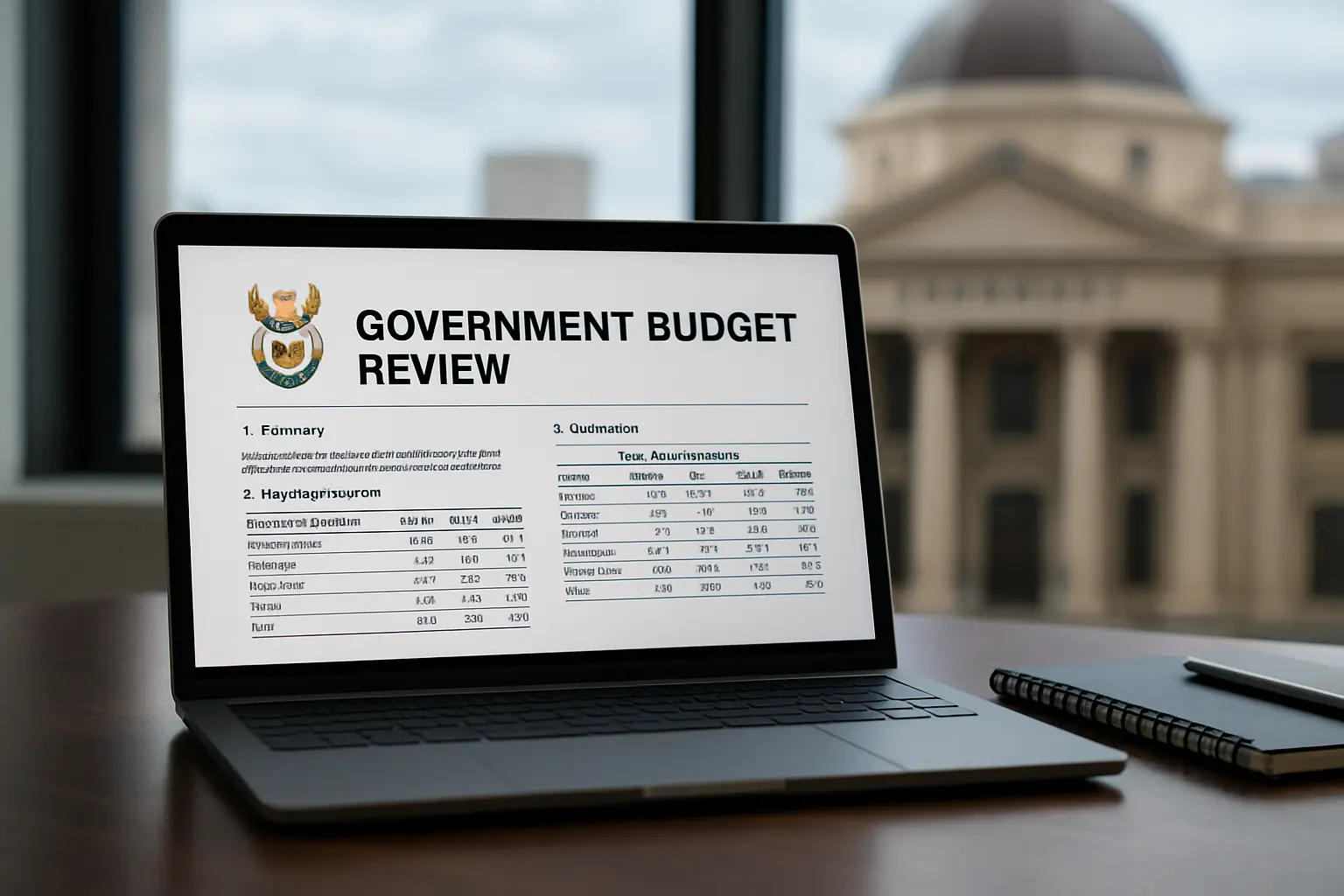
Where your dissertation examines public-sector financial management — municipal or departmental financial statements, budget execution, PFMA or MFMA compliance — National Treasury publishes the budget review and in-year monitoring reports, while the Auditor-General’s consolidated PFMA and MFMA reports set out audit outcomes across national and provincial departments and municipalities. This is the primary source layer generic private-sector accounting guides never mention, since public-sector accounting operates under a different reporting framework (modified cash or accrual basis depending on the entity) than IFRS-based private-sector reporting.
What does a data-sourcing paragraph look like in a methodology chapter, annotated?
Excerpt. “The sample comprised [n] JSE-listed companies in the [sector] sector, selected purposively from the JSE’s sector classification list as at [date]. Integrated annual reports for the [year range] financial years were downloaded from each company’s investor relations page between [dates]. Where a report was unavailable on the company’s own site, the JSE’s SENS archive was used as a secondary source. Disclosure was scored against a checklist adapted from [named framework/prior study], piloted on three reports before full-sample scoring.”
Annotation. This paragraph makes explicit what a vaguer version often leaves implicit: the exact sample frame and selection date, the collection window, a stated fallback when a primary source was unavailable, and the checklist’s origin and pilot step — each one a specific thing an examiner can check, rather than a general claim about where the data “came from.”
How does this compare to the statistical-methods piece already on this site?
The site’s existing accounting analysis methods comparison covers which analytical approach fits which accounting research design — content analysis, regression, event study, panel data, practitioner survey. This page answers the earlier question those methods all depend on: where the data behind any of those analyses actually comes from. A disclosure-index content analysis needs the annual reports themselves; an event study needs SENS announcement dates; a panel regression across many firms needs a terminal’s bulk extraction. Forty accounting and CA(SA) topic ideas, each already tied to a workable data source, sit in 40 accounting and CA(SA) research report topics.
A worked example: matching a research question to a source
Three illustrative accounting research questions and where each would most plausibly start its data search: a study measuring the extent of King IV governance disclosure across a sample of 30 JSE-listed retail companies starts at each company’s investor relations page, since 30 annual reports is a manageable manual read; a study testing whether earnings announcements move share prices across the full JSE-listed population over five years starts at SENS for announcement dates and a financial-data terminal for share-price data, since both need standardised, bulk extraction; a study of small and medium practitioners’ audit-quality perceptions starts at SAICA for professional context and a primary survey the student designs, since no existing dataset captures practitioner perception directly.
What if a company in my sample changes its financial year-end mid-study?
A less obvious data-collection snag: a JSE-listed company occasionally changes its financial year-end (to align with a new parent company after an acquisition, for instance), which produces a “stub period” annual report covering fewer or more than twelve months. Including this stub-period report in a disclosure-index or panel-data sample without adjustment distorts any metric calculated on an annual basis (revenue growth, disclosure count normalised by report length). Two defensible options exist: exclude the stub-period year from the sample and note the exclusion explicitly in your methodology chapter, or annualise the affected figures and state the adjustment formula used. Either is acceptable; silently treating a seven-month stub report as if it were a full year is not, and is exactly the kind of data-integrity issue a committee checks for when a sample includes companies that have undergone corporate restructuring during the study period.
Frequently asked questions
Do I need permission to use a listed company’s annual report as dissertation data?
No separate permission is typically needed to analyse a publicly disclosed annual report for academic research, since it is already public information, but cite the source and reporting period precisely in your methodology chapter.
How far back do most companies’ investor relations archives go?
This varies by company; established JSE-listed companies often keep several years of archived annual reports online, but check each company’s specific archive before assuming a longer historical sample is available.
Is a financial-data terminal such as IRESS free for students?
Not directly, but many South African university business schools and commerce faculties hold an institutional subscription — check with your library or your accounting department before assuming you must pay personally.
Can I use SARS aggregate data to make claims about individual taxpayers?
No — SARS published statistics are aggregated specifically to prevent identification of individual taxpayers, and using them to infer individual-level behaviour would be a methodological error as well as a misuse of the data’s intended scope.
What if a company I want to study delisted or was acquired during my study period?
Historical filings usually remain accessible through the JSE’s own historical SENS archive or the company’s successor entity where one exists; state clearly in your methodology how you handled any resulting gap in your sample.
Does CIPC data include private company financial statements?
Only limited information for most private companies — full financial statement detail for a private company generally requires the company’s direct cooperation, unlike a JSE-listed company’s disclosure obligations.
How do I cite a company’s integrated annual report in Harvard style?
Company name (year) followed by the report title, place of publication if stated, and the URL where you accessed it — treat it as a corporate author publication, consistent with the site’s general Harvard referencing guidance.
What is the difference between PFMA and MFMA data, and which applies to my study?
The Public Finance Management Act governs national and provincial departments and public entities; the Municipal Finance Management Act governs local government. A dissertation studying a specific municipality needs MFMA-framework data and the Auditor-General’s municipal audit outcomes specifically, not the PFMA reporting a national department would produce.
How many companies should a manual disclosure-index study sample?
There is no universal number: it should be large enough for the statistical comparison you plan and small enough to score by hand within a realistic timeline. Agree the specific number with your supervisor against your available time and your chosen statistical test’s sample-size needs.
Should I mention which data source I used in my dissertation title?
No — the title names your research question and field; the specific data source and its access details belong in the methodology chapter, not the title. Tesify can help you document your chosen data sources correctly once you have selected them.