
Thematic analysis is the method most South African master’s students actually use for interview data, and it is also the one most often done badly — because it looks simple. You read, you highlight, you group. The gap between that and a defensible analysis chapter is a documented procedure, and the standard procedure is a six-phase method. This guide works through all six for a South African dissertation, with the expected output stated at each phase and the local questions — multilingual data, transcription, privacy law — that generic guides skip.
How to do thematic analysis, step by step
Phase 1: Familiarise yourself with the data
Transcribe your own interviews if you possibly can, or read every transcript at least twice against the audio if someone else transcribed them. This is not a formality — familiarisation is where you begin to notice what is actually being said rather than what you expected to hear, and it is why outsourcing transcription without listening back is a false economy. Keep a running document of first impressions as you go: striking phrases, contradictions, things that surprised you.
Expected output: complete, checked transcripts, plus two or three pages of familiarisation notes dated before you started coding.
Phase 2: Generate initial codes
Work systematically through every transcript, attaching a short label to each segment that says something relevant to your research question. Code at the level of meaning, not topic: “resents being asked to justify the delay” is a code, “delays” is a filing label. Code generously in this phase — it is far easier to collapse forty codes later than to discover in month three that you never marked the thing that turned out to matter. Give equal attention to every transcript, including the ones you found boring, and code contradictory material rather than smoothing it away.
Expected output: a coded dataset and a code list with a one-line definition for each code and an example extract.
Phase 3: Search for themes
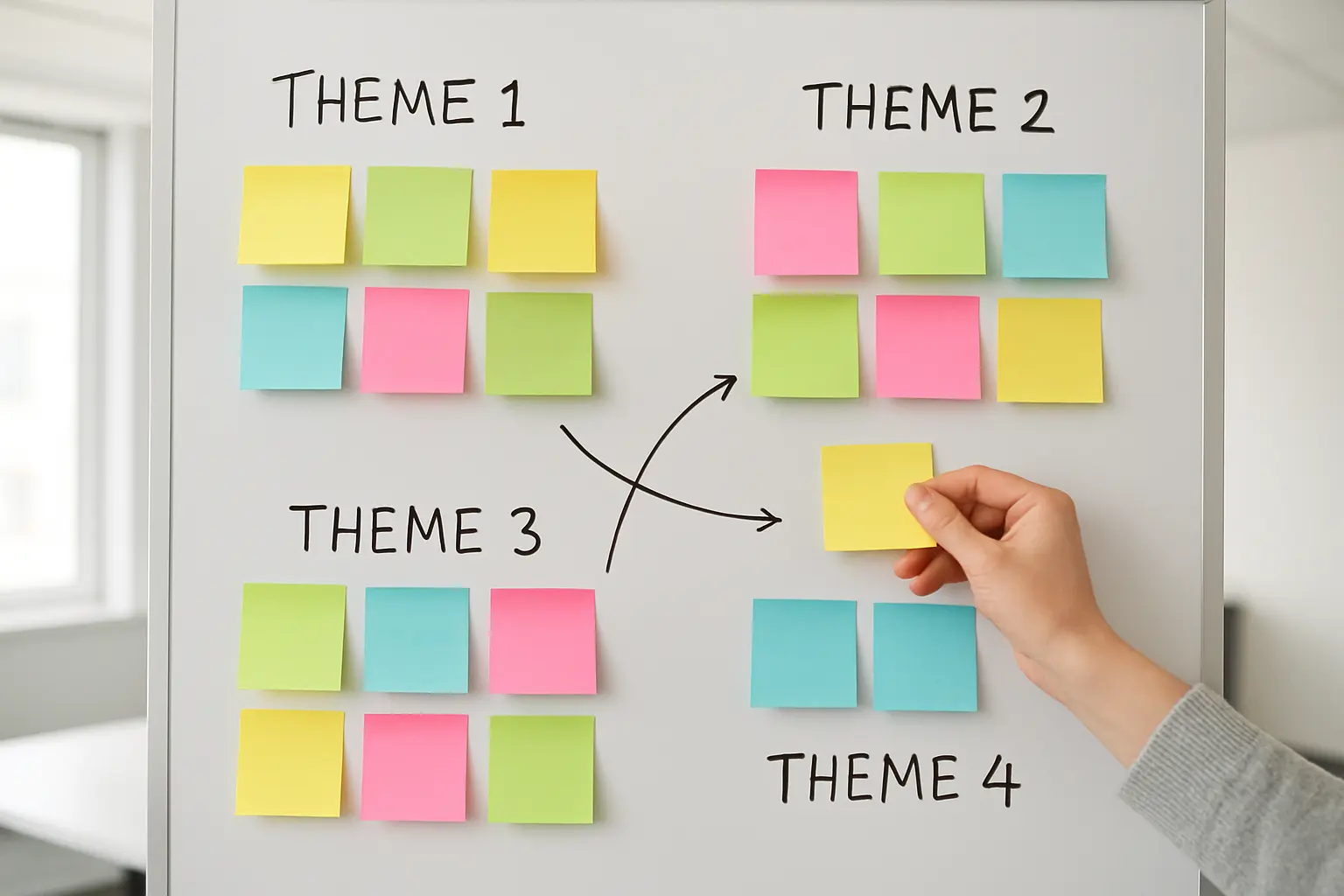
Now group codes into candidate themes. A theme is not a bucket of related codes; it is a pattern of shared meaning organised around a central idea. The test is whether you can state, in one sentence, what the theme argues — “participants treated supervision as a relationship they had to manage upwards” is a theme, “supervision” is a topic. This is the phase where sticky notes on a wall genuinely outperform software, because you need to move things around physically and see the shape.
Expected output: a set of candidate themes with their constituent codes, and a leftover pile you have not forced into anything.
Phase 4: Review the themes
Test each candidate theme twice. First against its own extracts: do they actually cohere, or have you assembled things that merely share a word? Second against the whole dataset: does this theme hold up across the corpus, and have you missed material that belongs to it? Themes will collapse, split and merge at this phase, and that is the phase working correctly. Expect to lose at least one theme you were attached to.
Expected output: a stable thematic map, and a written note of what changed and why — that note becomes part of your audit trail.
Phase 5: Define and name the themes
Write a short definition for each final theme: what it captures, what it excludes, and how it relates to your research question. If a definition takes a paragraph and several “and also” clauses, the theme is probably two themes. Names should be informative rather than clever — an examiner scanning your contents page should understand what each theme is about without reading the chapter.
Expected output: a final set of named, defined themes, typically a small number rather than a long list.
Phase 6: Produce the report
Write the analysis chapter theme by theme. Each section makes an analytic claim, supports it with selected extracts, and interprets them — the extracts are evidence for your argument, not the argument itself. A chapter that is 70% block quotations with a linking sentence between them is the commonest failure in South African qualitative dissertations, and examiners name it explicitly. Attribute every extract to a pseudonymised participant identifier, and keep the quotations short enough to read.
Expected output: a drafted analysis chapter in which every theme section ends with what that theme means for your research question.
How should you handle transcription?
Decide and state your convention before you start. For most thematic analysis, an intelligent verbatim transcript — every word, but without stammers and filler noises — is appropriate; conversation analysis needs far more detail, and a summary transcript is not adequate for any analysis you intend to quote from. Whatever you choose, be consistent, and note in your methodology what you did with pauses, laughter, overlapping speech and inaudible passages.
Number the lines. It costs nothing and it makes every later step easier — you can cite “P4, lines 122–128” in your coding notes, and your supervisor can find exactly what you meant.
What do you do when your interviews were not in English?
This is the South African question that international method guides simply do not address, and getting it wrong is visible to any examiner. In a country with twelve official languages, a great deal of postgraduate fieldwork is conducted in isiZulu, isiXhosa, Afrikaans, Sesotho or Setswana and written up in English. Three decisions must be made explicitly and recorded in your methodology chapter.
- What language you coded in. Coding in the language of the interview and translating only the extracts you quote preserves meaning far better than translating everything first, and it is the stronger methodological choice where you are fluent.
- Who translated, and with what checks. Name the translator’s competence, and say whether any back-translation or second-reader check was done on quoted material.
- How you present quotations. The defensible convention is to give the original alongside the English translation for quoted extracts, so a reader who speaks the language can evaluate your rendering.
Concepts that do not map cleanly between languages are not a problem to hide — they are frequently the most interesting finding in the chapter. Say so, and keep the original term.

Do you need a second coder or an inter-rater reliability score?
It depends on your stated approach, and this is more contested than most students realise. Where thematic analysis is framed as a coding-reliability method, a second coder and an agreement statistic such as Cohen’s kappa are appropriate. Where it is framed as reflexive thematic analysis — the version most commonly cited in South African dissertations — the method’s own authors have argued that the researcher’s interpretation is a resource rather than a source of bias, and that consensus coding and reliability coefficients sit awkwardly with its assumptions.
The safe path is not to pick a side blind. Read what your supervisor and your department expect, state which version you are doing, and use the quality practices that match it: for reflexive work, that means a reflexivity statement, an audit trail of how themes developed, supervisor review of coding, and enough extracts for a reader to judge your interpretation. Do not claim to be doing reflexive thematic analysis and then report a kappa as though it validated the themes.
What are your obligations for participant data?
Recordings and transcripts are personal information, and often special personal information where health, beliefs or trade-union membership come up. Your ethics approval sets the conditions — how the data is stored, who may access it, how long you keep it and when it is destroyed — and those conditions are binding rather than aspirational. Pseudonymise at transcription, keep the linking key separate from the transcripts, and do not put raw transcripts into any online tool that your clearance does not cover. Our guide to ethics clearance at a South African university covers what the committee checks and how the privacy requirements are applied.
One practical trap: an identifier can be a description as easily as a name. “The only male principal at a school in the district” is not anonymous, however carefully you removed the name. Read your extracts for that before submission.
How many themes should you have, and how many participants?
Themes: enough to represent the data, few enough to hold an argument together — a small handful is usual for a master’s dissertation, and a chapter with a dozen themes almost always has topics rather than themes. Participants: determined by your sampling logic and the depth of your data rather than by a target number, which our guide to sample size for a dissertation works through, including why “saturation was reached” needs demonstrating rather than asserting.
How do you cite the method?
You must cite the methodological source you followed, and cite it properly — an examiner checks this reference specifically. The worked Harvard example for the foundational journal article:
Braun, V. & Clarke, V. 2006. Using thematic analysis in psychology. Qualitative Research in Psychology, 3(2):77–101.
Check the exact punctuation, ampersand and italics against your own faculty guide — UCT, Wits and Stellenbosch each publish a different Harvard variant, and our Harvard vs APA comparison explains how to identify which one governs you. If you followed the authors’ later reflexive formulation rather than the 2006 six-phase paper, cite that work instead of or alongside it; citing the 2006 paper while describing a different procedure is a mismatch supervisors notice.
Should you use software?
For a master’s dissertation with fifteen or twenty interviews, careful manual coding in a word processor or spreadsheet is entirely defensible and many South African students do exactly that. Dedicated qualitative software earns its place on larger projects, on team projects, and where you want a retrievable audit trail of every coding decision — several South African universities provide a package free through a site licence, which changes the cost calculation considerably.
Whatever you use, the writing is the part that takes longest, and it is the part Tesify is built to hold — your theme definitions, chapter structure and sources in one project, so the analysis chapter grows as the themes settle instead of being written from scratch in the last fortnight. Keep the interpretation yours: it is the thing being examined, and the rules on disclosing tool use are set out in our guide to AI policies at South African universities.
FAQ
What is the difference between thematic analysis and content analysis?
Content analysis typically counts the occurrence of predetermined categories and can report frequencies; thematic analysis identifies patterns of meaning and interprets them, and does not depend on counting. Choose the one that answers your question and describe it accurately.
Is thematic analysis the same as grounded theory?
No. Grounded theory is a full methodology aimed at generating theory, with its own sampling and analytic procedures. Thematic analysis is a method for identifying patterns that can sit within various theoretical positions.
How many themes should a master’s dissertation have?
Usually a small number — commonly three to six for a focused study. A long list normally means you have produced topic summaries rather than themes with a central organising idea.
Can I count how many participants mentioned a theme?
You can indicate prevalence in general terms, and many South African dissertations do. Be careful not to imply statistical generalisation from a small purposive sample, and never let a count substitute for interpretation.
Do I need a second coder?
It depends on which version of thematic analysis you are doing. Coding-reliability approaches use one; reflexive thematic analysis does not require one and its authors argue against treating agreement statistics as validation. State your approach and match your quality practices to it.
Can I use AI to code my transcripts?
Only within your university’s disclosed-use rules, and never by uploading raw participant data to a tool your ethics clearance does not cover. The interpretive work is what is being examined, so anything you cannot explain and defend should not be in the chapter.
How long should my analysis chapter be?
Long enough to present each theme with sufficient evidence and interpretation. Your faculty guidelines and two recently passed dissertations in your own department are a far better benchmark than any general figure.
What if my themes just restate my interview questions?
That is the classic sign of coding at topic level. Go back to the extracts and ask what participants were doing or meaning within each topic — the theme is the pattern of meaning underneath, not the question that prompted it.
Do I present themes in the results chapter or the discussion?
Conventions differ by faculty. Many qualitative dissertations combine findings and discussion into one chapter organised by theme; others separate them. Check your faculty guide and recent passed dissertations in your department, and be consistent.