
Key finding: no single South African dataset publishes a definitive count of small and medium enterprises — Stats SA’s Quarterly Labour Force Survey (QLFS) measures informal and formal employment, not SME registration directly, and CIPC’s company register counts registered entities without classifying them by size. An MBA dissertation studying SMEs has to name exactly which proxy it used and why, not cite a single clean national SME count that does not exist in one place.
| Data proxy | Custodian | What it actually measures | What it does NOT measure | Update cycle |
|---|---|---|---|---|
| Quarterly Labour Force Survey | Stats SA | Employment status, informal-sector and own-account work, by individual respondent | A count of SME entities or their size classification | Quarterly |
| Company register | CIPC | Registered company existence, registration date, director data | Employee count, turnover or SME size category | Continuous |
| National Small Enterprise Act 102 of 1996 | Department of Small Business Development | The legal definitions and the schedule of size categories | Any live count of businesses meeting those thresholds | Amended, most recently by Act 21 of 2024; confirm the current schedule |
What does South Africa’s own small-enterprise legislation actually define as an SME?
The National Small Enterprise Act 102 of 1996 (previously titled the National Small Business Act) is the statute that established the national framework for supporting small business in South Africa, and it is the Act an MBA dissertation studying SMEs should cite for the legal basis of the size category itself, rather than an informal or borrowed international definition. The government’s page for the Act lists amendments in 2003 and 2004 and, most recently, the National Small Enterprise Amendment Act 21 of 2024. The size thresholds sit in the Act’s schedule, which has been revised since 1996 and differs by sector, so confirm the current, department-published schedule directly from the Department of Small Business Development or the Government Gazette before stating a specific numeric threshold in your dissertation, and cite the gazette date of the schedule you used.
Where does employment and informal-sector data on SMEs actually come from?
Stats SA’s Quarterly Labour Force Survey, already the standard South African source for employment data more broadly (covered in the site’s guide to economics dissertation data sources), is also the closest proxy South Africa has for informal-sector and self-employment activity, since it asks respondents directly about their employment status, including informal-sector and own-account work. It does not itself classify a business as small, medium or micro by the Act’s own size categories — it measures the people working in a sector, not the registered entities themselves. A dissertation using QLFS data to characterise the SME sector’s employment contribution should state this distinction explicitly: the QLFS measures people and their employment status, not a count of SME entities.
Where does company-level SME data come from?
The Companies and Intellectual Property Commission (CIPC), already covered as a data source for accounting research in the site’s guide to accounting dissertation data sources, holds the national register of company registrations, annual returns and director data. CIPC’s register does not itself tag a company as small, medium or micro — that classification would need to be derived by the researcher, typically from a company’s own disclosed employee count or turnover where available, cross-referenced against the National Small Enterprise Act’s current schedule. This makes CIPC useful for confirming a specific company’s existence, registration date and formal status as part of a purposively selected sample, rather than for a bulk national SME count.

What designs actually work for an MBA dissertation on SMEs?
Three designs recur in South African MBA research on SMEs: a survey of a purposively or conveniently sampled group of SME owners or managers (access to finance, growth barriers, digital adoption, succession planning); a case-study design following one or a small number of SMEs in depth, often within a specific sector or municipal area; and a secondary-data design using CIPC registration data or a sector association’s own membership list as the sampling frame, then surveying or interviewing a subset. Given that no single national SME register with contact details exists publicly, access is usually the binding constraint on an MBA SME study’s design — state in your methodology chapter exactly how your sample was identified and reached, since “SME owners were surveyed” without a stated access route is one of the first things an examiner will ask about.
What ethics and access considerations are specific to SME research?
Unlike a large listed company, an SME owner is often both the gatekeeper and the primary data source, which simplifies access in one sense (one conversation can secure both permission and participation) but raises a different confidentiality concern: in a small business, a specific financial or operational detail can be more identifiable and commercially sensitive than the same detail would be inside a large organisation with many stakeholders. State clearly in your consent process what will and will not be reported at the level of an individually identifiable business, and consider whether aggregating findings across your sample (rather than presenting individual case detail) is necessary to protect a participating business’s competitive position, particularly where your sample is small enough that a specific finding could be traced back to one company.
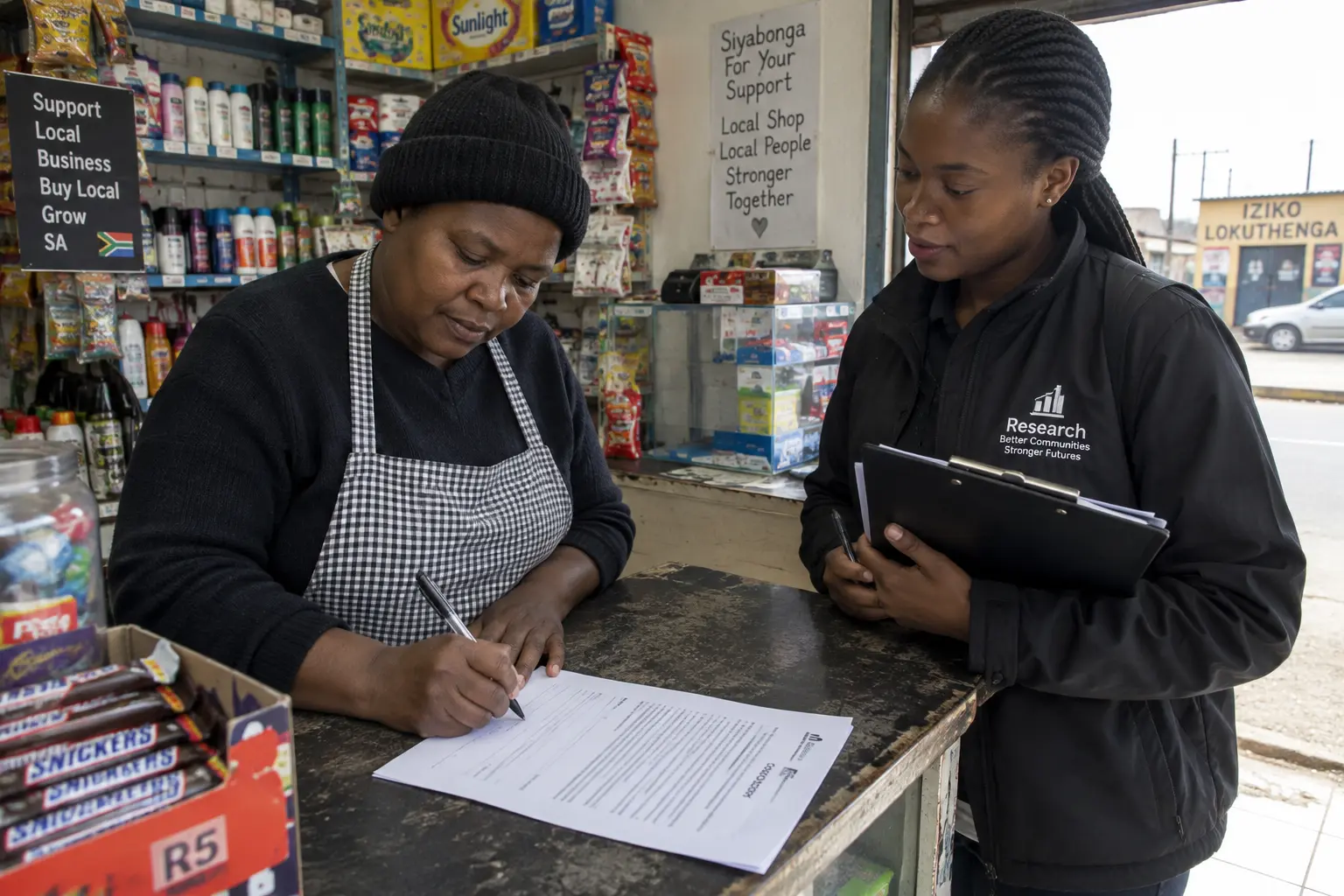
A related access complication specific to SME research: unlike a large organisation with a formal HR or research-liaison function, an SME’s owner is frequently the sole point of contact for both organisational permission and personal participation, and there is often no separation between the business’s institutional interests and the individual’s own. Where the owner is also your intended participant, name this dual role explicitly in your methodology chapter — the same insider-position transparency principle that applies whenever a researcher’s access route and their data source are the same person, rather than two independently consenting parties.
What does a worked population-and-data-source paragraph look like?
Illustrative example, not a real study. “The study population was small and medium enterprises operating in the manufacturing sector within a single metropolitan municipality, defined per the National Small Enterprise Act’s current schedule of size thresholds for manufacturing, as published by the Department of Small Business Development in the Government Gazette. As no single public register lists SMEs by this classification, the sampling frame was built from a regional manufacturers’ association’s membership list, cross-referenced against CIPC’s public register to confirm each business’s current registration status before contact. Of 40 businesses on the association’s list, 25 confirmed active CIPC registration and were invited to participate; 18 completed the survey, a response rate of 72% of the eligible frame.” Every named detail and figure here is illustrative, built to show the shape of a defensible population-and-sampling paragraph — naming the classification source, the access route, and the frame-to-response arithmetic an examiner can check.
How does an SME classification compare across different frameworks a dissertation might cite?
Where a dissertation’s literature review draws on international SME research (World Bank, OECD or a specific country’s own definition), state plainly that these frameworks use different thresholds from the South African National Small Enterprise Act, and that a finding built on an international definition does not automatically transfer to a South African-classified sample without adjustment. A common avoidable error is citing an international study’s SME findings as if they described the same population a South African-classified sample would produce, when the underlying size thresholds differ between countries and, within South Africa, between the sectors the Act’s schedule treats separately.
How is this different from the site’s existing MBA content?
The site’s guides to theoretical frameworks for an MBA research report and a complete MBA research report example cover framework choice and overall report structure generically across MBA topics. This piece is scoped specifically to SMEs as the population — where the data genuinely comes from, what it can and cannot tell you, and the access and confidentiality considerations that differ from an MBA study built around a large JSE-listed company instead.
Building an SME chapter that names its data sources precisely
Stating exactly which proxy dataset your SME research draws on, and being explicit about what it does and does not measure, is exactly the kind of precise, source-by-source writing Tesify helps with — drafting your population and data section once you have identified your access route, while every judgement about your sample and your findings stays yours and the dissertation stays 100% written by you. Draft your MBA data and methods section with Tesify.
Frequently asked questions
Is there a single national list of registered SMEs I can use as a sampling frame?
No single public list classifies CIPC-registered companies by SME size category; a sampling frame typically has to be built from a sector association’s membership list, a municipal business register, or a purposively identified group, since no ready-made national SME contact list exists.
What size thresholds define a micro, small or medium enterprise in South Africa?
The National Small Enterprise Act 102 of 1996 sets the legal framework and the schedule for this classification; confirm the current, department-published schedule directly from the Department of Small Business Development or the Government Gazette before citing a specific figure, since the schedule has been revised since the Act’s original enactment and the Act itself was most recently amended in 2024.
Can I use QLFS data to claim a specific number of SMEs in South Africa?
No — the QLFS measures employment status and informal-sector activity among individuals, not a count of registered SME entities. Cite it for employment and informal-sector context, and be explicit that it is not an SME entity count.
Do I need ethics clearance to survey SME owners?
Yes, the same South African university ethics-clearance process that applies to any human-participant research applies here; check whether your specific faculty also requires a separate business-confidentiality or non-disclosure agreement given the commercially sensitive nature of much SME data.
Is a case study of one or two SMEs considered weaker than a larger survey?
No — a case-study design is a legitimate and common choice, particularly given the access constraints, provided your methodology chapter justifies the selection and states the design’s limitations explicitly rather than presenting it as more generalisable than it is.
How do I protect a small business’s identity in my findings if my sample is small?
Consider aggregating findings across your sample rather than presenting individually identifiable case detail, and agree explicitly with each participating business what level of detail will appear in the final, publicly accessible dissertation.
Should I treat businesses from a government support programme as a representative national sample?
No — any sample drawn from a government support programme is a convenience sample of businesses that sought or received that specific support, not a representative cross-section of SMEs generally; state this limitation explicitly if you draw your sample this way.
Is it better to study formal (CIPC-registered) SMEs only, or include informal businesses too?
This depends on your research question, not a fixed rule — a study of access to formal finance or compliance behaviour needs a registered sample by definition, while a study of township or informal-sector entrepreneurship needs a design that can reach unregistered businesses, which CIPC’s register cannot provide by itself. State which population you are studying explicitly and justify why your sampling frame matches it.
Can I compare my SME findings against a specific sector’s larger-firm data?
Yes, and doing so can strengthen a dissertation’s contribution, but state clearly that the comparison group differs in scale and likely in data availability — large listed firms publish integrated annual reports SMEs do not, so the comparison may need to rely on different data types for each group rather than a like-for-like dataset.