
The methodology chapter of a civil engineering dissertation is judged on whether a reader could rebuild your test rig, your model or your site survey from your description alone. That is a different bar from a social-science methodology chapter, and South African civil engineering departments add their own layer: the SANS standard your test method follows, and, for research that touches practice, the professional registration framework the Engineering Council of South Africa sets for the profession you are entering. Ten steps, in writing order.
Step 1: Get the faculty template and confirm your research tradition
Download your department’s dissertation template before writing a word, since civil engineering departments differ on where the literature review, the design chapter and the validation section sit relative to each other. Then decide, in one sentence, which of the three traditions your study belongs to: an experimental or laboratory study (materials or structural testing under controlled conditions), a numerical or computational study (finite element, hydraulic or transport modelling), or a field or case-study investigation (an existing structure, a site, or an infrastructure system observed rather than built or simulated). Each tradition below has its own methodology-chapter shape, and naming the tradition in your opening paragraph tells the examiner which shape to expect.
Output: the faculty template saved with your chapter headings in place, and a one-sentence statement of your research tradition.
Step 2: Name the design in the field’s own vocabulary
| Tradition | What the chapter documents | Typical output | Validation check |
|---|---|---|---|
| Experimental / laboratory | Materials, specimen preparation, apparatus, test procedure, replication | Measured mechanical or material properties against a control or benchmark mix/specimen | Repeatability across replicate specimens, calibration records |
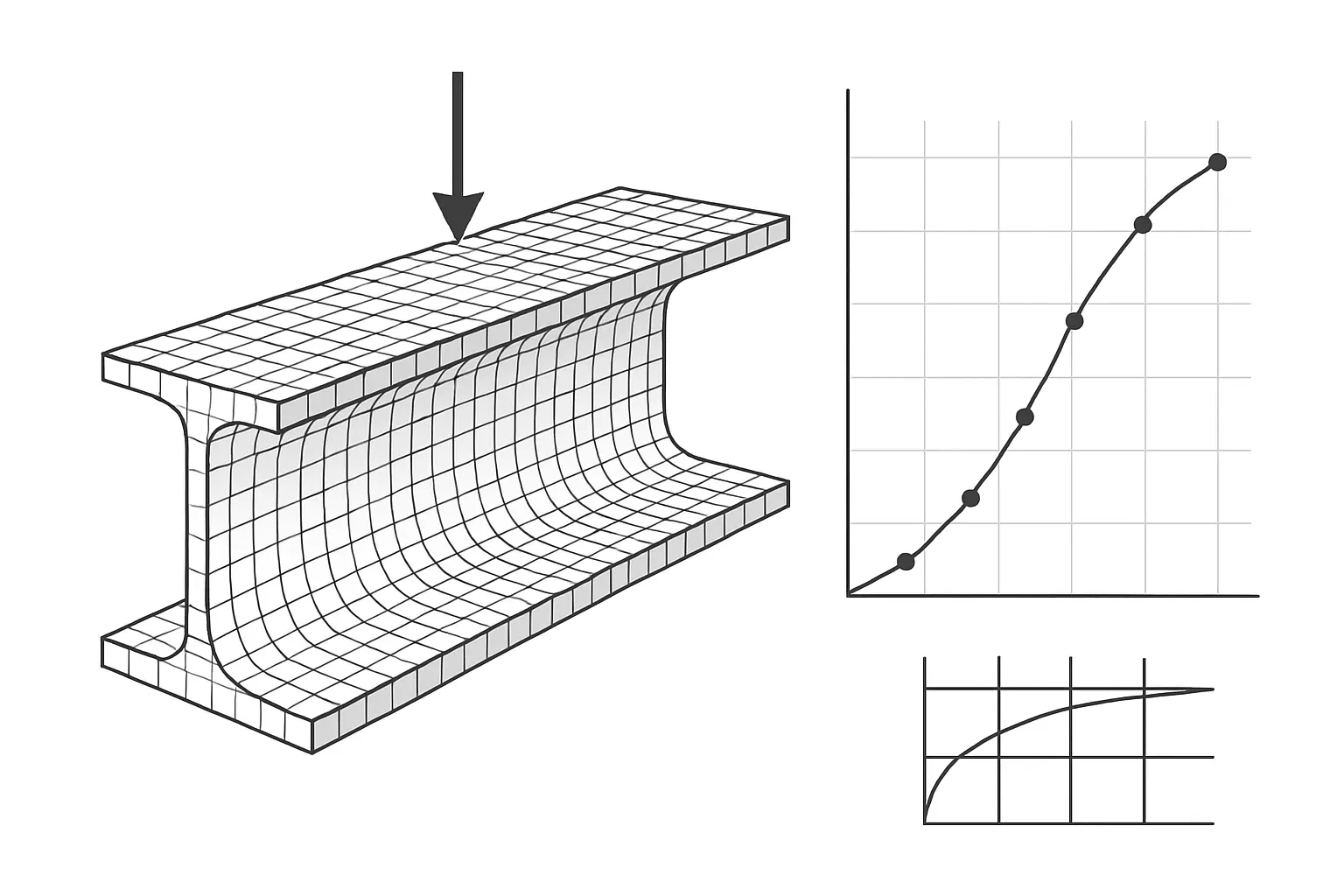
| Numerical / computational | Governing equations, software and version, boundary conditions, mesh or discretisation | Model output for defined load cases or scenarios | Mesh or grid convergence, validation against experimental or published benchmark data |
| Field / case study | Site or structure selection criteria, instrumentation or inspection method, access and safety arrangements | Condition assessment, monitored performance data, or a comparative case analysis | Instrument calibration, inter-rater consistency for visual assessments, triangulation across data sources |
Name the design you chose, cite the standard method or governing text your department expects — a materials-testing study cites the relevant SANS test method by name; a finite element study cites the software manual and the underlying formulation it implements — and state briefly why the alternative traditions above were not chosen for your research question.
Output: one paragraph naming the tradition, one naming the specific design within it, one naming the rejected alternative.
Step 3: Describe materials, apparatus or model inputs precisely enough to be repeated
For an experimental study, specify every material’s source, grade and any pre-treatment, the apparatus by make and model, and the calibration status of any measuring instrument. South African structural and materials testing is conventionally reported against the SANS standard the test method follows — the SANS 10100 series for structural concrete and the SANS 10160 series for basis of design and structural actions are the two most commonly cited families in a South African civil dissertation, though the specific test standard (for compressive strength, slump, aggregate grading, and so on) depends on your material and should be named individually. Confirm the current edition with your supervisor or your university library before citing it, since SANS standards are revised periodically and an outdated edition number is an easy examiner objection to avoid.
For a numerical study, specify the software and version, the governing equations or constitutive model, boundary and loading conditions, and the mesh or grid resolution, with a stated convergence criterion. For a field study, specify the site or structure, the instrumentation or inspection protocol, and any access or safety constraint that shaped what could be measured.

Step 4: State the sample — specimens, model runs, or sites — and justify the number
Civil engineering’s version of a sample size is specimen count, model run count, or site count, and each has its own justification logic rather than the participant-count logic used in social-science dissertations. Experimental work typically reports a minimum number of replicate specimens per test condition, following the relevant SANS or equivalent test method’s own minimum-replicate requirement, so that a mean and a coefficient of variation can be reported rather than a single value. Numerical work reports a convergence study — increasing mesh density or model resolution until the output stabilises within a stated tolerance — as the numerical equivalent of a sample-size justification. Field and case-study work justifies the number of sites or structures by the range of conditions they need to cover (age, exposure class, structural system) rather than by a target count alone.
Output: a sample statement specific to your tradition, with the replicate, convergence or coverage logic that justifies the number you used.
Step 5: Write the test or data-collection procedure step by step
Write the procedure as a numbered sequence a technician or a research assistant could follow without asking you a question: specimen preparation and curing conditions and duration; the loading rate, increment and stop criterion for a structural test; the exact sequence of a site inspection, including what was measured, in what order, and with what instrument. For fieldwork on existing infrastructure, this step must also record the access and safety permissions obtained — written permission from the asset owner (a municipality, a road agency, a private client), and, where the fieldwork happens on or near an active site, the safety induction and any permit-to-work process followed. Departments increasingly expect this permission chain documented with the same rigour a social-science dissertation documents ethics clearance, and the mechanics of that general university process are covered in our explainer on what ethics clearance involves at a South African university, which applies to engineering research on human-occupied or publicly accessible infrastructure just as it does elsewhere.
Step 6: State the analysis method before you have the results
For experimental data, name the descriptive statistics you will report for each specimen group (mean, standard deviation, coefficient of variation) and any inferential test used to compare groups or against a design value — the logic for choosing between tests is the same one worked through in our guide to which statistical test to use for a dissertation, applied here to specimen groups rather than survey respondents. For a numerical study, state the comparison metric against experimental or published benchmark data (percentage error, root-mean-square error) and the tolerance you will treat as acceptable agreement, decided before you see the results. For a case study, state how evidence from different sources (drawings, inspection records, monitoring data) will be triangulated into a single assessment.
Output: an analysis subsection naming the statistic or comparison metric for every result type your study produces.
Step 7: Report validation, not just results
A civil engineering methodology chapter is judged heavily on whether the method itself was validated before it generated the results the rest of the dissertation relies on. For an experimental method, this means calibration certificates for key instruments and a repeatability check across replicates. For a numerical model, this means a mesh or grid convergence study and, wherever possible, validation against independent experimental or published data rather than only against the model’s own internal consistency. For a field method, this means checking instrument calibration and, for any subjective assessment (a visual condition rating, for instance), a stated inter-rater consistency check if more than one assessor was involved. State the validation result explicitly in the chapter rather than assuming a reader will infer that the method was sound because the results looked reasonable.
Step 8: Write safety, professional conduct and any ethics implications
Laboratory and field civil engineering research carries occupational health and safety obligations under your university’s own safety policy and, on an active construction or infrastructure site, the site owner’s own safety system, and your methodology chapter should record what was followed — personal protective equipment, a documented risk assessment for the test or site work, and any induction completed. If your supervisor or you hold professional registration with the Engineering Council of South Africa (ECSA), the body that is the sole authority in South Africa for registering engineering professionals and controlling the use of engineering titles across its categories — Professional Engineer, Professional Engineering Technologist, Professional Engineering Technician and Professional Certificated Engineer, alongside candidate categories for those working toward registration — note that registration and the conduct it implies in a short paragraph if the research involves recommendations that could affect public safety, such as a structural assessment of an occupied building.
Output: a safety subsection naming the specific protocol followed, and, where relevant, a short professional-conduct note.
Step 9: Close with limitations specific to your tradition
Limitations in a civil engineering methodology chapter are methodological, not a general disclaimer. For experimental work: the specimen scale relative to full-scale structures, curing or environmental conditions that differ from field service conditions, or a material batch that may not represent supply variability. For numerical work: simplifying assumptions in the constitutive model, boundary conditions that approximate but do not replicate real support conditions, or a validation dataset that covers only part of your model’s intended range. For field work: access constraints that limited which structures or locations could be studied, or instrumentation limits on what could be measured non-destructively. State each limitation against the specific decision that caused it, not as a generic caveat.
Output: a limitations paragraph confined to method, each limitation traced to a specific decision made earlier in the chapter.
Step 10: A worked Harvard reference for a civil engineering source
UCT, Wits, Stellenbosch, Pretoria and other South African engineering faculties each publish their own Harvard variant, so check your faculty guide; the shape below is the common core for a standard.
Reference list: South African Bureau of Standards (2019) SANS 10100-1: The structural use of concrete – Part 1: Design. Pretoria: SABS Standards Division.
In text: Specimens were designed and tested in accordance with the relevant provisions of SANS 10100-1 (South African Bureau of Standards, 2019).
Always verify the exact edition and part number your department expects against the current SABS catalogue rather than reusing an example from a previous dissertation, since standards are periodically revised and superseded.
Getting the chapter drafted without losing lab time to it
A civil engineering methodology chapter is long because it is precise — materials, apparatus, procedure, validation and limitations, each reported to a standard a stranger could repeat — which is exactly the kind of structured writing Tesify handles well once you supply the design, the materials or model inputs, and your validation results. It drafts each subsection in your faculty’s order and keeps your reference list consistent with the SANS or software citations you name throughout. There is a free plan.
Draft your civil engineering methodology chapter with Tesify
If your study needs formal ethics or site-access clearance beyond a standard safety induction, the general South African process is set out in our guide to writing a research proposal for a South African university, and the statistics that support your results chapter follow the same test-selection logic covered in which statistical test to use for a dissertation.
Frequently asked questions
How long should a civil engineering methodology chapter be?
Typically 4 000 to 7 000 words, shorter than a qualitative social-science methodology chapter because the reporting is more technical and structured; a numerical study with an extensive validation section can run longer. Your faculty guide’s word range overrides any general figure.
Do I need ethics clearance for a purely laboratory materials study?
Usually not the same human-research ethics process a social-science study needs, since no human participants are involved, but your university’s laboratory safety and risk-assessment approval process still applies and should be documented in the methodology chapter as its own permission step.
Which SANS standard should I cite for my specific test?
The one your specific material and property require — there is no single standard covering all civil materials testing. Confirm the current, correct standard number and edition with your supervisor or your university library’s standards collection before you cite it, since using an outdated or wrong standard number is a common and avoidable examiner objection.
What if my numerical model does not converge?
Report the convergence behaviour honestly rather than stopping at a mesh density that happens to give a result you expected. A documented convergence study that shows instability, with an explanation of the likely cause, is defensible; an undocumented single mesh density presented as final is not.
Can I combine laboratory testing and numerical modelling in one dissertation?
Yes, and it is common — using experimental data to validate a numerical model is one of the strongest validation strategies available, provided the methodology chapter clearly separates the two methods and states how they relate to each other rather than blending them into one undifferentiated procedure.
Do I need ECSA registration to complete my dissertation?
No, ECSA registration is a professional career milestone separate from your academic qualification, typically pursued after graduation through the Candidate Engineer or equivalent category. Mention it in your methodology chapter only if your research explicitly touches practice recommendations that carry professional-conduct implications.