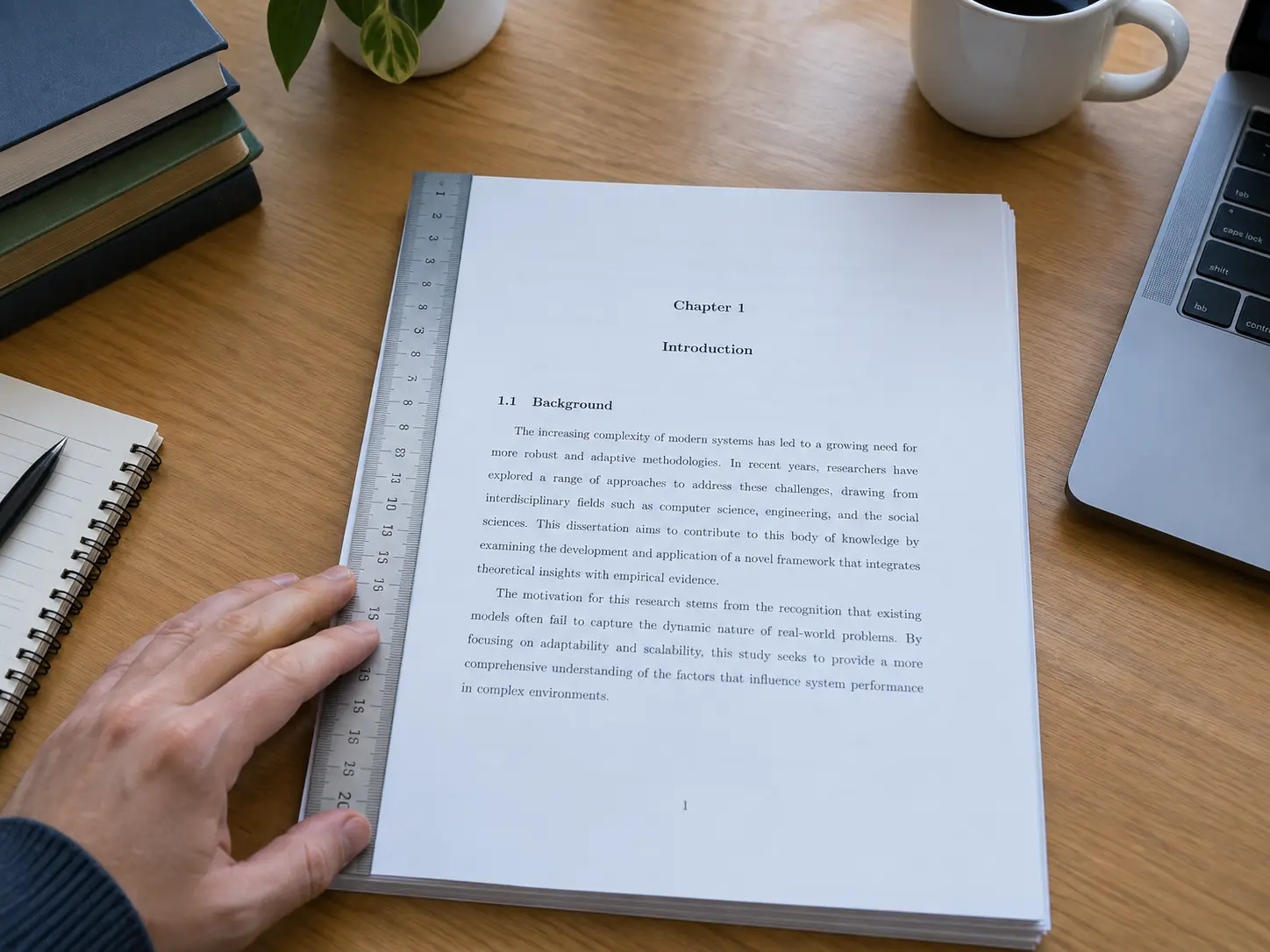
| Rule | A4 option | A5 option |
|---|---|---|
| Page size | 210 x 297 mm | Approximately 147 x 210 mm |
| Margins | Approximately 2.5 cm on the left, approximately 2 cm on the other three sides | About 2.0 cm for margins |
| Printing | Not specified; the margins must leave room for the page number | May be printed on both sides of the paper |
| Status | Listed as an acceptable format | Listed as an acceptable format |
Every rule below is quoted or closely paraphrased from North-West University’s own “Manual for Higher Degree Studies,” approved by NWU Senate on 1 September 2020, for use by the university’s master’s and doctoral students — this is the source document for the format, numbering and examination-timeline rules that follow, not a third-party summary. Where a rule leaves room for faculty-level discretion, the manual says so explicitly, and this piece flags every one of those points rather than presenting faculty discretion as a fixed university-wide number.
What does “dissertation,” “mini-dissertation” and “thesis” mean at NWU specifically?
The manual defines these terms precisely rather than using them interchangeably. A dissertation means a manuscript prepared for examination purposes, or a single published research article or set of published articles or unpublished manuscripts in article format, for a master’s degree. A mini-dissertation is the same kind of product but more limited in scope, evaluated in addition to a number of prescribed examination papers — the research component of a structured (coursework-based) master’s degree, and also of an honours or other professional degree. A thesis means a manuscript prepared for examination purposes, or a set of research articles or unpublished manuscripts in article format, and/or an internationally examined patent, for a doctoral degree. Confirm which of the three applies to your specific programme before assuming a rule written for one applies to another.
What does the manual say about the title page?
Among the required elements the manual lists for the front matter is a precise instruction on dating: “provide the month and year of the submission for examination” on the title page, rather than a full date or the date of an earlier draft. This detail is easy to overlook when a title page is copied from an earlier proposal draft and never updated before final submission — a title page still showing the proposal’s original submission month is a small but avoidable inconsistency an examiner may notice.
What does the manual say about page format and layout?
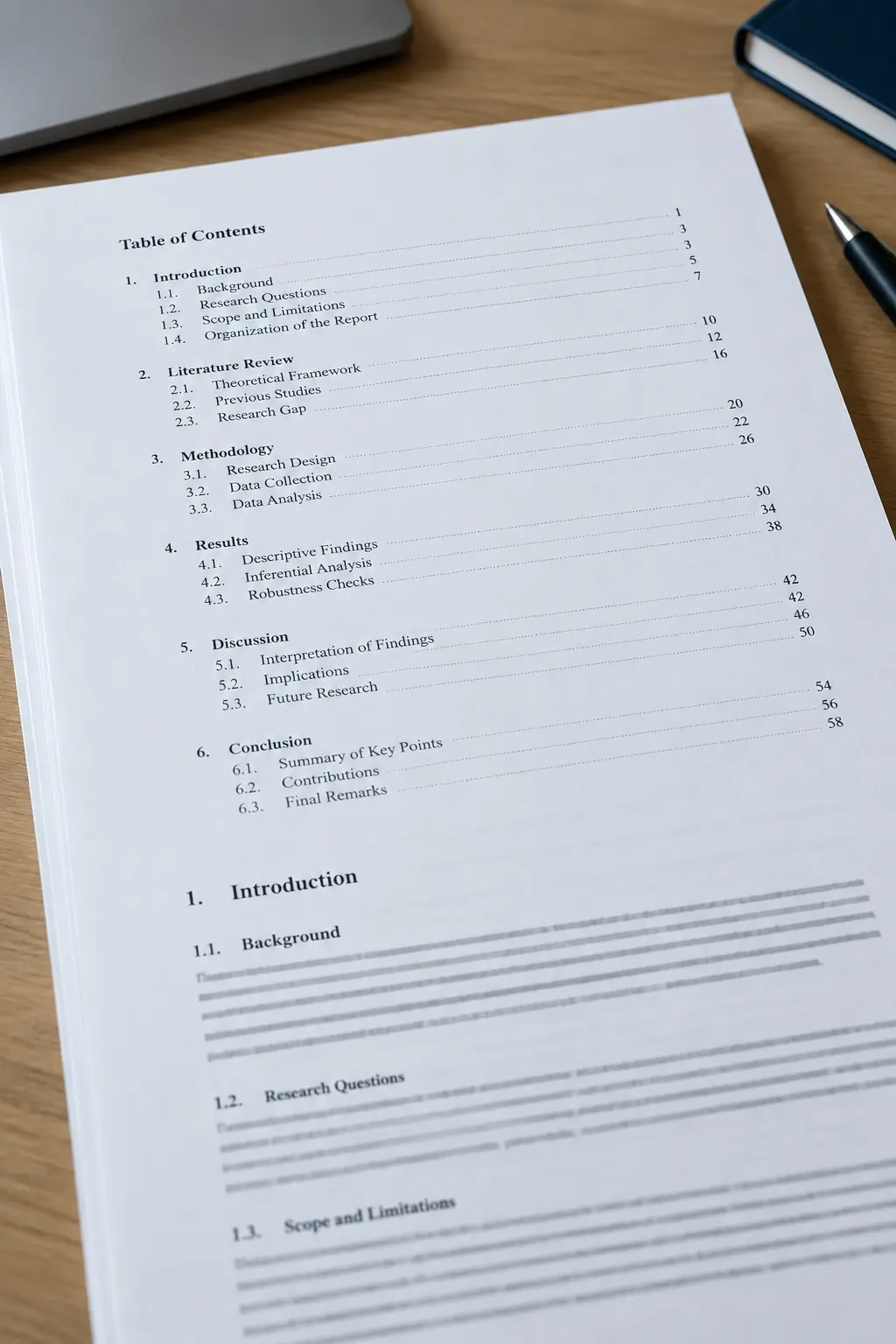
The manual states that “the format of the page layout of the research product must be determined beforehand,” and names the two acceptable options in the table above. It says a font size 11 may be used, and recommends the fonts Arial or Times New Roman “because of their legibility.” On line spacing, the manual’s own wording is: “printing in double line spacing is acceptable if one-and-a-half spacing is not possible” — one-and-a-half spacing is treated as the default, with double spacing as an acceptable alternative where needed. Page numbers may appear at the top or bottom of the page, and the manual notes that placing them in the middle eliminates confusion.
What does the manual say about language and editing?
On language, the manual states that “the choice of language should be in accordance with the language policy of the University and language use should follow its style guide” — meaning the specific language a dissertation or thesis is written in is governed by NWU’s own language policy, not left entirely to student preference. On editing, the manual places primary responsibility on the student, while expecting the supervisor to ensure the research product has actually been through language editing before submission: “language editing primarily remains the responsibility of the student. However, the supervisor/promoter should ensure that the student has the research product edited.”
How long does a dissertation or thesis need to be?
The manual is explicit that there is no set answer: “there are no universal rules about the length (minimum and maximum number of pages/words) for a (mini-)dissertation or thesis; each faculty has its own rules for each type of research that is done.” This means a page or word count you have heard quoted for NWU is, at best, a faculty-specific convention, not a university-wide rule — check your own faculty’s postgraduate handbook or your supervisor for the actual expected length in your discipline.
What does the manual say about heading and section numbering?
The manual recommends a decimal numbering system for headings and sub-headings, and specifically cautions against numbering that goes too deep: “normally it is meaningful to use no more than four, and in exceptional cases five, decimals; for example, 2.1.3.2 or 2.1.2.3.1, but not 2.1.2.3.1.7.” A heading numbered to six decimal places is, by the manual’s own example, a sign the document’s structure needs simplifying.
What does the manual say about paragraphs, tables and figures?
The manual treats paragraph structure as more than a style preference: “paragraphs are a necessary concession to the natural limitations of the human attention span,” and a properly divided text signals that “the author has analysed the material for the reader” rather than leaving that work to the reader. On tables and figures, the manual gives a specific, practical instruction: “guard against presenting the same information in tables as well as in figures,” and expects tables to be “fully comprehensible as separate units” — meaning a table should make sense read on its own, without depending on surrounding prose to explain what its columns mean. The manual also treats a concluding chapter as non-optional: “a closing chapter is essential for any research product.”
What does the manual say about word processing and templates?
The manual expects students to use “the full functionality of the word processor” to automate cross-referencing, section numbering, the bibliography and in-text references — not to build these manually. It also points to a university-provided Word template for (mini-)dissertations and theses, available through NWU’s own IT services page, and encourages students to use its features such as the automatic table of contents, list of figures and tables, and page numbering.
What does the manual say about Turnitin and integrity checks?
The manual states that a text-similarities report (for example Turnitin) is required so that parallel texts are checked for plagiarism, and that it is the supervisor’s responsibility to ensure the research product is subjected to similarity testing. It sets out at least two main integrity checks within the higher degree life cycle: one during or before proposal approval, when the supervisor submits a Turnitin (similarity) report of the proposal to the Faculty Scientific Committee, and another just before examination, when the supervisor attaches a Turnitin report of the final product together with the ethics approval letter. To avoid bottlenecks, the manual also suggests running Turnitin regularly after each chapter is completed, not only at the end of the study.
What does the manual say about examiner appointment timing?
Examiners “may be appointed at any time after the title has been registered but no later than six months prior to submission for examination.” The manual also notes that the exact trigger point differs by faculty: in some faculties the examiner-appointment process starts as soon as a title is registered, while in others examiners are appointed later — and for PhD studies, given the time lapse between title registration and examination, examiners may rather be appointed early in the final year of study. Confirm your own faculty’s practice with your supervisor rather than assuming the university-wide default timeline applies unchanged.
What does the manual say about corrections and the final manuscript?
Before examination, the supervisor/promoter and student should set a date on which “the final revised or corrected version of the document” is submitted to the supervisor/promoter, so that the final manuscript is print-ready well ahead of the deadline. After examination, the formal result letter may require the student to make certain corrections, or to revise and resubmit, and the product may also be rejected; once results are released, the final manuscript is submitted to Higher Degrees Administration in the format specified at that stage — confirm the required number and form of copies with that office beforehand.
How is research conducted under NWU’s approved research entities?
The manual notes that “at the NWU, research is mainly conducted in a number of approved research entities,” each guided by a research director; where a qualification is not hosted in a research entity, the relevant school director manages the student’s academic life cycle instead. Separately, research proposals go to the Faculty Scientific Committee, while ethical clearance comes from a faculty research ethics committee — two distinct approval layers a student should expect to pass through.
How does this compare to the generic cross-institution rules already on this site?
The site’s dissertation format, title page and declaration piece audits which front-matter elements appear across a range of South African universities generally, without quoting any single institution’s own regulation document — this piece goes the other direction, quoting one named university’s manual directly so an NWU student can check an exact rule rather than a general pattern. Referencing style is a separate matter from page format: the site’s Harvard vs APA comparison covers how UCT, Wits and Stellenbosch each publish their own referencing variant — NWU students should check the NWU Referencing Guide, which the manual lists among the documents to be read alongside it, since the manual itself covers page format and structure, not citation style specifics.
Where does this fit in the submission process?
Format compliance is checked as part of the broader submission-for-examination process — the site’s guide to submitting a dissertation for examination in South Africa covers the general sequence (supervisor sign-off, Turnitin, binding, submission to the faculty office) that these NWU-specific format and Turnitin rules slot into. Confirming your format meets these standards early — well before the proposal stage closes — avoids a late scramble; see the site’s research proposal guide for how format expectations connect to the earlier stages of the degree.
Keeping a long manuscript’s heading numbering, cross-references and formatting consistent across dozens of pages is exactly the kind of structuring work Tesify helps with, while the research and every word remain entirely yours.
Frequently asked questions
Does the NWU manual specify a required font size?
Not as a strict requirement — the manual says a font size 11 may be used and recommends Arial or Times New Roman for legibility.
Is A4 or A5 format compulsory at NWU?
Neither is stated as compulsory over the other — both are listed as acceptable options in the manual, with the specific choice typically settled by faculty or supervisor convention rather than a single university-wide rule.
Does the manual say how many pages a master’s dissertation should be?
No — it explicitly states there is no universal length rule, and that each faculty sets its own expectations for each type of research product.
How many Turnitin checks does the manual require?
At least two main integrity checks: one during or before proposal approval and one just before examination, each with a Turnitin similarity report. The manual also suggests running Turnitin after each chapter to avoid last-minute bottlenecks.
When are examiners appointed for an NWU dissertation or thesis?
At any point after title registration, but no later than six months before the planned submission for examination — the exact timing depends on the faculty’s own process.
What happens if examiners require corrections?
The formal result letter may require corrections or a revise-and-resubmit; once results are released, the final manuscript is submitted to Higher Degrees Administration in the format it specifies.
Does this manual apply to undergraduate research reports too?
The manual is written for master’s and doctoral students; honours-level research reports follow your faculty’s own rules, so check the faculty yearbook or your supervisor.
Does the manual say which decimal numbering software feature I should use?
It does not name a specific software feature, but it does expect the numbering to be generated using the word processor’s built-in heading and cross-referencing tools rather than typed in manually, since manual numbering is far more likely to drift out of sync as a document is edited.
Is this the most recent version of the manual?
The version referenced here was approved by NWU Senate on 1 September 2020, and it is still the edition linked from the NWU library guide in September 2026. Check with your faculty or the postgraduate office for any newer edition before relying on a specific rule.