If you have been looking for the South African standard for dissertation margins, font and line spacing, this article will save you the search: there isn’t one. Not nationally, and not at university level either. The numbers are devolved — and the level they are devolved to is the college, faculty or department, which is where you have to go and look.
That is worth knowing before you spend an evening hunting, because it changes what you should do. This guide shows you what the university-level guides do and do not specify, what a real college-level guideline looks like when you find one, full specimens of the two pages that actually get sent back — the title page and the declaration — and the eleven questions that turn “I don’t know my format” into a five-minute email to your postgraduate administrator.
What the university-level guidelines actually say
The University of South Africa’s library publishes a guide called Formatting Your Dissertation (or Thesis). It runs to twenty-five pages across four sections — structure, text and visual elements, word-processing, and proofreading — and it is the most comprehensive thing of its kind we could read at a South African institution. Here is what it specifies.
- Its Margins and Page Layout page explains how to open Layout, choose Custom Margins, enter the values you want, and set them as the default. It does not say what those values should be.
- Its Font and Typography page explains how to download and install a font file on Windows and Mac. It names no typeface and no point size.
- Its Templates and Style Guides page sends you to Microsoft’s own template gallery to pick an APA or MLA template. There is no Unisa template on it.
- Its Title Page page names the elements — and then says, in its own words, “Follow your university’s specific guidelines for formatting the title page.”
The guide’s introduction is explicit about why: “Every university has its specific guidelines and requirements for formatting dissertations or theses,” and “Remember to consult your college’s guidelines and departmental requirements throughout the process.”
The picture is the same elsewhere at this level. Stellenbosch University’s Library and Information Service law guide points law students to the Faculty of Law website for their guidelines, and its own formatting help is a set of Word training slides and a practice document rather than a specification.
Where the numbers actually live: the college level
Take the Unisa guide’s own instruction seriously — go and consult a college’s guidelines — and you find the specifics. Unisa’s College of Agriculture and Environmental Sciences publishes a Quick guide to CAES procedures for final submission of a dissertation or thesis for examination, dated 2020 and, in its own words, “approved by College Management”. It is four pages of exactly the detail the library guide declines to give.
What that college document specifies:
- A college-specific declaration is compulsory. The college “has developed a specific declaration which is required to be included in the dissertation or thesis”, hosted on the college’s own Masters and Doctoral Information page, and it must include the title of the dissertation or thesis.
- Where the declaration sits, and its page number. “Usually the declaration carries page number ii of the dissertation or thesis in Roman lettering and follows the dedication” — though the document is careful to add that the sequence “is only a suggestion”.
- One page. “It is advisable that this declaration is captured on one page.”
- Three compulsory annexures that most generic guides never mention: the Turnitin receipt, the ethics clearance certificate, and the questionnaire used in the study, each included as an annexure at the end.
And here is the detail that tells you the most. On typeface the document says only that you may format the declaration “to follow the Arial font and size of the dissertation or thesis” — naming the typeface in passing, as something already settled, and still not stating a point size. Even at college level, some of the numbers live one step further down, in the departmental or supervisor-level convention.
So the honest position is this. The university-level guides state no measurements and point downward; the college level supplies some of them and points down again. Any article that hands you “2.5 cm margins, Arial 12, 1.5 line spacing” as the South African standard has invented it. We are not going to. What we can tell you is exactly where to go, and what to ask when you get there.
What is specified: the elements and their order
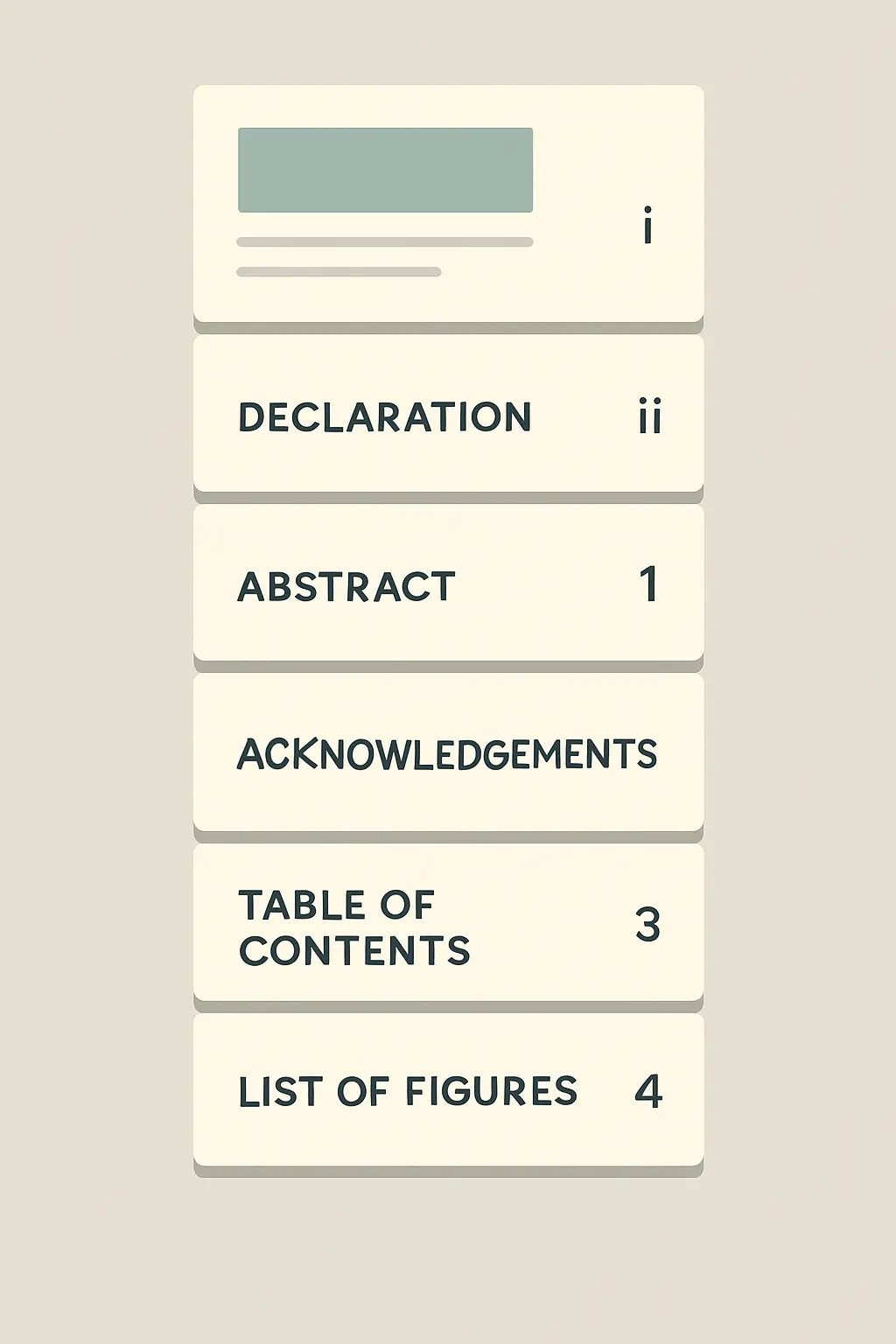
Where the guides are consistently useful is on what goes in and in what order, and that part does not vary much. The Unisa guide’s own structure section gives this running order:
- Title page
- Abstract
- Table of contents
- List of figures and tables
- Chapters and sections
- References or bibliography
- Appendices
In practice South African dissertations insert a declaration and acknowledgements into the preliminary pages too. Our own count of 60 dissertations downloaded from eight South African university repositories found acknowledgements in 98%, an abstract in 90%, a signed declaration in 88% and a copyright statement in 73%. Only 60% named the supervisor in the preliminary pages, and just 2% named a language editor.
Read that as a description of practice, not a rule. Your faculty guide decides; the count tells you what an examiner is used to seeing. And note from the college example above that the back matter can be prescribed too — a Turnitin receipt and an ethics certificate are not optional extras where a college requires them.
The title page, written out
The Unisa guide names five elements for the title page: the title, your name, the degree you are pursuing, your university’s name, and the submission date. Most South African title pages carry a little more than that, because the degree statement is usually written as a formal submission sentence. A specimen you can adapt:
THE TITLE OF YOUR STUDY, STATING THE PHENOMENON, THE POPULATION AND THE SETTING
by
YOUR FULL NAME
Student number: [number]
Submitted in [partial] fulfilment of the requirements for the degree of
[Master of Education / Master of Commerce / Master of Nursing]
in the [Department / School] of [name]
[Faculty of name]
[University name]
Supervisor: [title and name]
Co-supervisor: [title and name][Month] [Year]
Two things decide whether this page is accepted. The first is the phrase “in partial fulfilment” versus “in fulfilment”: a degree made up of coursework plus a dissertation is normally partial, and a research-only degree is normally full fulfilment. Getting this wrong is a common and entirely avoidable correction. The second is the exact, official name of the degree and the department — take both from your registration record, not from memory.
If you are unsure which rung of the ladder you are on, the distinction between the honours research report, master’s dissertation and doctoral thesis governs the wording of that submission sentence.
The declaration, written out
The declaration is the single page most likely to be returned, and it is also the easiest to get right, because it asserts a fixed set of things. Check first whether your college publishes its own compulsory wording, as the Unisa college above does — where it exists, that version wins outright. Where it does not, a specimen covering the standard assertions:
DECLARATION
I, [full name], student number [number], declare that this [dissertation / research report / thesis], titled “[full title]”, is my own original work.
All sources that I have used or quoted have been indicated and acknowledged by means of complete references.
This work has not been submitted previously, in whole or in part, for any degree or examination at this or any other university.
[Where applicable: The empirical research reported here was conducted with the written approval of [ethics committee], reference number [number].]
Signature: ______________________ Date: ______________
Practical notes. Sign it by hand, in ink, then scan — a typed name is not a signature and is one of the more common reasons a submission is bounced at the administrative check. Date it on the day you submit, not the day you drafted it. Include the full title of the work, which at least one college requires explicitly. Check whether your faculty wants the student number on this page; many do. And if your faculty requires a separate supervisor’s certificate confirming the work is ready for examination, that is a different page with a different signatory, and its absence will hold your submission.
The layout decisions you still have to make
Because the numbers are devolved, treat them as questions rather than facts. These eleven cover essentially everything a South African faculty or college guide specifies, and the answers fit on one page.
- What are the four margins, and is the binding edge wider than the others?
- Which typeface and point size, for body text and for headings?
- What line spacing, and does it change for long quotations, footnotes, table contents and the reference list?
- Is the text justified or ragged right?
- Are the preliminary pages numbered in lower-case roman numerals, and does the title page carry a number or merely count as one?
- Where do page numbers sit — centre footer, top right, something else?
- Does each chapter start on a new page, and is there a prescribed drop before the chapter heading?
- How many heading levels are permitted, and are they numbered decimally?
- Do table and figure captions go above or below, and how are they numbered?
- Is a word limit set, and does it include the reference list and appendices?
- What is required for submission: PDF only, PDF plus Word, printed and bound copies, and how many — and which annexures are compulsory?
Send that list to your postgraduate administrator if you cannot find the guide. Look on your college or faculty’s own postgraduate pages first rather than the library’s, because that is where the specifics turned out to be. It is a far better use of an afternoon than reformatting twice.
The Word mechanics that actually matter
Three mechanics cause most of the formatting pain, and all three are one-time setup rather than ongoing effort.
Roman then arabic page numbers. Preliminary pages in i, ii, iii and the body in 1, 2, 3 requires a section break between them, then page numbering formatted separately in each section. The Unisa guide’s own instruction for the related problem of a numbered first page is useful here: if you want numbering to start at 1 on the second page, open Page Number, then Format Page Numbers, and set “Start at” to 0. The “Different First Page” option handles the title page itself.
Heading styles, not manual formatting. If you format headings by hand — bold, size up, done — your table of contents cannot be generated, and you will build it manually and then rebuild it after every revision. Apply Heading 1, Heading 2 and Heading 3 styles from the start and the contents page writes itself.
One file, not twelve. Chapter-per-file feels safer and is not. Cross-references break, numbering restarts, and the final merge is done in the week you have least time. Keep one document and one backup routine.
Watch the page-numbering setup once
The roman-to-arabic transition is much easier to see than to read about. The University of Michigan Library’s dissertation Word series walks through it directly; the mechanics are identical in a South African document.
Five mistakes that get front matter sent back
- A typed signature on the declaration. It is a signed statement. Sign it, scan it, embed the image.
- Using a generic declaration where your college publishes its own. Where a college has developed compulsory wording, yours must be that wording.
- A manually typed table of contents. It will be wrong by submission, because the page numbers will have moved.
- Formatting to a guide you found online. An overseas template is not your faculty guide, and the differences are exactly the details that get checked.
- Leaving the front matter to the last week. The declaration may need an ethics reference number, the title page may need the official degree name, and your college may require a Turnitin receipt as an annexure — all take longer to obtain than to type.
While you are checking the preliminary pages, the reference list is the other thing checked mechanically at submission. If yours has drifted, the repair order for a reference list that does not match the faculty guide deals with it, and legal sources in particular follow their own rules — see citing South African Acts and case law in Harvard and APA. Whether your faculty wants Harvard or APA in the first place is settled in our Harvard versus APA comparison.
Frequently asked questions
Is there a standard South African dissertation format?
No. There is no national standard, and the university library guides we could read state no measurements at all, pointing instead to college and departmental requirements. Your college or faculty guide is the specification.
Where exactly should I look for my own rules?
Your college or faculty’s postgraduate pages, not the library’s formatting guide. That is where a real example turned out to carry the declaration wording, the page number, the typeface and the compulsory annexures.
What margins should I use if nothing specifies them?
Ask before you guess. If nobody will commit to an answer, choose a comfortable binding margin, apply it consistently and say nothing further about it. We are not going to invent a number and neither should you.
Does the title page count as page i?
Usually it counts but does not display a number, with the visible roman numbering beginning on the next page. One college guide we read places the declaration at page ii in roman lettering, after the dedication. Faculty guides differ, which is why this is on the eleven-question list.
Do I need a copyright statement?
Not universally. We found one in 73% of 60 South African dissertations sampled, which means roughly a quarter did without. Check your own guide.
Must I name my supervisor on the title page?
Only 60% of the dissertations in that sample did. It is conventional rather than universal, so follow your faculty’s instruction.
What is the difference between a declaration and a supervisor’s certificate?
The declaration is your statement that the work is your own. A supervisor’s certificate is the supervisor’s statement that the work is ready for examination. Some faculties require both, and they are separate pages with separate signatures.
Do I have to attach my Turnitin receipt and ethics certificate?
Where your college requires it, yes, as annexures at the end. At least one Unisa college requires the Turnitin receipt, the ethics clearance certificate and the questionnaire used in the study. Check yours before submission week.
Should the abstract come before or after the declaration?
Practice varies. The Unisa guide’s structure places the abstract immediately after the title page; many South African dissertations put the declaration first. Follow your guide, and be consistent with your table of contents.
Can I use a Microsoft Word template?
Unisa’s own guide points students to Microsoft’s template gallery, so yes as a starting point — but a generic APA or MLA template will not match a faculty guide’s margins or heading scheme. Treat it as a skeleton to adjust.
How long before submission should I fix the formatting?
Set up section breaks, heading styles and page numbering at the beginning, and the last week becomes a check rather than a rebuild. The front matter itself is a two-hour job if the ethics number, the official degree name and any compulsory annexures are already in hand.
Spend the time on the argument instead
Front matter is compliance work. It has to be right, it earns you nothing when it is, and it costs you a resubmission when it is not. Tesify keeps the structure and references of a whole dissertation consistent while the thinking stays 100% written by you.