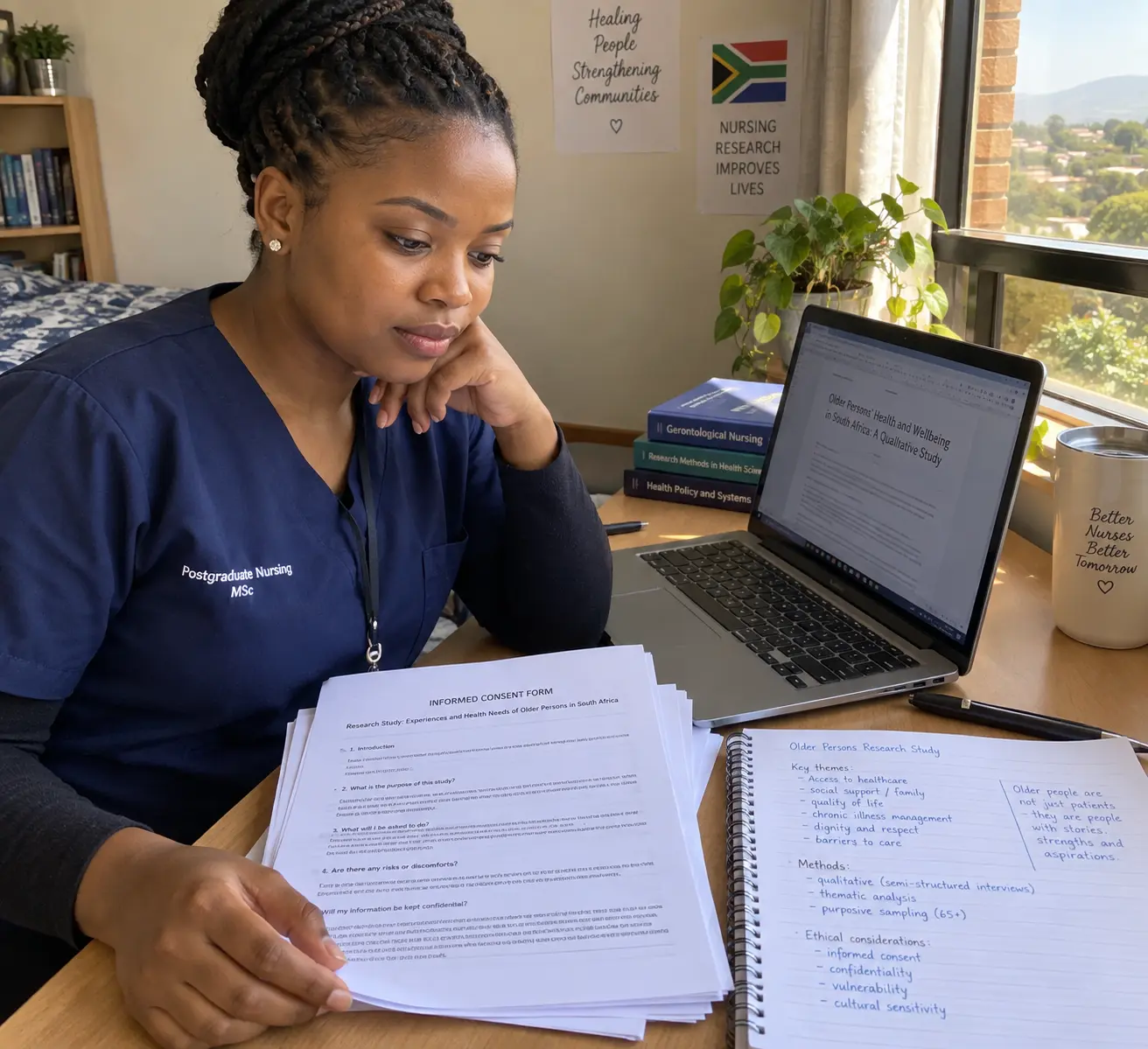
Researching older persons in a South African nursing dissertation means designing around three things at once: who legally counts as an “older person,” the extra informed-consent care a population with a higher rate of cognitive impairment requires, and the gatekeeper chain into a registered residential facility. Most projects work, but only once access and consent are planned before data collection starts, not during it.
Who counts as an “older person” in South African research?
The Older Persons Act 13 of 2006 is the governing statute, and it exists, in its own words, to deal with “the plight of older persons by establishing a framework aimed at the empowerment and protection” of the population, alongside “matters connected therewith.” The Act commenced on 1 April 2010. Read its definition carefully, because it is not a single age: as enacted, section 1 defines an older person as a man aged 65 or older or a woman aged 60 or older. The older person’s grant, by contrast, is paid to eligible people aged 60 or older, men and women alike. The government’s own page for the Act also lists an Older Persons Amendment Act 1 of 2025 as still to be proclaimed, so check the current consolidated text before you quote the definition. State which definition you are using in your first chapter, since a study drawing on Department of Social Development (DSD) registers or grant eligibility should match the age band those systems themselves use, and a sample of everyone aged 60 and above is not the same population as the Act’s enacted definition.
Which designs actually work for this population?
Three designs recur in South African nursing dissertations on older persons: a cross-sectional survey of a defined community-dwelling or facility-based sample (functional status, quality of life, caregiver burden, health-seeking behaviour); a qualitative study using interviews or focus groups (lived experience of chronic illness, dignity in care, end-of-life preferences); and a facility-based record review or observational study (fall incidence, medication administration practice, pressure-injury prevalence) that does not require direct participant contact at all. The record-review design is worth naming early if consent capacity is a real concern for your target group, since it sidesteps some of the consent complexity below while still answering a genuine clinical question. The general sampling-technique logic that underlies any of the three — how a target population differs from an accessible population, and how to justify the technique you chose — is covered in the site’s broader guide to population and sampling for a South African dissertation; this piece builds on that general logic for the specific case of an older-persons population.
What makes informed consent harder with this population, and how do you handle it?
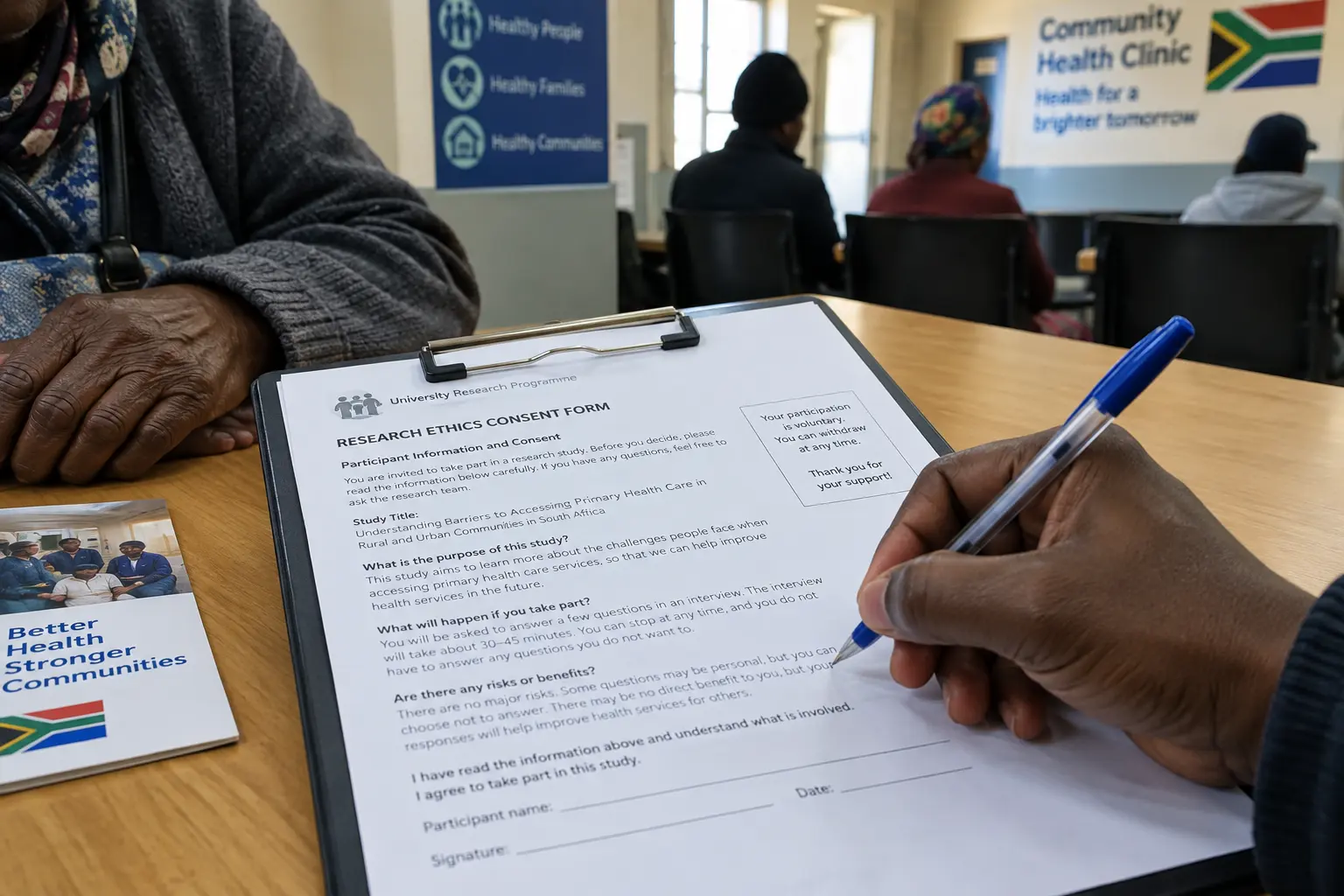
Age alone is never a reason to doubt someone’s capacity to consent, and treating every older participant as if capacity were in question is itself a form of the ageism nursing ethics guidance warns against. The real complication is that a meaningful minority of older participants, particularly in residential care or a hospital ward, may have a cognitive impairment that genuinely affects their ability to understand and retain the information in a standard consent form. A defensible protocol states, in advance, three things: how capacity will be screened (a brief, named cognitive screen administered by a trained team member, not an informal judgement call), what happens when capacity is uncertain or absent (a legally authorised representative process, following your university’s own ethics committee guidance and, where the participant lives in a registered facility, the facility’s own next-of-kin or guardian records), and how ongoing assent will be checked during data collection, since capacity can fluctuate within a single interview. Build all three into your ethics application rather than improvising once fieldwork starts.
What is the gatekeeper chain into a registered facility?
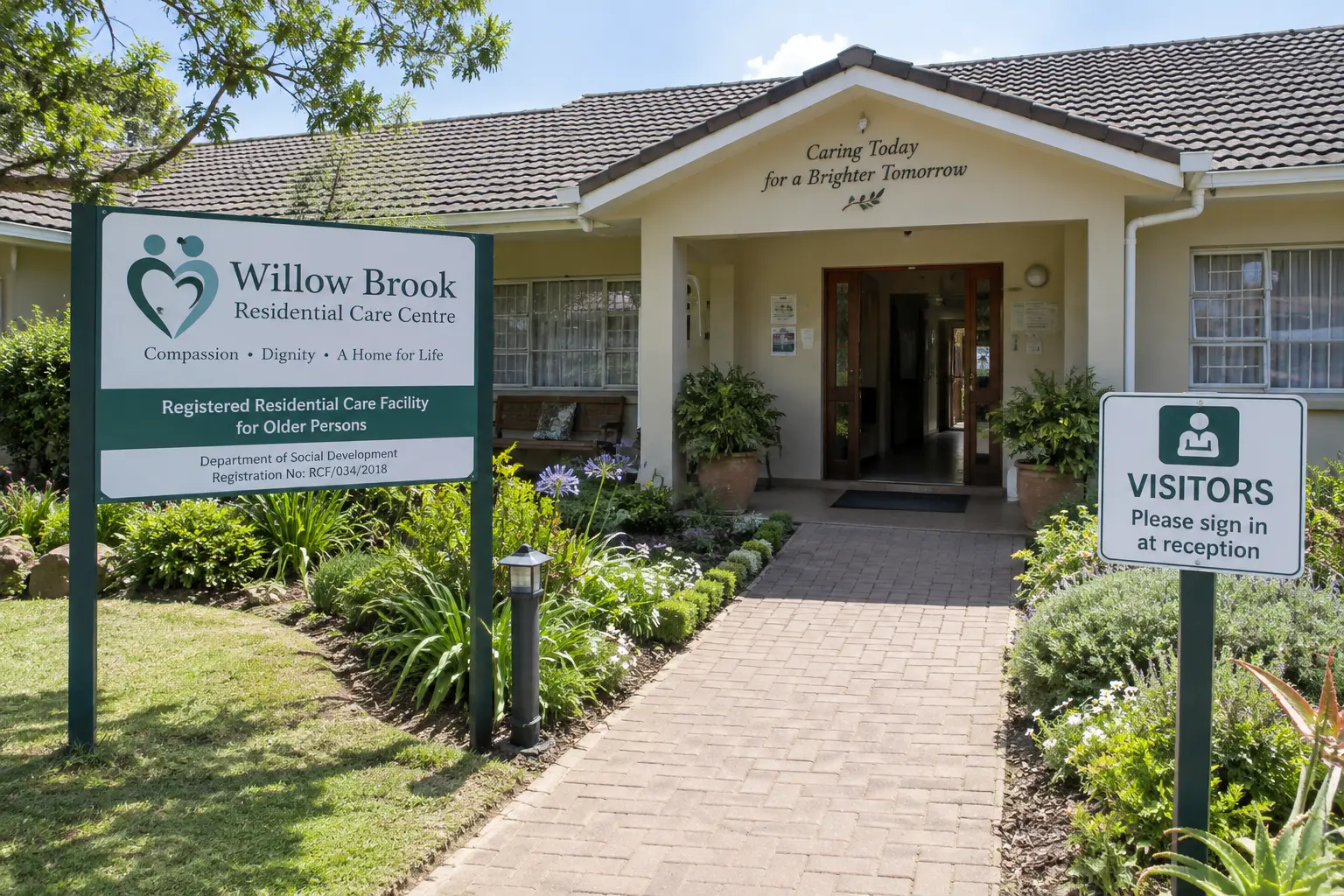
A study recruiting from a residential facility for older persons follows a longer permission chain than a community survey. First, your own university’s NHREC-registered research ethics committee. Second, where the facility is publicly funded or subsidised, the Department of Social Development, since sections 18 to 22 of the Older Persons Act prohibit operating an unregistered residential facility, require operators to apply to the Minister for registration, and provide for monitoring of registered facilities. Third, the facility itself — its manager or matron, who will want to see your ethics approval, your data-collection instrument, and a plan for how residents’ daily routine and care will not be disrupted. Fourth, individual (or legally authorised representative) informed consent, consistent with the Protection of Personal Information Act’s requirements for processing personal information, the same POPIA layer South African nursing ethics guidance already applies to hospital-based research. Build in weeks, not days, for this chain to clear before your data-collection window opens.
Which instruments do South African nursing studies on older persons actually use?
Three instrument families turn up repeatedly in this literature, at the level of general professional knowledge rather than a single named validation study: functional-status tools such as the Katz Index of Independence in Activities of Daily Living and the Barthel Index, which score a person’s ability to manage basic daily tasks; cognitive-screening tools such as the Mini-Mental State Examination and the Montreal Cognitive Assessment, used both as a research variable and, per the consent section above, as a capacity check; and quality-of-life or caregiver-burden scales suited to an older or chronically ill population, such as the Zarit Burden Interview for caregivers. Do not assume a scale validated on a different population or in a different country applies unchanged to a South African sample — check whether a South African or at least an African validation study exists for your specific instrument before you commit to it, and report what you find (or the absence of one) in your methodology chapter rather than assuming equivalence — the same discipline the site’s guide to choosing a validated scale for a nursing research report works through for the discipline generally.
Language adds a further layer most generic instrument guidance skips. A meaningful share of older South Africans, particularly outside the major metros, are more comfortable in isiZulu, isiXhosa, Sesotho or Afrikaans than in English, and an instrument administered only in English risks systematically under-representing that group or measuring language proficiency rather than the construct you intended. Where your sample is likely to include participants who are not first-language English speakers, plan for a translated and back-translated version of your instrument (or a trained interpreter for a qualitative interview), and say so explicitly in your methodology chapter rather than treating English administration as a neutral default.
Where does population-level data on older persons in South Africa come from?
Two custodians matter most for the background chapter. The South African Social Security Agency (SASSA) administers the older person’s grant, the means-tested grant paid to eligible South African citizens, permanent residents and refugees aged 60 or older, and its own published statistics are the closest thing to a national administrative register of the older population’s economic circumstances. Stats SA separately runs population-representative household surveys, such as the General Household Survey, whose results can be broken down by age group, giving a picture of household composition, health-seeking behaviour and living arrangements that does not depend on who receives a grant. Cite the specific edition and year of whichever publication you draw a figure from, since both are updated periodically and an undated figure is an easy examiner objection.
What does a worked population-and-sampling paragraph look like for this group?
Illustrative example, not a real study. “The target population was community-dwelling adults aged 60 years and above (the qualifying age for the older person’s grant) residing in a peri-urban health sub-district. A two-stage sampling approach was used: primary health care facilities in the sub-district were listed and four were selected purposively for a spread of urban and peri-urban catchments, then patients aged 60+ attending a chronic-disease clinic at each facility over a four-week period were invited to participate using systematic sampling, every third eligible attendee approached until the target of 120 was reached. Capacity to consent was screened using a brief, standardised cognitive check administered by the researcher before the consent process began; two potential participants were excluded on this basis and referred back to clinic staff.” Every named and numeric detail here is illustrative, built to show the shape a defensible paragraph takes — the sub-district, the facility count, the sampling interval and the target size all belong to your own study, not to this example.
Notice what the illustrative paragraph does that a vaguer version would not: it states the age threshold and its source, names a concrete two-stage sampling logic rather than an unspecified “convenience sample,” gives a defined recruitment window, and reports the capacity-screening step as a measured event (two exclusions) rather than an assumed formality. An examiner reading a population section checks for exactly these specifics before checking anything about your results.
How is this different from the site’s existing nursing content?
The site’s 40 nursing dissertation topics piece lists topic ideas across the whole discipline without population-level design guidance, and the site’s guide to ethics approval and informed consent for a nursing research report covers the general NHREC-to-POPIA gatekeeper chain that applies to every nursing study on this site. This piece is the first on the site to work through what changes, end to end, when your specific population is older persons specifically rather than a general adult sample — the age-threshold question, the capacity-to-consent layer, and the Older Persons Act facility-registration chain above are all additions on top of that general chain, not a replacement for it.
Getting the population and access sections drafted without losing weeks to the ethics queue
The gatekeeper chain above is exactly the kind of multi-step, easy-to-get-wrong-on-a-deadline writing Tesify is built to help with — drafting a consent protocol, a facility-access letter and a population section that names your age threshold, your design and your instruments consistently across every chapter, while the substance and every judgement call stay yours, because the dissertation stays 100% written by you. Draft your population and methods section with Tesify.
Frequently asked questions
What age threshold should I use to define “older persons” in South Africa?
It depends on the source you align with. As enacted, the Older Persons Act 13 of 2006 defines an older person as a man aged 65 or older or a woman aged 60 or older, while the older person’s grant is paid from age 60 for both sexes. State your chosen definition and its source explicitly in Chapter 1.
Do I always need a legally authorised representative for consent?
No — only where a capacity screen indicates the participant cannot understand and retain the consent information. Most community-dwelling older adults can consent for themselves; build a capacity-screening step into your protocol so the decision is documented rather than assumed either way.
Can I recruit through a day-care centre instead of a residential facility?
Yes, and it is often a faster access route, since a day-care centre for older persons is a less restrictive setting with a shorter gatekeeper chain than a full residential facility, though the centre’s own management still needs to approve your study and your ethics committee still needs to see that approval.
Is a facility-based record review easier than direct participant contact?
Generally yes for the consent-capacity concern specifically, since you are not interviewing participants directly, but you still need facility permission, POPIA-consistent handling of any personal information in the records, and your university’s ethics approval for secondary data use.
Where do I find how many older persons live in my province?
Stats SA’s household surveys, such as the General Household Survey, are the population-representative sources and can be broken down by age group; SASSA’s own published statistics give the grant-register picture specifically. Cite the exact edition and year you use.
Should I use an international cognitive-screening tool or look for a South African one?
Check whether a South African or African validation study exists for the tool you are considering before assuming an internationally developed instrument applies unchanged; report what you find in your methodology chapter either way.
How long does the facility-access permission chain typically take?
There is no fixed national timeline — it depends on your ethics committee’s own cycle, the provincial department’s response time where the facility is subsidised, and the facility’s own administrative capacity. Build in several weeks of buffer rather than assuming a single email will secure access.
Does the Older Persons Act apply to a community-dwelling sample, not just facility residents?
The Act’s protection and empowerment framework applies to older persons generally, but its facility-registration provisions are most directly relevant when your sample is drawn from a registered residential or day-care facility rather than the general community.