The population and sampling section is short, and it is where a methodology chapter most often quietly overclaims. The usual failure is not a wrong technique. It is a study that names a national population, recruits from three sites in one province, and then writes conclusions as though the first sentence were true.
This article deals with that gap directly: the distinction between the population you want and the one you can reach, how to choose a technique you can defend, and six written-out paragraphs to adapt. For how many participants you need, that is a separate calculation and we cover it in how many participants your dissertation needs. This article is about who they are and how you reach them.
Three populations, not one
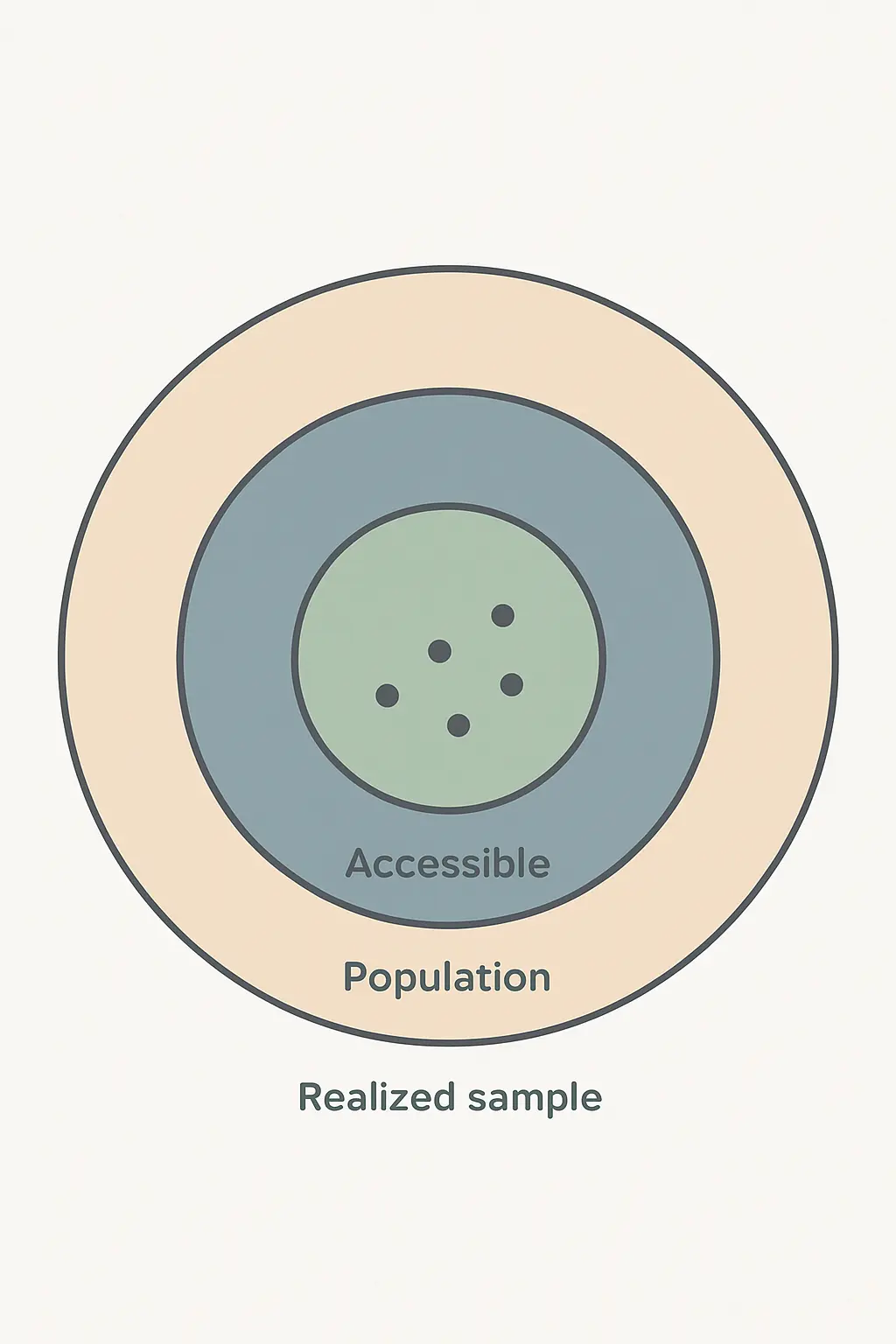
- The target population is everyone your research question is about. “All Grade 7 mathematics teachers in South Africa.”
- The accessible population is the part of it you can actually reach, given permissions, geography, budget and time. “Grade 7 mathematics teachers in the [named] district who have departmental approval to participate.”
- The realised sample is who actually took part.
Writing all three is not an admission of weakness. It is the thing that lets you make a precise claim at the end instead of a vague one, and examiners read the gap between the first and the second as a measure of how carefully you thought. A study that names only a target population has not told the reader where its findings apply.
The sentence that does the work
Somewhere in this section you should have a sentence of this shape:
The target population was [X]. The accessible population was [Y], which differs from the target population in that [the specific restriction]. Findings are therefore interpreted as applying to [Y], and their transferability to [X] is addressed in section [limitations].
Write that sentence early and the limitations chapter gets easier, because you have already conceded the right thing in the right place.
Choosing the technique
Two questions settle it in most South African dissertations.
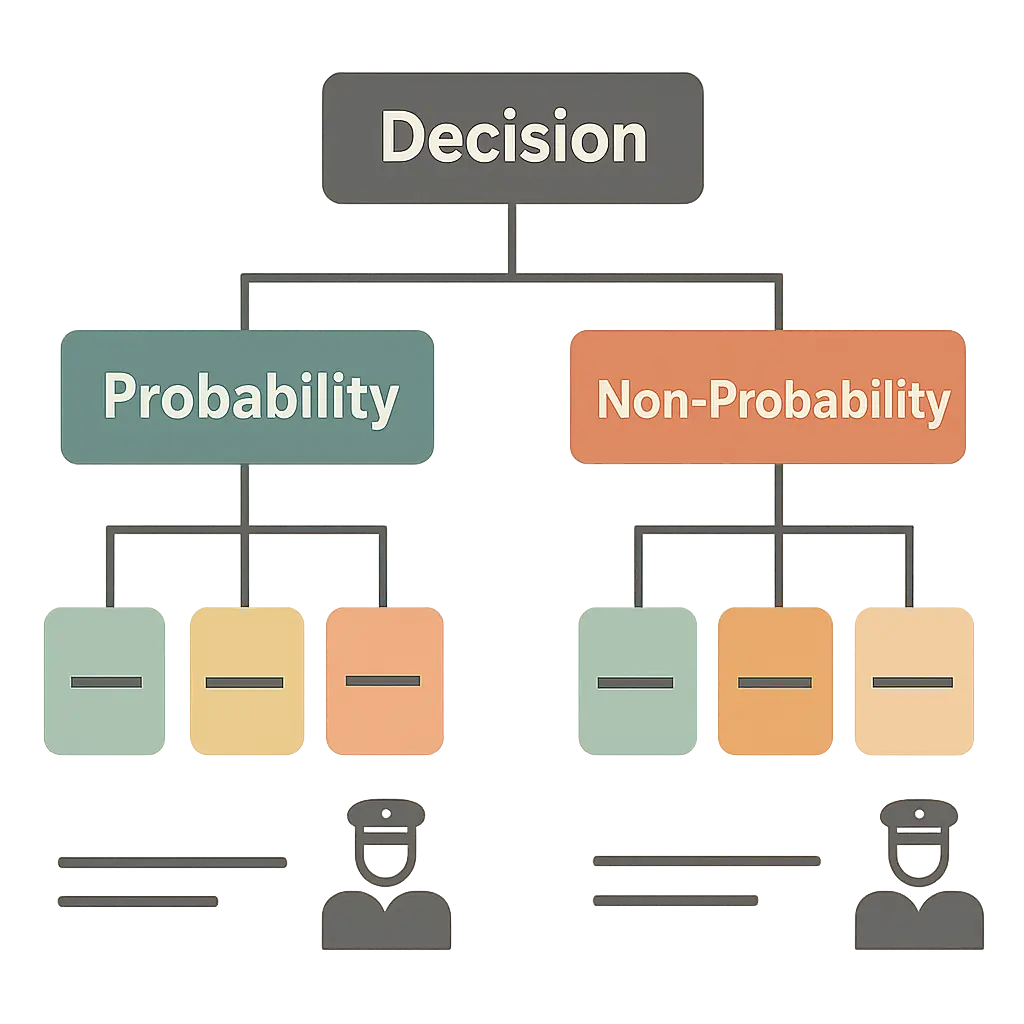
Do you have a sampling frame? A list of every member of the accessible population. If you genuinely have one — a staff establishment, an enrolment register, a membership list, a company register — probability sampling is available. If you do not, it is not, and no amount of describing your sample as “random” will make it so. The word “random” in a methodology chapter without a frame behind it is one of the more common examiner flags.
Do you need to generalise statistically? If your objectives use verbs like determine the relationship or compare, and you intend inferential statistics, you want probability sampling and you must justify any departure. If your objectives explore or describe, purposive sampling is not a compromise — it is the correct choice, and you should say so affirmatively rather than apologetically.
| Technique | Use when | What you must report |
|---|---|---|
| Simple random | You have a complete frame and no reason to stratify | The frame, its source and date, and the randomisation method |
| Stratified random | A frame exists and a known characteristic must be represented proportionally | The strata, why those strata, and the allocation within each |
| Systematic | A frame or an ordered flow of participants exists | The interval, the random start, and any periodicity risk |
| Cluster | The population is naturally grouped and reaching individuals directly is impractical | The clusters, how they were selected, and how many per cluster |
| Purposive | You need participants with specific experience, and generalisation is not the goal | The inclusion criteria, stated before recruitment |
| Snowball | The population is hard to reach or not enumerable | The seeds, the chain length, and the resulting homogeneity risk |
| Convenience | Nothing better is available | Say so plainly, and state the bias it introduces |
Convenience sampling is used far more often than it is named. If that is what you did, write the word. An examiner will recognise it regardless, and naming it converts a concealed weakness into a declared limitation.
Six written-out paragraphs
Each is a shape to adapt, with your own detail in the brackets.
Education, purposive within a district
The target population was intermediate-phase mathematics teachers in public schools in [province]. The accessible population comprised teachers at the [n] schools in [district] for which written approval to conduct research was obtained from the provincial department and from each school principal. Twelve teachers were selected purposively against three inclusion criteria: at least two years’ experience teaching the phase, current responsibility for at least one mathematics class, and willingness to be interviewed outside contact time. Recruitment continued until no new themes emerged in two consecutive interviews. Findings are interpreted as applying to this district rather than to the province.
Nursing, stratified within facilities
The target population was professional nurses employed at [category] facilities in [district]. A sampling frame was obtained from the [named office] staff establishment as at [date], listing [n] professional nurses across [k] facilities. The sample was stratified by facility, with participants allocated proportionally to the number of professional nurses at each, and selected randomly within each stratum using [method]. The frame excluded agency and locum staff, who are therefore outside the accessible population.
Management, convenience and named as such
The target population was employees of small and medium enterprises in [sector] in [metropolitan area] without a formal human resource function. No sampling frame exists for this population: the national business register does not record the presence of a human resource function, and no list of qualifying enterprises could be constructed. A convenience sample was therefore drawn through [route], and enterprises were screened against the qualifying criterion at first contact. This approach does not support statistical generalisation to the sector, and results are presented accordingly.
Public administration, complete enumeration
No sampling was undertaken. The study analyses all [n] municipalities meeting the matching criteria of [criteria] over the period [dates], constituting a complete enumeration of the accessible population rather than a sample of it. Inferential statistics are therefore reported as descriptive of this population, and significance testing is [used with a stated rationale / not used].
That last clause matters. A complete enumeration raises a legitimate question about what a p-value would mean, and answering it in one sentence is better than being asked.
Accounting, documentary population
The population comprised the integrated reports of all companies listed in the [named index] as at [date], being [n] companies. Companies were excluded where [criteria], leaving [m] reports for analysis. Reports were obtained from company websites between [dates]; where a report was unavailable, [what was done]. No sampling was applied within this population.
Public health, routine data
The study uses records extracted from [named routine system] for all facilities in [sub-districts] for the period [dates]. The unit of analysis is [the record type], and the extracted dataset contained [n] records after de-duplication. Because the dataset is a complete extract rather than a sample, the limitations addressed are those of the routine system itself — completeness of capture and consistency of coding across facilities — rather than sampling error.
A course explainer on sampling methods
If the probability and non-probability families still blur together, a university course lecture is a good, neutral reference.
The permissions that define your accessible population
In South Africa, the accessible population is often set by who will let you in rather than by geography. Three gates come up repeatedly, and all three take longer than students expect.
- Institutional ethics clearance, which you need before approaching anyone. Timelines and committee expectations are in our guide to ethics clearance at a South African university.
- Gatekeeper permission from the organisation — a provincial department, a district office, a hospital management, an employer. This is usually a separate written approval and is frequently conditional on ethics clearance already being in hand.
- Site-level consent from the principal, facility manager or line manager, which can be refused even after the provincial approval is granted.
Build all three into your timeline, and write your accessible population definition after you know which of them you have. A definition written in advance of the approvals is a prediction, and it will need rewriting.
Five mistakes
- Naming a national population and sampling one district. Name the accessible population too, and interpret findings against it.
- “Random” without a frame. If you cannot produce the list, it was not random sampling. Say what it actually was.
- Inclusion criteria written after recruitment. Criteria decided once you have seen who volunteered are not criteria. Write them into the proposal.
- Silent non-response. Report how many were approached, how many participated, and what is known about the difference. A response rate with no denominator is not a response rate.
- Sampling described in the results chapter. It belongs in the methodology. What belongs in the results is who actually took part.
Where this sits
The population section follows the design and precedes the instrument description in most methodology templates. It should name the same constructs you set out in your operationalisation table and answer the objectives you wrote. Two fields on this site have their own worked methodology chapters where the population step appears in context: an education mini-dissertation and a nursing master’s dissertation.
Frequently asked questions
What is the difference between target and accessible population?
The target population is everyone your question is about. The accessible population is the subset you can actually reach given permissions, geography and time. Both belong in the chapter.
Is purposive sampling acceptable in a master’s dissertation?
Yes, and in qualitative work it is usually the correct choice. State the inclusion criteria in advance and do not claim statistical generalisation.
Can I use convenience sampling?
You can, provided you name it as convenience sampling and state the bias it introduces. Concealing it is the problem, not using it.
Do I need a sampling frame?
For any probability technique, yes. Without one you are doing non-probability sampling, whatever it is called in your draft.
What is saturation and can I claim it?
Saturation is the point at which new data stops producing new themes. You can claim it if you can describe how you recognised it, ideally by stating the rule in advance.
Where does sample size go?
In this section, with its justification. The calculation itself is a separate topic; see our guide on how many participants a dissertation needs.
How do I report non-response?
Approached, responded, included after screening, and anything known about those who declined. Report it in the results, not the methodology.
Can my population be documents rather than people?
Yes. Reports, judgments, policies and records are all legitimate populations, and the same logic applies: define the population, state the inclusion criteria and say whether you sampled or enumerated.
Do I need gatekeeper permission as well as ethics clearance?
Usually yes, and they are separate. Gatekeeper approval frequently requires ethics clearance to be in place first, so sequence them.
What if my approved sites refuse access after clearance?
Redefine the accessible population, document the change and tell your supervisor. A study whose access changed mid-course is normal; one that reports its original plan as though nothing changed is not.
Write it once, defend it later
Population and sampling is half a page that decides what your conclusions may claim. Tesify helps you draft the methodology and keep it consistent with your objectives and framework, while the research stays 100% written by you.