
Operationalisation is the step where an abstract idea becomes something you can actually record. “Job satisfaction” cannot be measured. A score on a named instrument can be. The table that documents that journey is one of the most-requested items in a South African methodology chapter, and one of the least often shown filled in.
This article gives you the five-column table, filled in for six disciplines, with the operational definitions written out and the measurement decisions each one forces. Placeholders marked [cite] are where your instrument source belongs — the examples name instrument types rather than attributing properties to specific published scales we have not verified for you.
The three definitions you must keep apart
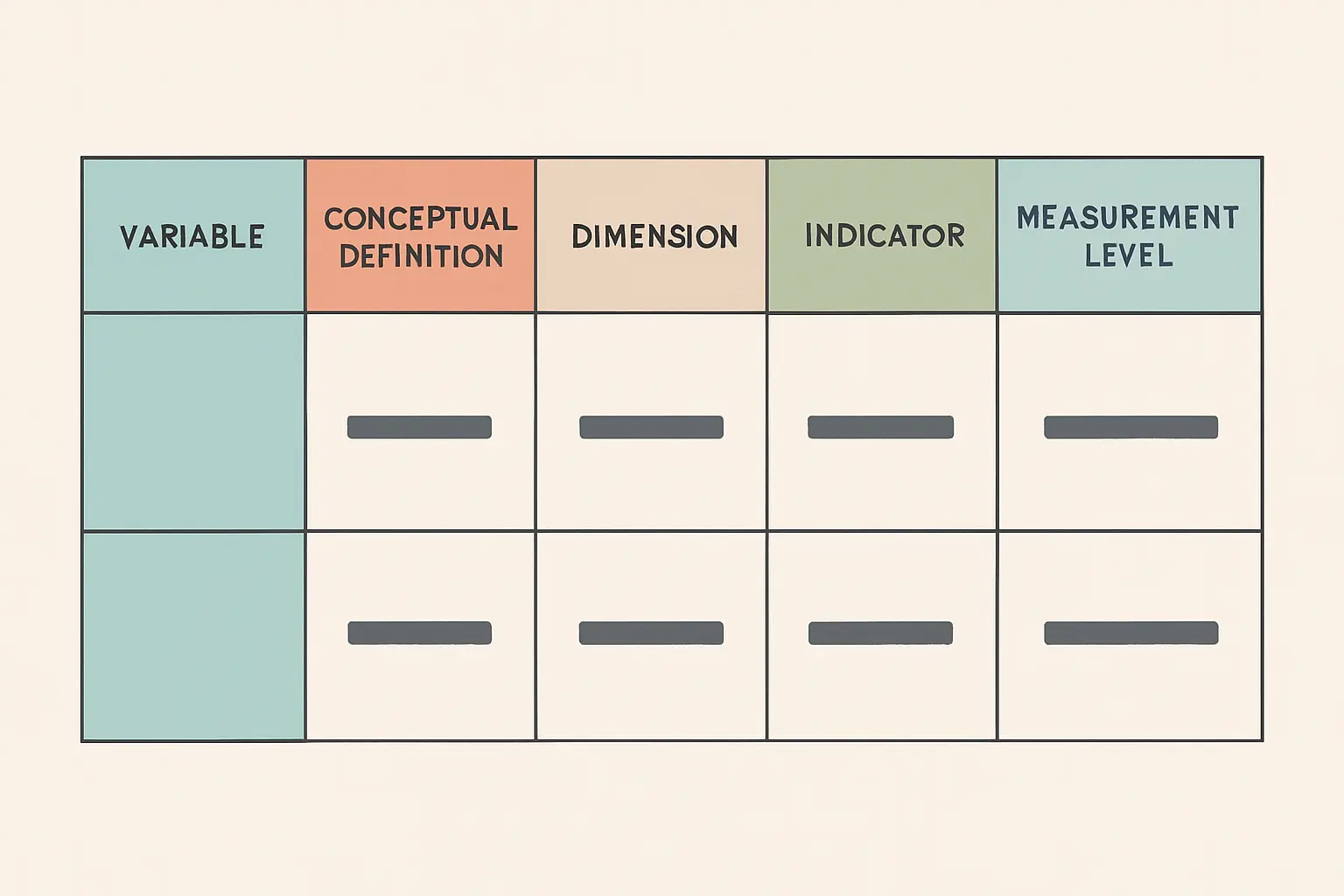
- The conceptual definition says what the construct means, in theory. It is usually borrowed and cited.
- The operational definition says how this study will record it. It is yours, it is specific, and it names an instrument, a question, a document or a count.
- The measurement level — nominal, ordinal, interval or ratio — follows from the operational definition and determines which analyses are available to you.
The link between the last two is the practical point of the whole exercise. If you operationalise an outcome as a five-point agreement scale, you have made a decision about your statistics, whether or not you noticed making it.
The table
Five columns, one row per variable. Put it in the methodology chapter, after the design section and before the instrument description.
| Column | What goes in it |
|---|---|
| Variable | The name, and its role: independent, dependent, mediating, moderating, control |
| Conceptual definition | One sentence, cited |
| Dimension(s) | The sub-parts, where the construct has more than one |
| Indicator / item(s) | Exactly what you will record: items, question numbers, document fields, counts |
| Measurement level and scoring | Nominal / ordinal / interval / ratio, plus how a score is computed |
Two columns that are worth adding if your faculty allows a wider table: source of the instrument and reliability reported in this study. Both pre-empt questions.
Six filled-in rows
Education: implementation self-efficacy
- Variable: Implementation self-efficacy (mediating).
- Conceptual definition: A teacher’s belief in their own capacity to enact the prescribed curriculum in their own classroom conditions
[cite]. - Dimensions: Instructional confidence; assessment confidence; adaptation confidence.
- Indicator: Twelve items across the three dimensions, four each, on a self-administered questionnaire
[cite for the source instrument]. - Measurement and scoring: Ordinal items on a five-point agreement scale; a dimension score is the mean of its four items; the overall score is the mean of the twelve. Treated as interval for the planned analysis, with that assumption stated.
That last sentence is the honest version of what nearly every social-science dissertation does. Stating it is better than doing it silently, because an examiner who cares will ask, and an examiner who does not will still notice the candour.
Nursing: scope interpretation
- Variable: Scope interpretation (dependent).
- Conceptual definition: The boundary a nurse treats as applying to their own permitted practice in a given clinical situation
[cite]. - Dimensions: Assessment; initiation of treatment; referral decision.
- Indicator: Responses to three standardised clinical vignettes, each followed by a forced-choice item on the action the participant would take, plus an open follow-up on the reasoning.
- Measurement and scoring: Nominal for the forced choice; the open responses are qualitative and analysed thematically rather than scored.
A vignette is a legitimate operationalisation and often the only ethical one. Say explicitly that you are measuring reported intention rather than observed behaviour — that distinction belongs in the limitations, and putting it in the table too shows you knew it in advance.
Management: perceived organisational support
- Variable: Perceived organisational support (mediating).
- Conceptual definition: An employee’s global belief about the extent to which the organisation values their contribution and cares about their wellbeing
[cite]. - Dimensions: Treated as unidimensional, following the source instrument.
- Indicator: The items of a published support scale, administered unchanged
[cite]. - Measurement and scoring: Seven-point agreement scale; total score is the mean of items after reverse-scoring the negatively worded ones.
The phrase “administered unchanged” is doing real work. Any alteration to a published instrument — dropping items, changing the anchors, rewording for local English — must be declared, because the instrument’s published properties no longer transfer automatically to your version.
Public administration: audit outcome
- Variable: Audit outcome (dependent).
- Conceptual definition: The published opinion issued on the municipality’s annual financial statements for the year in question.
- Dimensions: None; single categorical variable.
- Indicator: The opinion category recorded in the published audit report for each municipality-year in the sample.
- Measurement and scoring: Ordinal, ordered from the most to the least favourable category, with the ordering stated explicitly and justified in the text.
Documentary variables are the easiest to operationalise defensibly, because the recording rule is checkable. State where the document came from and on what date you retrieved it, since published records are revised.
Accounting: disclosure extent
- Variable: Disclosure extent (dependent).
- Conceptual definition: The degree to which a company reports the items specified by [named framework] in its integrated report.
- Dimensions: The categories of the disclosure checklist.
- Indicator: A binary coding of each checklist item as present or absent in the report, applied by content analysis; a disclosure index is the proportion of applicable items present.
- Measurement and scoring: Ratio, bounded 0 to 1. Coder agreement assessed on a subsample and reported.
Content-analysis variables need one extra thing the others do not: a statement of who coded, how disagreements were resolved and what the agreement statistic was. Without it the index is one person’s reading.
Engineering: prediction error
- Variable: Prediction error (dependent).
- Conceptual definition: The difference between deterioration predicted by the published model and deterioration observed in the sampled assets.
- Dimensions: None; derived quantity.
- Indicator: Observed value minus predicted value for each asset, using [named measurement procedure] for the observation and the published parameters for the prediction.
- Measurement and scoring: Ratio, in the physical units of the measurement. Sign retained, because systematic optimism and systematic pessimism are different findings.
Watch operationalisation explained
A university methods course explains the concept-to-measure descent more compactly than prose can.
Writing the operational definition as prose
The table is a summary; the chapter still needs sentences. A reliable four-part formula:
[Variable] is defined conceptually as [one clause, cited]. In this study it is operationalised as [exactly what is recorded], measured using [instrument or procedure, with source]. Scores are computed by [the arithmetic]. Higher scores indicate [direction], and the variable is treated as [measurement level] in the analysis.
The fourth sentence is the one people leave out, and it is the one that prevents a results chapter from surprising its own author. If you cannot state the direction, you will eventually misinterpret a negative coefficient.
Five mistakes
- A conceptual definition presented as operational. “Motivation is the drive to act” tells nobody what you recorded. Name the items.
- Silently changing a published instrument. Dropping items or changing anchors alters the instrument. Declare it and stop claiming the original’s properties.
- An ordinal variable analysed as interval without comment. Common and often defensible. Undeclared, it is a soft target at examination.
- Variables in the table that are not in the framework. The two documents must contain the same constructs. A mismatch means one of them was updated and the other was not.
- No scoring rule. “Measured by the questionnaire” leaves your reader unable to reproduce a single number. Say sum or mean, and say what happens to reverse-scored items.
What comes before and after
Operationalisation sits between the conceptual framework, which names the constructs, and the instrument section, which describes the tool in detail. Two fields on this site already have a treatment of instrument choice: validated scales for an HRM dissertation and validated scales for a nursing research report, and if you built your own tool, proving your questionnaire is valid is the next step.
Downstream, the measurement level you record here decides which statistical test you may use, and the scoring rule is what you will implement when you analyse questionnaire data in SPSS. Filling the table honestly now removes most of the confusion later.
Frequently asked questions
What is the difference between a conceptual and an operational definition?
The conceptual definition says what the construct means and is usually borrowed with a citation. The operational definition says exactly what you will record in this study, and it is yours.
Does every variable need an operational definition?
Every variable that appears in your analysis, including controls and demographics. “Age” needs one too: recorded in completed years, self-reported or from a record.
Where does the operationalisation table go?
In the methodology chapter, after the design and before or within the instrument section. Some faculties place it in an appendix; follow your template.
Can I operationalise a variable in more than one way?
Yes, and reporting both is a strength when they agree. Nominate one as primary in advance, so that choosing after seeing results is not possible.
Is a Likert scale ordinal or interval?
A single item is ordinal. A mean of several items is commonly treated as interval in practice. State which you are doing and why, rather than leaving it implicit.
What if no instrument exists for my construct?
Then you are building one, and that becomes part of your method: item generation, expert review, a pilot and reported reliability. Say so explicitly rather than presenting a new instrument as established.
Do qualitative studies operationalise variables?
Not in this form. Qualitative work defines concepts and describes how they will be recognised in the data, which serves a similar purpose without measurement levels.
How do I operationalise a demographic like home language?
As a nominal variable with categories defined in advance, plus a rule for multiple or other responses. Decide before collection how you will handle a respondent who names two.
Must I report reliability for every scale?
Report it for every multi-item scale you score, computed on your own data rather than quoted from the source publication. Your sample is not the validation sample.
Can I change an operational definition after data collection?
You can change how you describe it only to match what you actually did. Changing the scoring rule after seeing results is a different matter and must be declared if done at all.
Get the methodology chapter moving
Operationalisation is fiddly, unglamorous and load-bearing: get it right and the analysis chapter almost writes itself. Tesify helps you draft and keep it consistent with the framework and the objectives, while the research stays 100% written by you.