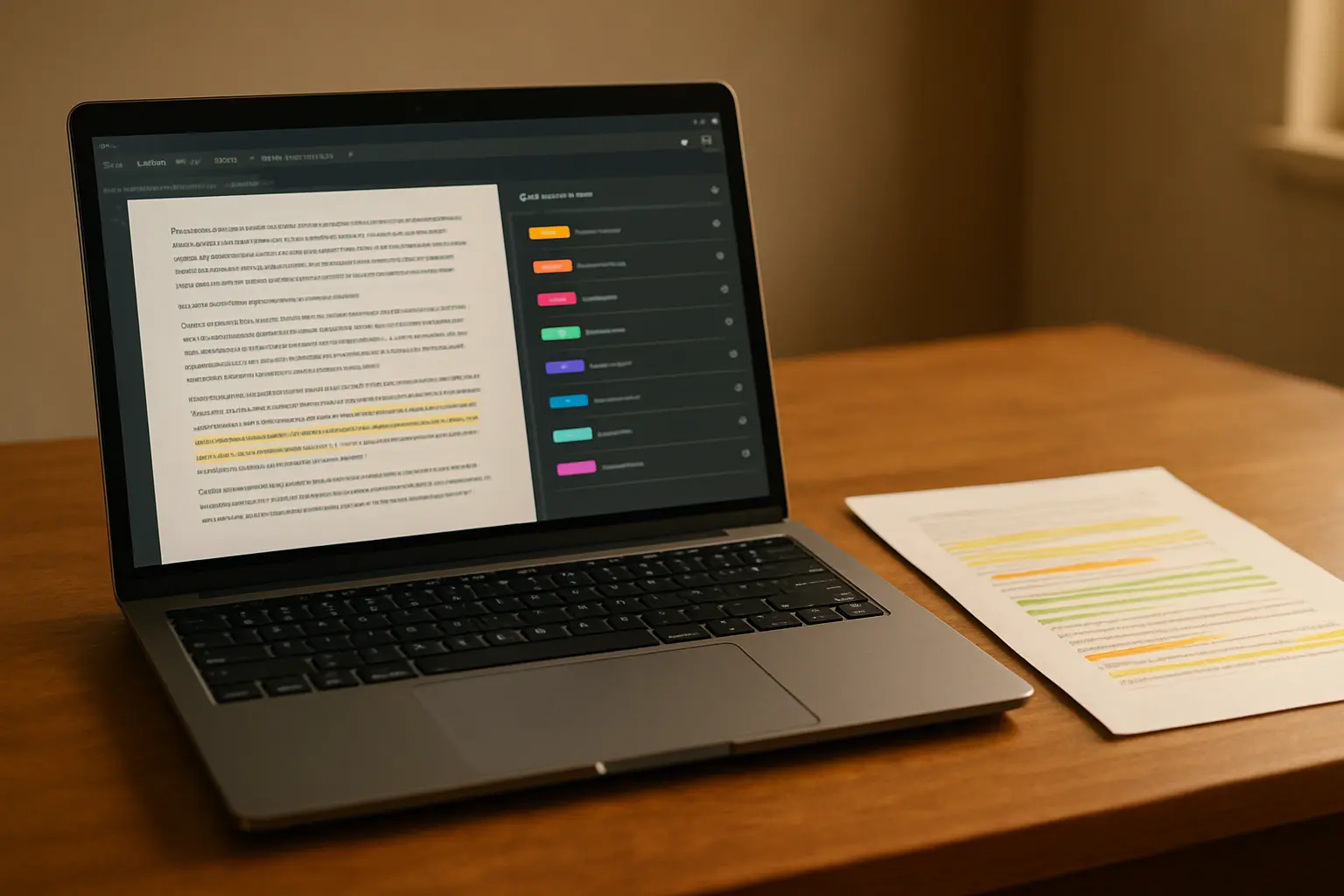
| Tool | Student list price (vendor’s own shop) | Licence term | Provided by SA universities? | Best for |
|---|---|---|---|---|
| NVivo (Lumivero) | Around USD 130 a year; Lumivero’s shop also quotes a rand price of roughly R2 150 | Annual subscription | UCT — full site licence, install on your own machines | Large projects; the default where your campus licenses it |
| ATLAS.ti | About EUR 81 / USD 107 for a year; about EUR 42 / USD 55 for six months; a web-only option around EUR 10 a month | 1 year, or a 6-month semester licence | Stellenbosch, Unisa, UP, Wits — via software hub, portal or research office | Most SA campuses; the widest institutional availability |
| MAXQDA (VERBI) | Roughly EUR 88 / USD 105 for 12 months; about EUR 50 / USD 57 for a semester | Fixed period, expires automatically | Rarely — Wits Health Sciences offers lab access without a personal licence | Mixed-methods work; strong visual tools |
| Taguette | Free (open source, BSD licence) | None — yours permanently | Not needed; install it yourself | A straightforward interview study on any budget |
Prices are the vendors’ own published student list prices at the time of writing, exclusive of tax and subject to change — always check the current figure at purchase, and note that only NVivo quotes natively in rand.
Check your site licence first — South African campuses split cleanly
This is the finding that should determine your choice, and almost nobody tells students about it: South African universities have not standardised on one package, and the split is close to binary.
- UCT is an NVivo campus. Its ICTS pages list NVivo under site-licensed research software and state that current staff and registered students “may install as many copies of NVivo as they need for their own use”, with the software to be removed once you are no longer registered. UCT’s published software list does not include ATLAS.ti or MAXQDA.
- Unisa routes students to ATLAS.ti, listing it as available to all staff and students on request to its College of Graduate Studies statistics support address. NVivo and MAXQDA do not appear on that page.
- Stellenbosch lists ATLAS.ti among the institutionally licensed packages registered students download from its Software Hub.
- UP asks registered students to request ATLAS.ti through the service portal, and also provides a free version on Library Research Commons workstations.
- Wits allocates ATLAS.ti licences through the Research Office, with free training recommended first. Separately, its Health Sciences postgraduate facility provides NVivo and MAXQDA on machines in the PGAS Writing Room but states plainly that no personal licence can be provided for either.
So the practical position for most South African postgraduates is that you have ATLAS.ti free of charge, unless you are at UCT, in which case you have NVivo free of charge. Paying a vendor before checking your institution’s software page is the most avoidable expense in this entire article. Terms do change annually, so verify against your own university’s current page rather than this summary. The same principle applies on the quantitative side, where the licensing picture is different again — our companion comparison of SPSS, R, jamovi and JASP sets out which statistical packages each university provides.
The ranked shortlist
1. Whichever one your university licenses — and it is not a close call
Who it suits: essentially everyone. Free access, local training, a supervisor who has seen it before, and campus support beat any feature comparison. If you are at Unisa, UP, Stellenbosch or Wits, that is ATLAS.ti. If you are at UCT, that is NVivo. Both are mature, full-featured packages that will comfortably handle a master’s dissertation, and no examiner has ever preferred one over the other.
Where it falls short: access is tied to your registration. Export your coded project and your outputs before your student status lapses, because re-purchasing a licence to answer an examiner’s query after graduation is a miserable expense.
2. Taguette — the free option that is genuinely enough for many dissertations
Who it suits: a student with no site licence, or one who wants a tool that stays theirs permanently. Taguette is free and open source under a BSD licence, and its documented feature set covers what most interview studies actually need: importing PDFs, Word documents, plain text, HTML, EPUB and Open Document files; highlighting words, sentences or paragraphs and tagging them with codes you create; collaborating with other users; and exporting your project, highlights, documents and codes. Its stated motivation is precisely the South African student’s problem — that qualitative software is “far too expensive” or does not support the core method of highlighting and tagging.
Where it falls short: its advertised feature set stops at manual highlight-and-tag, collaboration and export. It publicises no automated or AI-assisted coding and no intercoder-reliability statistics, so if your design requires a formal agreement coefficient you will be calculating it yourself. Visual model-building and the heavier query tools of the commercial packages are also absent.
3. MAXQDA — strong, but hard to justify paying for here
Who it suits: mixed-methods researchers who want quantitative and qualitative data genuinely integrated, and anyone who has already learned it. VERBI publishes student pricing at around EUR 88 for twelve months or EUR 50 for a semester, verified through a student-status check.
Where it falls short: almost no South African institution provides it, so you would be paying for a tool your supervisor probably cannot help you with, and MAXQDA does not price in rand — you carry the exchange rate and any card conversion fee. Its licences also expire automatically at the end of the period you bought.
4. Buying NVivo or ATLAS.ti personally — only if you have no licence and Taguette will not do
Who it suits: students whose institution provides neither, who need features Taguette lacks. ATLAS.ti is the cheaper entry: it publishes a six-month semester licence at about EUR 42 and a full-year student licence at about EUR 81, both requiring proof of full-time enrolment submitted within five days of purchase. These are strictly personal licences — ATLAS.ti states they cannot be purchased by or through an institution, and may not be installed on an institutional computer.
Where it falls short: you are paying in foreign currency for something most of your peers get free, and a semester licence that expires mid-analysis is a genuine hazard when dissertations routinely overrun. Buy the longer term if you buy at all.
The recommendation, stated plainly
Use your university’s licensed package — ATLAS.ti at most South African institutions, NVivo at UCT — and if you have neither, use Taguette rather than paying anything. For a master’s dissertation built on fifteen or twenty interviews, the software is not the constraint. The constraint is the quality of your coding and the strength of your themes, and no package supplies either. Our step-by-step guide to thematic analysis covers the work that actually earns the marks.
One genuine caution before you commit: for a modest interview study, careful manual coding in a word processor or spreadsheet remains entirely defensible, and many passed South African dissertations were analysed exactly that way. Learning a new package during your analysis phase costs days you may not have. Software earns its keep on larger corpora, on team projects, and where you want a retrievable record of every coding decision — and how large your corpus needs to be in the first place is a sampling question, covered in our guide to how many participants a dissertation needs.
What none of these tools will do for you
They will not decide your themes. Every one of them will let you tag text and produce a tidy report of codes that are merely topic labels, which is the commonest weakness examiners flag in South African qualitative chapters. They also will not resolve your data-protection obligations: transcripts are personal information, your ethics clearance governs where they may be stored, and a cloud-hosted or collaborative project needs checking against those conditions before you upload anything — our guide to ethics clearance at a South African university sets out what applies.
And they will not write the chapter. Turning themes into an argued analysis, with the methodology properly justified and every citation consistent, is the long part — which is what Tesify holds, keeping your theme definitions, chapter structure and reference list in one project while the interpretation stays yours.
FAQ
Is NVivo free for South African students?
At UCT, yes — it is site-licensed and registered students may install it on their own machines, removing it when they leave. At most other South African universities it is not provided, and Lumivero’s own shop lists a student seat at roughly USD 130 a year.
Is ATLAS.ti free at South African universities?
It is provided to students at Stellenbosch, Unisa, UP and Wits through their respective software hubs, portals or research offices. Request routes differ by institution, so start at your own university’s software or research-support page.
What is the cheapest qualitative analysis software?
Taguette, at no cost — it is open source under a BSD licence and stays yours permanently. Among paid options, ATLAS.ti’s six-month semester licence is the lowest entry price.
Can I do thematic analysis without any software?
Yes. Manual coding in a word processor or spreadsheet is a legitimate and commonly used approach for a master’s dissertation, provided your coding is systematic and you can show an audit trail.
Does using software make my analysis more rigorous?
No. It makes retrieval and record-keeping easier, which supports rigour, but the interpretive judgement is entirely yours. Examiners assess your themes and your reasoning, not your toolchain.
Which one handles multilingual data best?
All four let you code text in any language your system displays. What matters more is your documented decision about which language you coded in and how you translated quoted extracts — a methodology question rather than a software one.
Do I have to name the software in my dissertation?
Yes — state the package and version in your methodology chapter and cite it. If you coded manually, say that instead; it is not a weakness to declare.
Can I switch tools mid-project?
Technically possible via export, but coding structures rarely survive the move intact. Decide before you start coding in earnest, and if you are unsure, begin in the package your university provides.
What happens to my project when my student licence expires?
The software stops working; your data does not disappear, but you may be unable to open the project file. Export your coded data, codebook and reports to an open format well before your registration lapses.