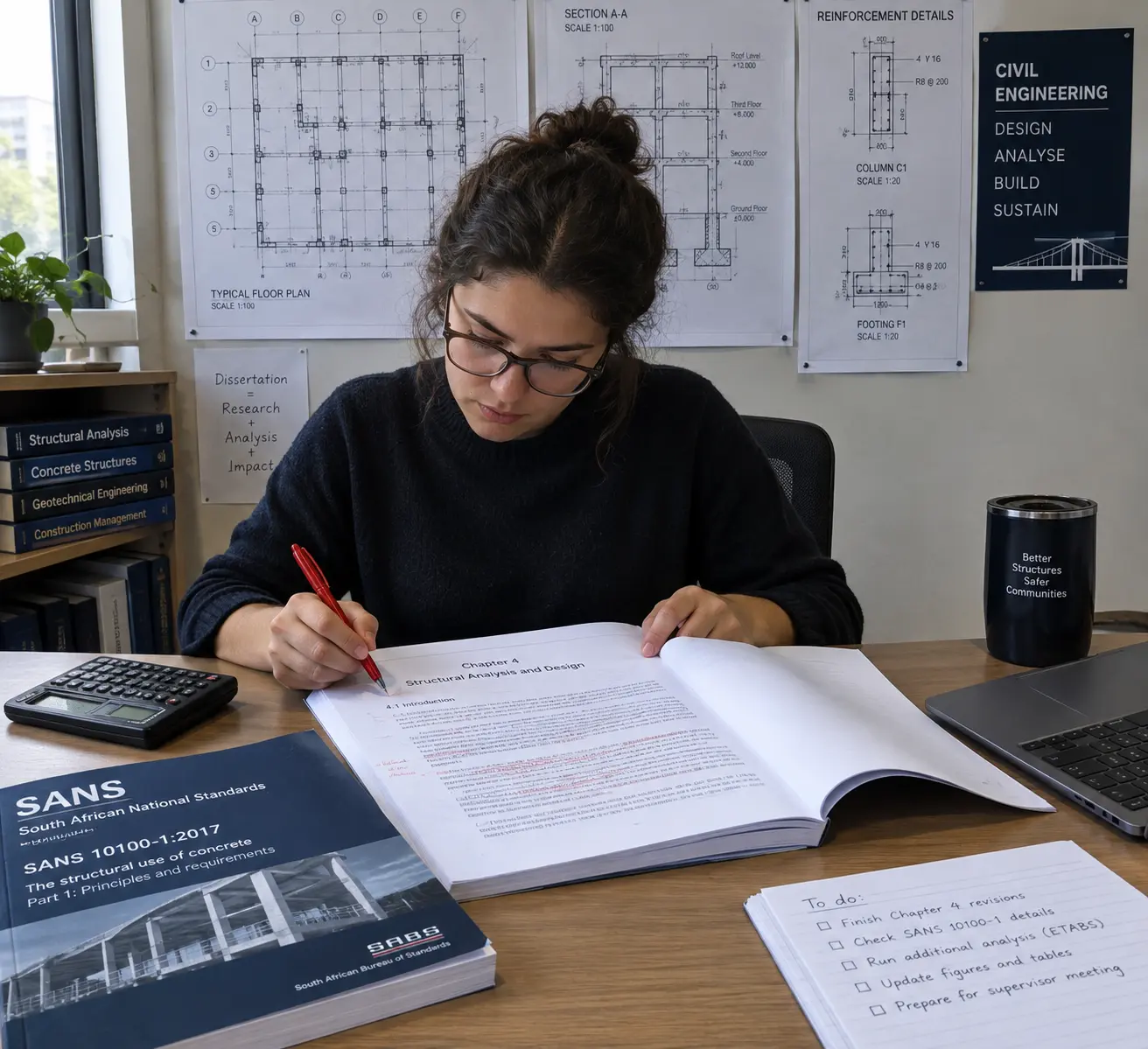
A civil engineering dissertation is written in a register most humanities and social-science guides never cover: mostly passive voice, past tense for what you did, present tense only for established facts, SI units throughout, and a citation form built around standards and codes rather than journal articles alone. Seven conventions, in the order a chapter draft usually needs them.
Step 1: Default to passive voice for methods and procedure
“Specimens were cured for 28 days at 23°C” is the expected register for a methodology or results chapter, not “I cured the specimens for 28 days.” The passive construction keeps the focus on the procedure and the material, which is what an examiner checking whether your method could be repeated actually needs to evaluate — not who personally carried out each step. This is a genuine difference from a qualitative social-science dissertation, where first-person voice is increasingly accepted to signal the researcher’s own positionality; in civil engineering, first person is still the exception, reserved mainly for a short reflective statement in a preface or acknowledgements section, never the results or methodology chapters.
Step 2: Match tense to what the sentence is actually claiming
Three tenses do almost all the work in a civil engineering dissertation, and mixing them up is one of the fastest ways to make a chapter read as imprecise. Past tense reports what you specifically did and found: “the beam failed at 42 kN” (your own result, your own study, reported as a completed past event). Present tense states an established, general fact or a standard’s current requirement: “SANS 10100-1 specifies a minimum concrete cover” (true now, not only true at the moment you tested it). Present perfect signals a body of prior work leading up to your study: “several studies have investigated fibre-reinforced concrete’s flexural behaviour” (ongoing relevance up to the present). A results chapter written entirely in the present tense reads as though the finding is a general truth rather than a specific, bounded result from your own specimens — precisely the overclaim examiners are trained to flag.
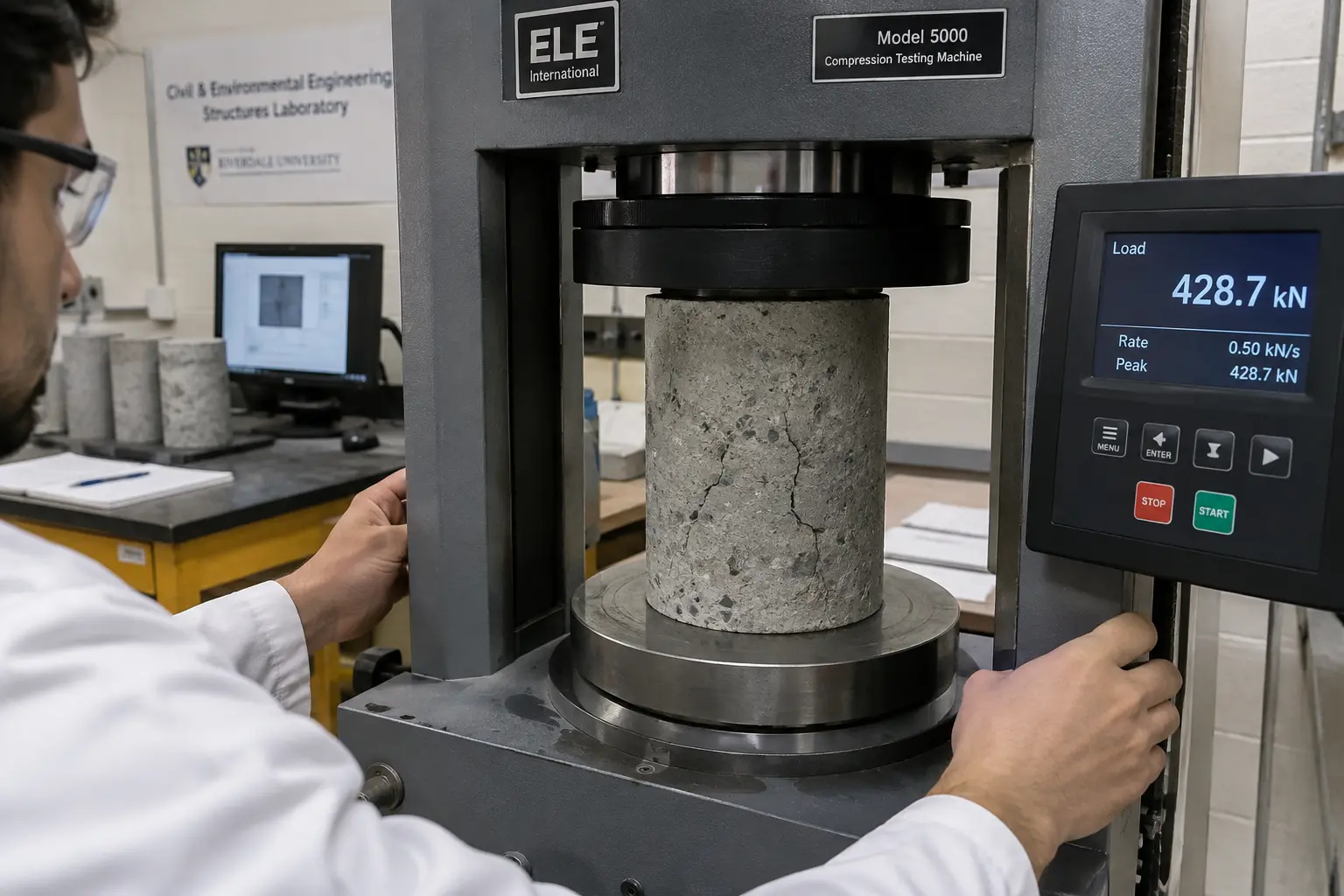
Step 3: Report every quantity in SI units, with the precision your method actually supports
South African civil engineering practice and its governing standards, the SANS 10100 and SANS 10160 families among them, use SI units throughout — kilonewtons, megapascals, millimetres — and a dissertation should never silently switch to an imperial figure quoted from an international source without converting it. Report each value to the precision your measurement method can actually support: a load cell reading to the nearest 0,1 kN should not be reported as if it were accurate to four decimal places, and a hand-measured crack width should not carry more precision than a ruler or crack gauge can deliver. Overstating precision is a specific, checkable error examiners look for, distinct from getting the value itself wrong.
Step 4: Number and caption every equation, table and figure consistently
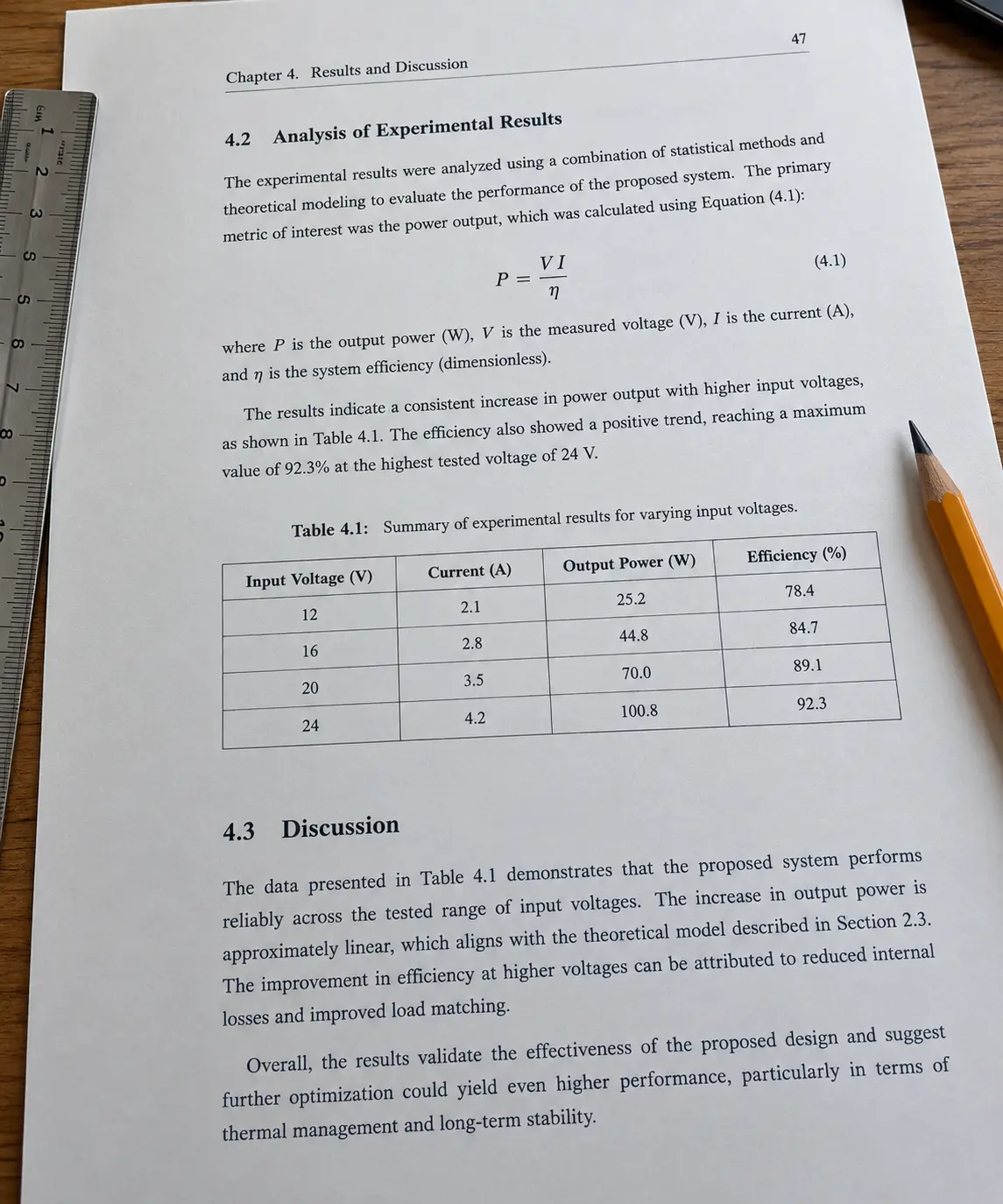
Equations are numbered sequentially, usually chapter by chapter (Equation 3.1, 3.2 and so on), with the number right-aligned in parentheses and every symbol defined in the text immediately after the equation appears, not left for a reader to infer from a nomenclature list alone. Tables are conventionally captioned above the table and figures below the figure — a small convention that is nonetheless an easy formatting slip for a first-time engineering writer, so check it against your faculty template. Every table and figure needs a number and a caption specific enough to stand alone if photocopied out of context — “Results” is not a caption; “Compressive strength versus curing age for Mix A and Mix B” is.
Step 5: Cite standards and codes in the form your faculty actually expects
A civil engineering dissertation cites two source types most other fields do not: national standards (the SANS family, cited by number, part and year of the specific edition used) and, where relevant, international codes the standard itself references. The reference-list form is close to a normal Harvard organisational-author entry: the issuing body as author, the year of the edition you used, the standard number and part followed by its full title in italics, then the place of publication and the publisher. In the text, name the standard and its year on first use, then the short form on later mentions. Always confirm the current edition and part number against your university library’s standards collection before you cite it, since an outdated standard number is an easy, avoidable objection; the site’s guide to the methodology chapter of a civil engineering dissertation covers this citation pattern in the context of a full worked methodology section.
Step 6: Keep hedging proportional to your actual uncertainty, not habitually cautious
Civil engineering writing hedges less than a typical social-science discussion chapter, and for a specific reason: a numerical result either falls inside a stated tolerance or it does not, and dressing a clear result in unnecessary qualification (“it might possibly suggest,” “could potentially indicate”) reads as a failure to commit to your own finding rather than appropriate caution. Reserve genuine hedging for what actually carries uncertainty — a numerical model’s behaviour outside its validated range, or a field observation limited by access constraints — and state a clean, validated result plainly: “the specimen achieved a mean compressive strength of 38,4 MPa” needs no qualifier if the test followed the stated standard and the calibration was current. Where your chapter does report an inferential statistical test comparing specimen groups, the general decision logic in the site’s guide to choosing the right statistical test for a dissertation applies to specimen groups just as it does to survey respondents — and the register convention is the same: report the test statistic and significance level plainly, without additional hedging once the test itself has been correctly run.
Step 7: Use abbreviations and acronyms consistently, defined once
Define every abbreviation and acronym in full on its first use in the body text — South African Bureau of Standards (SABS), Engineering Council of South Africa (ECSA), finite element (FE) — then use the short form consistently afterwards, never reverting to the full form mid-chapter out of habit. A nomenclature or abbreviations list at the front of the dissertation is expected in most faculties and does not remove the requirement to define a term on its first use in the running text as well; the two serve different readers, one skimming for a quick lookup and one reading the argument in order.
A worked before-and-after paragraph
Weak register: “I think the results show that our concrete mix was probably stronger than expected, which could suggest the water-cement ratio maybe had an effect.” This mixes first person, unnecessary hedging, an unstated baseline (“expected” against what figure?), and an untested causal claim presented as speculation rather than an analysed result. Corrected register (illustrative figures, not a real study): “Mix A achieved a mean 28-day compressive strength of 41,2 MPa (SD = 1,8 MPa, n = 6), exceeding the 35 MPa design strength set for the mix. The lower water-cement ratio of Mix A relative to Mix B (0,45 versus 0,55) is consistent with the higher strength observed, in line with the established inverse relationship between water-cement ratio and compressive strength.” The corrected version is in passive and third person throughout, states the specific numeric result with its variability and sample size, names the target the result is compared against, and states the causal relationship as consistent with established theory rather than as personal speculation.
Does the register change between the literature review and the results chapter?
Yes, and the shift trips up more students than any single sentence-level rule. A literature review reports other researchers’ findings mainly in present perfect or past tense depending on how settled the finding is (“research has shown” for an established consensus, “the authors found” for a specific study’s result), and it is where hedged, comparative language belongs — weighing one study’s method against another’s, noting where the literature disagrees. Once you cross into your own methodology and results chapters, the register tightens: your own procedure and findings are reported in confident, specific past tense, and hedging is reserved only for genuine uncertainty in your own data, not habitual academic caution carried over from the literature review’s tone. A discussion chapter then relaxes slightly again, using present tense to connect your specific finding back to the general body of knowledge it now contributes to. Recognising which chapter you are in, and which register job that chapter is doing, resolves most of the tense and hedging confusion students report.
How does register interact with ECSA’s professional expectations?
The Engineering Council of South Africa (ECSA) is a statutory body established under the Engineering Profession Act 46 of 2000, and its primary role is the regulation of the engineering profession. It registers engineering professionals across categories including Professional Engineer, Professional Engineering Technologist, Professional Engineering Technician and Professional Certificated Engineer, alongside candidate categories for those working toward registration. Precise, unhedged, unit-consistent technical writing is not only an academic-register convention; it is the standard of communication expected of a registered professional making a finding that could affect public safety. Building that discipline into your dissertation writing now is preparation for the standard your career will hold you to later, not a separate academic-only skill.
Getting the register consistent across a whole chapter
Keeping passive voice, tense, unit precision and abbreviation use consistent across a long methodology or results chapter is exactly the kind of mechanical, easy-to-slip-on-a-deadline consistency Tesify helps with — drafting each section in the register this piece describes, while every measured value and every judgement about your results stays yours and the dissertation stays 100% written by you. Draft your civil engineering chapters with Tesify.
Frequently asked questions
Is first-person writing ever acceptable in a civil engineering dissertation?
Occasionally, in a short reflective preface or acknowledgements section, but not in the methodology, results or discussion chapters, where passive, third-person construction remains the expected register across South African civil engineering faculties.
Should I use British or American spelling for technical terms?
South African academic convention generally follows British spelling (“fibre,” “colour,” “metre”), consistent with South African English generally; check your specific faculty’s style guide, since some technical terms have standardised American-derived spellings in international codes your dissertation may cite.
How precise should I report a measured value if my instrument’s precision is unclear?
Check the instrument’s calibration certificate or manufacturer specification for its stated precision, and report your result to match; when genuinely unclear, report conservatively (fewer decimal places) rather than implying a precision your method cannot support.
Do I need to define an abbreviation every single time it reappears in a new chapter?
Most South African faculties expect the abbreviation defined once at first use in the body text, with a running nomenclature list at the front of the dissertation for reference thereafter, not a fresh definition in every chapter, but confirm your own faculty’s specific convention.
Can I use “significant” loosely, or does it need a statistical meaning?
Reserve “significant” for a stated statistical test result (p < a defined threshold) where your chapter reports inferential statistics; use “substantial,” “considerable” or a specific numeric comparison where you mean size or importance generally, to avoid an examiner reading an unintended statistical claim into the word.
Is it acceptable to mix SI and imperial units if my source data was originally in imperial?
No — convert every imperial figure to SI units before reporting it, and state the conversion factor or method in a footnote or appendix if precision in the conversion matters to your analysis.
Does register discipline matter as much for a comparison-heavy chapter, like choosing between software tools?
Yes — the site’s comparison of STAAD.Pro, ETABS and Civil 3D for a civil engineering dissertation uses the same passive, unit-precise register throughout its recommendations, even though its job is comparative rather than reporting original results.
How do figure and table numbering conventions differ between departments?
Many South African civil engineering departments number sequentially by chapter (Table 3.1, Figure 4.2), but confirm against your specific faculty template before you draft, since a whole-dissertation sequential numbering convention also exists at some institutions.
Does this register apply equally to a numerical modelling dissertation as to an experimental one?
Yes — passive voice, tense discipline, SI units and precise abbreviation use apply across all three research traditions (experimental, numerical, field), though a numerical study additionally needs its software version and governing equations stated with the same precision as an experimental study states its apparatus.