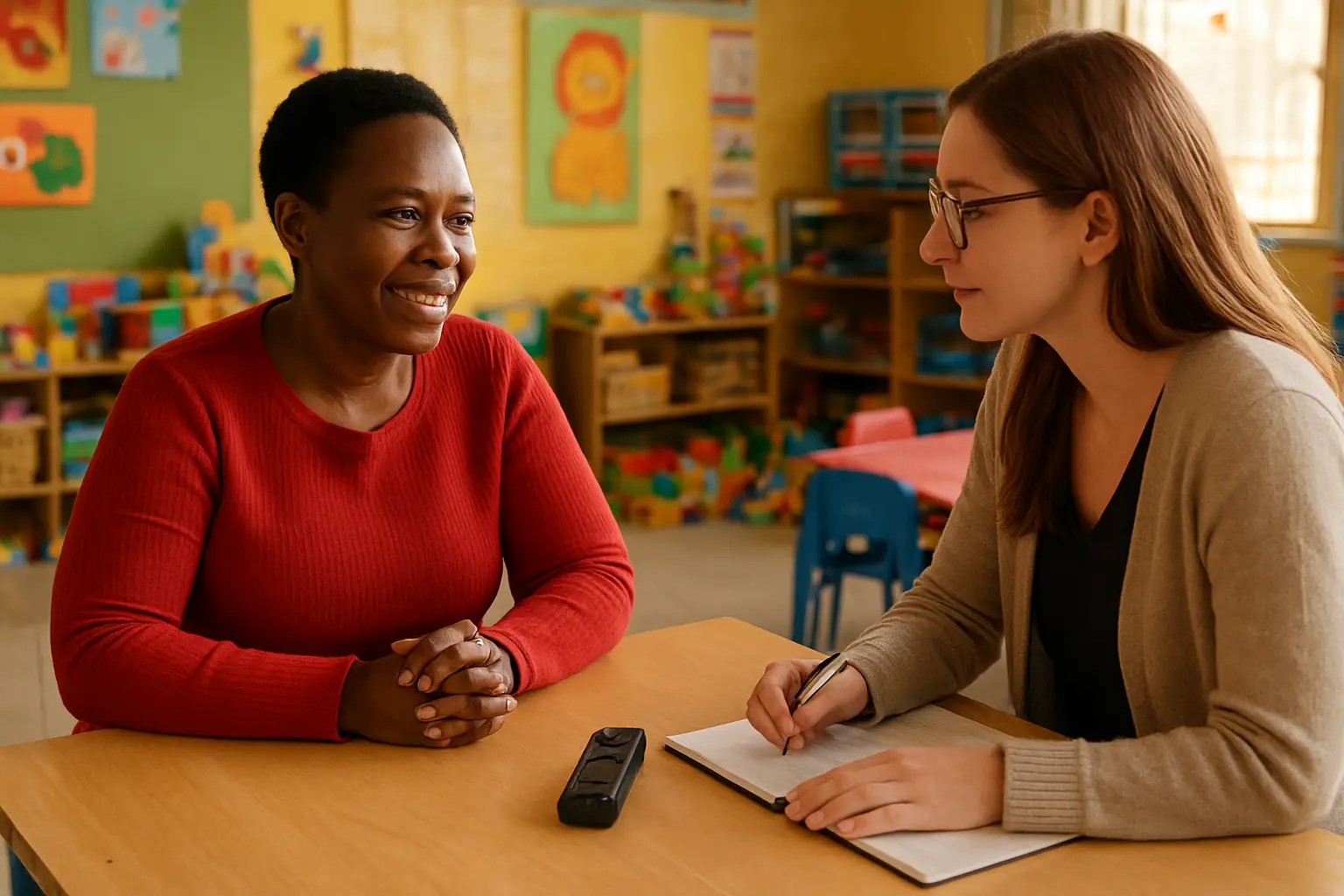
An interview guide is not a list of questions you think of the night before. It is a question bank organised by research objective, with planned probes for when an answer is thin, a pilot step that catches confusing wording before it wastes a real participant’s time, and a plan for how the transcripts will be coded once collected. For a South African education qualitative study — teachers, principals or Foundation Phase practitioners as participants — a guide built this way is what separates a defensible instrument from a conversation with a recorder running.
What does a complete interview guide contain?
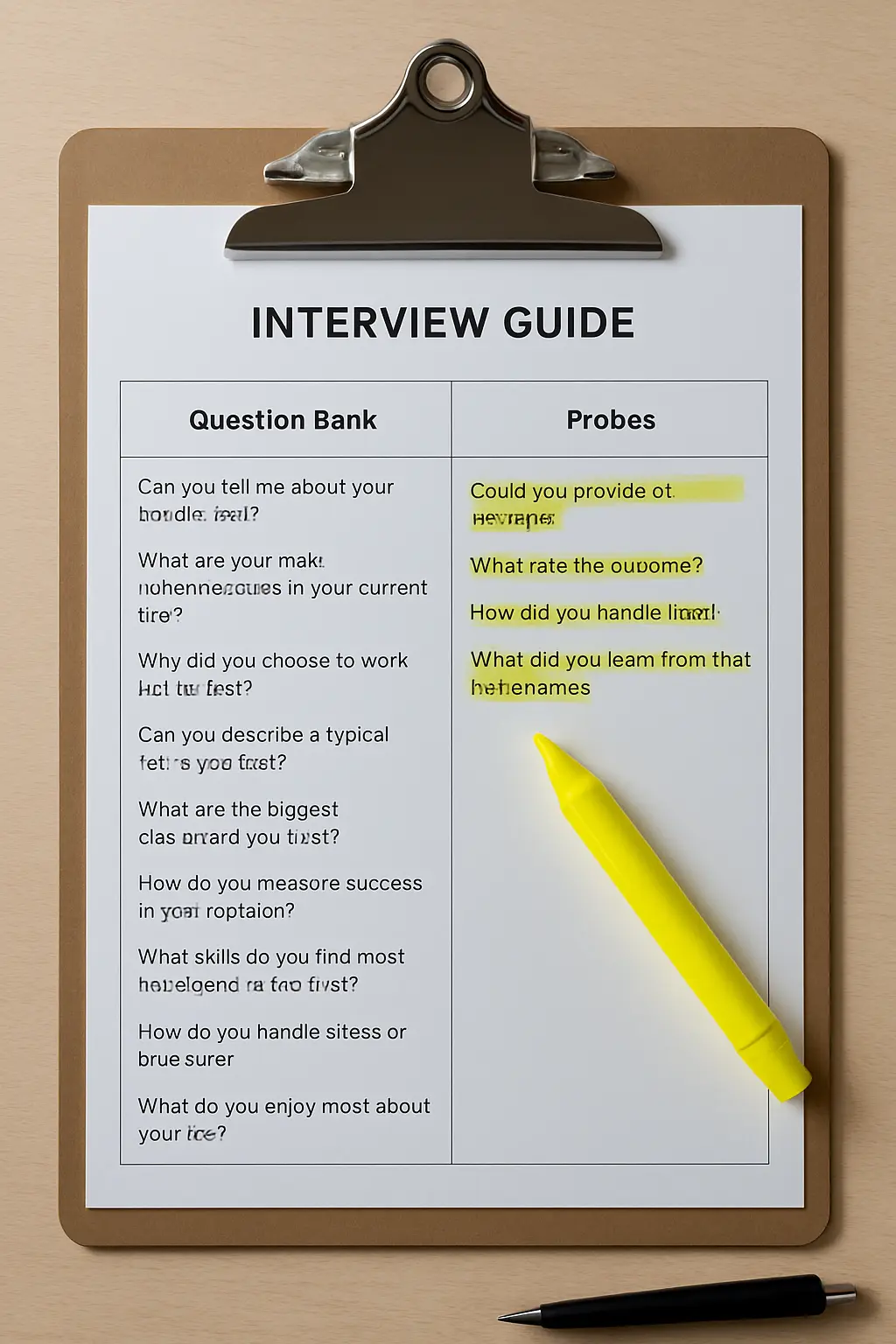
Six parts, in order: (1) an opening script that restates consent, confidentiality and the right to stop, read aloud rather than assumed from a signed form; (2) two or three warm-up questions that are easy to answer and build rapport before the substantive questions start; (3) the main question bank, organised under each research objective rather than asked in a random order; (4) a planned probe under each main question, for when the first answer is too brief to analyse; (5) a small set of closing questions that let the participant add anything the guide did not ask; and (6) a debrief script that thanks the participant and explains what happens to the recording next.
How do I organise questions by objective?
Every main question should trace back to one of your study’s objectives, and every objective should have at least one main question — the same alignment check a quantitative variables matrix runs, done for a qualitative design instead. A guide with questions that do not map to any stated objective produces data the analysis chapter cannot use; an objective with no matching question produces a gap the discussion chapter cannot fill. Building the question bank objective by objective, rather than brainstorming questions freely and sorting them afterward, is the more reliable order to work in — it is much harder to notice a missing objective once a long list of interesting-sounding questions already exists.
A worked example: Grade R teachers and play-based learning
The example below follows one illustrative topic: Grade R teachers’ experiences of implementing play-based learning within the CAPS Foundation Phase framework. Objective 1 is to describe how teachers understand play-based learning; Objective 2 is to explore the barriers teachers report; Objective 3 is to explore what support teachers say they need.
| Objective | Main question | Planned probe |
|---|---|---|
| 1. Understanding of play-based learning | How would you describe play-based learning in your own words, in your own classroom? | Can you walk me through what that looked like in a lesson last week? |
| 2. Barriers to implementation | What makes play-based learning difficult to implement here? | You mentioned [barrier] — can you tell me more about how that affects a typical day? |
| 3. Support needed | What kind of support would make this easier for you? | If you could ask the department for one thing, what would it be, and why that specifically? |
Each probe is written in advance, not improvised, because a probe invented in the moment often unintentionally leads the participant toward the answer the researcher expects — a common validity risk in a first-time interviewer’s guide.
Opening script and consent, annotated
Excerpt. “Thank you for agreeing to speak with me today. As explained in the information sheet, this interview is part of a study on Grade R teachers’ experiences of play-based learning. Everything you share will be kept confidential and your name will not appear in the final report. You can stop the interview at any time, or choose not to answer any question, without giving a reason. I would like to record this conversation so I can focus on listening rather than writing — is that alright with you? [Confirm recording consent verbally before starting, even where written consent was already signed.]”
Annotation. Verbal re-confirmation of recording consent, immediately before the recorder starts, is good practice worth documenting — a signed form obtained days earlier does not substitute for consent confirmed at the point of recording.
How do I pilot an interview guide?
Pilot the guide with one or two people who resemble your real participants but will not be included in the final sample — a colleague’s Grade R class, or a teacher at a school outside your final site. Time the interview, note any question that produced confusion or a one-word answer, and revise before the real data collection begins. A pilot is reported in the methodology chapter as a distinct step, with what changed and why — not silently folded into the main round of interviews. A common pilot finding worth planning for: a question that works well in English can still confuse a participant who would rather answer in isiXhosa, isiZulu or Afrikaans, which the next section addresses directly.
What does language add to a South African interview guide?
Where interviews may be conducted in a language other than the report’s writing language, the guide needs a translated version prepared in advance, ideally checked by back-translation, and the methodology chapter needs to state which language each interview was actually conducted in and how translation of quotations was handled. A guide that exists only in English, offered to a participant more comfortable in another language, risks thinner answers that are a translation artefact rather than a genuine finding — and an examiner reading a discussion chapter that quotes translated speech as if it were the participant’s exact words, with no translation note, will ask about it.
What happens to the guide once transcripts come in?
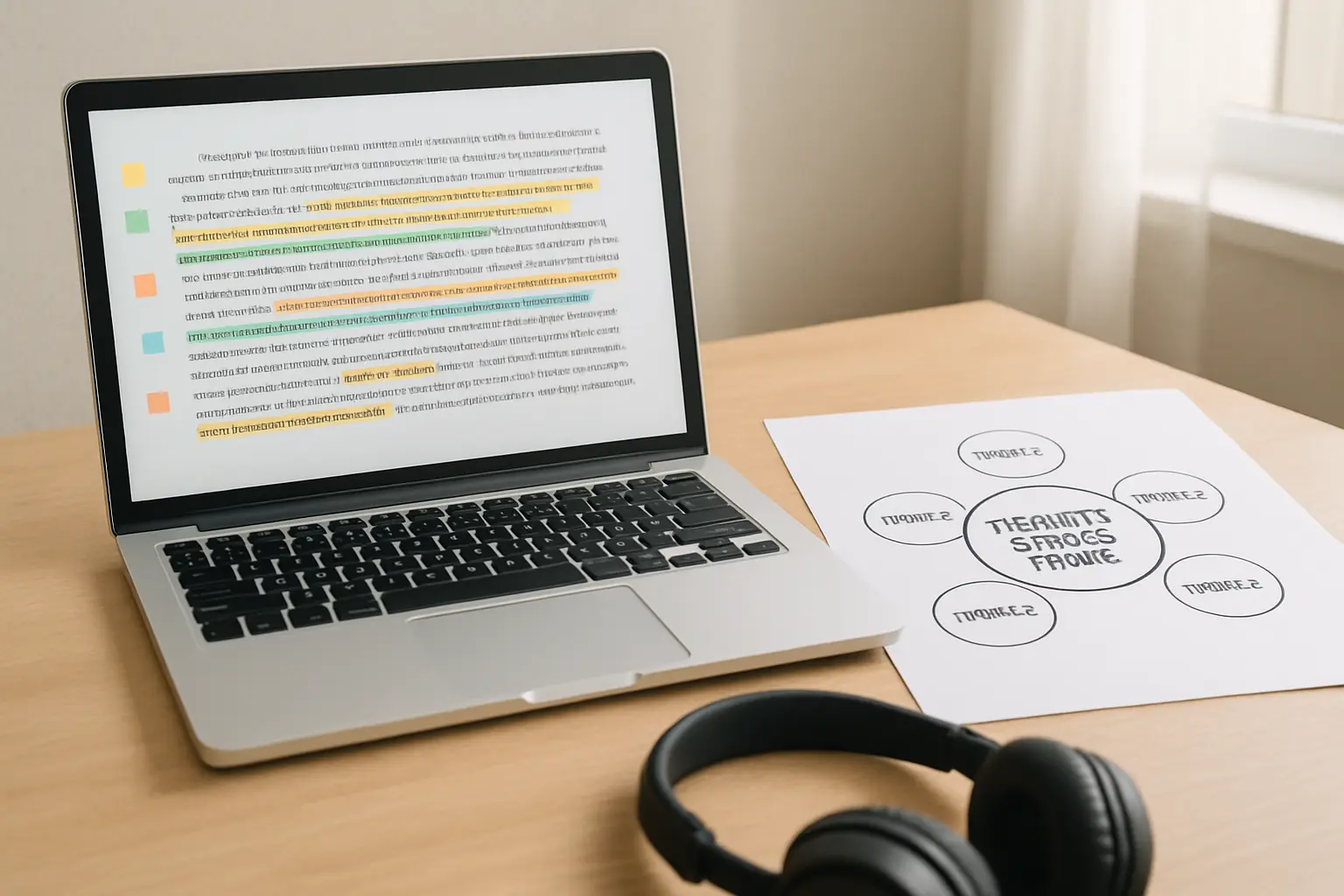
The objective column becomes the first-pass coding frame: responses to Objective 1’s questions are read together, Objective 2’s together, and so on, before line-by-line coding begins within each group. Transcription itself is a decision point — verbatim transcription (including pauses, false starts and filler words) supports a discourse-level analysis, while a cleaned transcript is often sufficient for thematic analysis, and the methodology chapter should state which convention was used and why. This is not the only way to code qualitative data, but it keeps the guide’s structure visible in the analysis chapter, which is what lets an examiner trace a specific finding back to a specific question.
How is this different from the questionnaire and interview templates already on this site?
The site’s existing data collection instruments guide builds one generic questionnaire and one generic semi-structured interview schedule, useful across disciplines. This page does a different, narrower job: an education-specific interview guide built around a real Foundation Phase curriculum context, with the DBE permission chain this vertical actually requires factored into the opening script and the sampling plan, not left as a generic template gap.
What permission does this design need before a single interview happens?
The same chain that governs any South African school-based research: university ethics clearance first, then provincial education department research approval, then the school principal and governing body, then — for a study of teachers rather than learners — the individual teacher’s own informed consent, which is the layer this interview guide’s opening script exists to document. The full chain, including the department-level step generic guides skip, is set out in how to write the methodology chapter of an education mini-dissertation. Where the study involves learners directly rather than teachers, parental consent and learner assent add a further layer, both of which need their own scripted, age-appropriate explanation — a teacher-only design, as in this worked example, avoids that additional layer but should still say so explicitly in the methodology chapter rather than leaving the reader to assume it.
Five things an examiner checks in an interview guide
- Whether every main question traces back to a stated objective, and every objective has at least one question.
- Whether probes are planned in advance rather than improvised, to avoid leading the participant.
- Whether the opening script re-confirms consent verbally at the point of recording, not just via an earlier signed form.
- Whether a pilot step is reported, with what changed as a result.
- Whether the guide’s structure is still visible in how the analysis chapter organises its findings.
Building your own guide from this model
Swap the topic, keep the six-part structure and the objective-to-question mapping. Forty education topic ideas, each already scoped to a permission pathway, are in education dissertation topics in South Africa 2026, and the site’s worked research aims and objectives examples show how to write the objectives this guide’s question bank needs to trace back to. Tesify can help you draft your objectives and question bank side by side before you walk into your first interview.
Frequently asked questions
How many questions should a main interview guide have?
There is no fixed number: plan only as many main questions as you can cover properly, with probes, in the time you have agreed with participants. Too many risks running out of time before covering every objective, or rushing the participant’s answers — your pilot will show whether the list fits.
Do I need a different guide for a focus group than for a one-on-one interview?
Yes. A focus-group guide needs fewer main questions (group discussion naturally expands each one), plus facilitation notes for managing dominant speakers and drawing out quieter participants — both absent from a one-on-one guide.
Should I share the interview guide with participants beforehand?
Many faculties require the topic areas to be described in the information sheet, but sharing the exact question wording in advance can produce rehearsed rather than spontaneous answers. Check your own ethics committee’s expectation.
What if a participant gives a one-word answer to every question?
This is exactly what planned probes are for — use the prepared follow-up rather than moving straight to the next main question, and note in your reflexive journal if a participant remains consistently brief despite probing.
Can I change the guide partway through data collection?
Minor wording refinements based on early interviews are normal and should be documented; a substantial change to the question set partway through affects the comparability of your data and usually needs supervisor sign-off.
Does the guide need to be included as an appendix?
Yes — the final version of the interview guide is standard appendix material in a South African qualitative education dissertation, alongside the ethics certificate and consent form.
How long should each interview last?
Long enough to cover every objective with probes, short enough to avoid participant fatigue — time your pilot interview, state the expected duration in the information sheet, and keep to it.
What is the difference between a probe and a main question?
A main question opens a new topic tied to an objective; a probe follows up within that same topic to deepen an answer already given. Confusing the two — using probes to introduce new topics — makes the guide harder to code by objective afterward.
Who should transcribe the interviews, me or a service?
Either is acceptable, but if you use a transcription service, check your ethics approval covers a third party handling the audio, and that the service signs a confidentiality agreement before receiving any recordings.
What should I do with the interview guide if I switch from individual interviews to focus groups partway through planning?
Rebuild it rather than adapt it lightly — the question count, the facilitation script and the consent process all differ enough between the two formats that a focus-group guide built from an interview guide by minor edits usually still reads like an interview guide to a group.