There are three separate jobs around a data collection instrument, and most guidance covers only two of them. Choosing a published scale is one job, and this site covers it for HRM and nursing. Proving your instrument measures what you claim is another, covered in how to prove your questionnaire is valid.
This article does the third job: building the thing. A full questionnaire template, a full semi-structured interview schedule, the blueprint that proves coverage, and the review and pilot routine that turns a draft into an instrument you can defend.
Start with the blueprint, not the questions
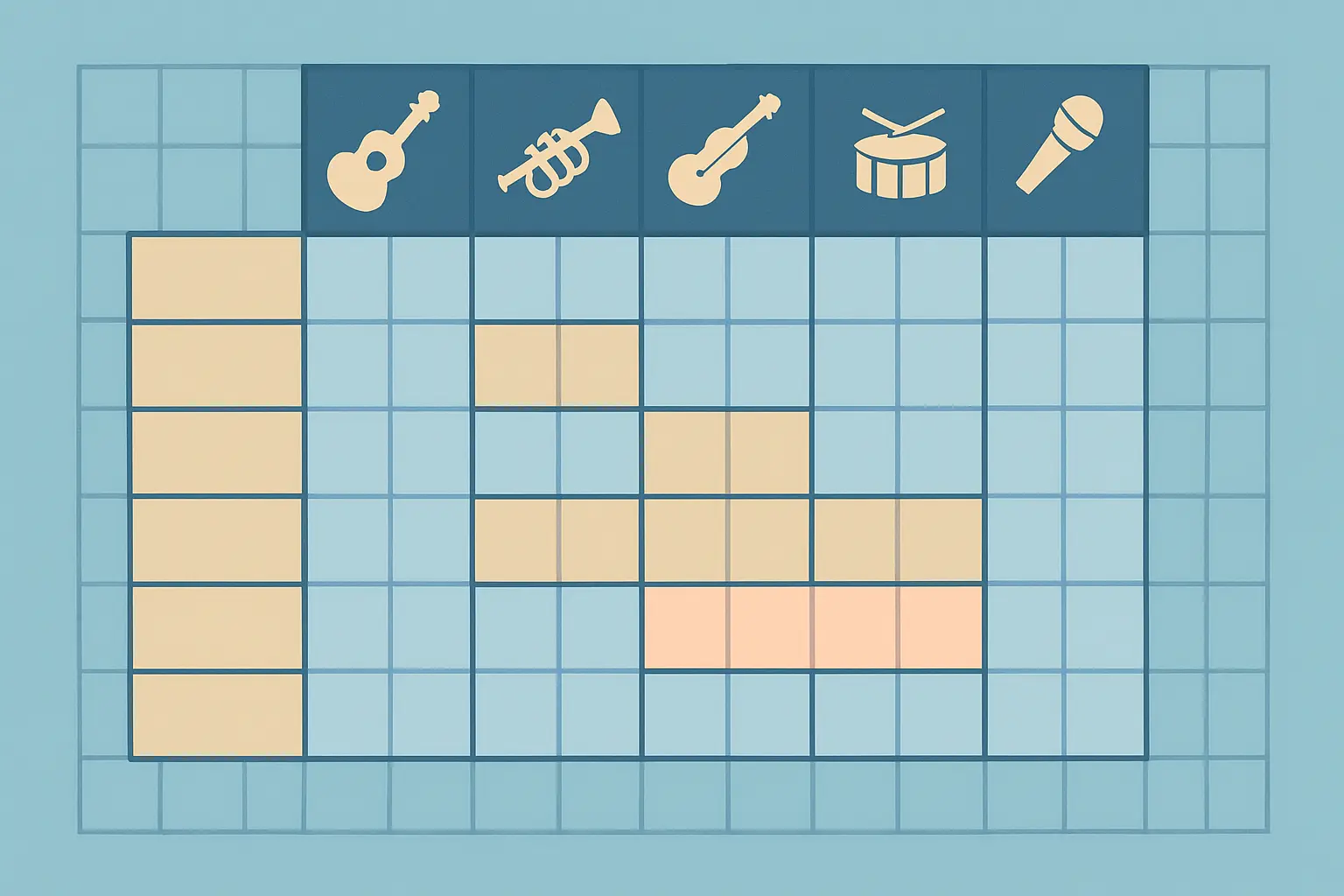
The blueprint is a table with your objectives (or constructs) as rows and your items as columns. Build it before you write a single question, and the two most common instrument failures become impossible: an objective with no items behind it, and a block of items that serve no objective at all.
| Objective / construct | Items | Number of items | Source |
|---|---|---|---|
| Objective 1: describe [X] | A1–A6 | 6 | Adapted from [cite] |
| Objective 2: measure [construct] | B1–B12 | 12 | Published scale, unchanged [cite] |
| Objective 3: measure [construct] | C1–C8 | 8 | Newly written for this study |
| Demographics | D1–D5 | 5 | — |
Put this table in the methodology chapter. It is the single most economical way to demonstrate content coverage, and it answers the question an examiner would otherwise ask about why the instrument has the length it has.
The questionnaire template
Five sections, in this order. The ordering is not arbitrary: easy and non-threatening first, sensitive material once the respondent is committed, demographics last because they are the least interesting to answer and the most likely to be abandoned.
Section 0: the cover
[Study title]
You are invited to take part in a study about [topic], conducted as part of a [degree] at [institution]. Ethics clearance reference: [number].
The questionnaire takes about [n] minutes. Participation is voluntary and you may stop at any time without giving a reason and without any consequence. Your responses are anonymous / confidential [choose and be accurate about which]. Data will be stored [how and where] and kept for [period].
There are no right or wrong answers. Please answer according to your own experience.
Contact: [researcher, email]. Supervisor: [name, email]. Ethics committee: [contact].
By continuing, you confirm that you have read this information and agree to take part.
Anonymous and confidential are not the same word. Anonymous means you cannot identify the respondent, even if you wanted to. Confidential means you can but will not. If your questionnaire asks for a staff number or is distributed by a named link, it is not anonymous, and saying so incorrectly is an ethics problem rather than a wording preference.
Section A: screening and context
A1. How long have you worked in [role]? ☐ Less than 1 year ☐ 1–3 years ☐ 4–10 years ☐ More than 10 years
A2. Which of the following best describes your current [setting]? [mutually exclusive options, plus Other: ________]
A3. [Screening question that determines eligibility, with a skip instruction if the respondent does not qualify.]
Section B: the main scale
The following statements describe [construct]. Please indicate how much you agree with each one.
1 = Strongly disagree · 2 = Disagree · 3 = Neither agree nor disagree · 4 = Agree · 5 = Strongly agree
B1. [Statement, one idea, present tense, no negation.] 1 2 3 4 5
B2. [Statement.] 1 2 3 4 5
B3. [Reverse-worded statement, marked R in your codebook but not on the form.] 1 2 3 4 5
Rules that matter more than they look. One idea per item — “My supervisor is available and responds quickly” is two items pretending to be one, and a respondent whose supervisor is available but slow cannot answer it. Avoid negation, because “I do not feel unsupported” is a puzzle rather than a question. Keep the anchors identical throughout a section; changing from agreement to frequency mid-section produces data you cannot combine.
Section C: open questions
C1. What, if anything, would make [the thing] easier in your setting?
C2. Is there anything about [topic] we have not asked that you think we should know?
Two is plenty. Open questions in a questionnaire generate real insight and real analysis time; ten of them turn a survey into an unfunded qualitative study.
Section D: demographics
D1. Age in completed years: ____
D2. Gender: ☐ Woman ☐ Man ☐ Prefer to self-describe: ____ ☐ Prefer not to say
D3. Home language: [list, plus Other: ____]
D4. Highest qualification completed: [ordered list]
Collect only what your analysis will use. Every demographic item is a small privacy cost, and an item you never report is a cost with no return — a point an ethics committee may well raise.
The semi-structured interview schedule
An interview schedule is not a spoken questionnaire. It is a small number of open questions with planned probes, and it is meant to be departed from.
Opening (not recorded as data)
Thank you for your time. As the information sheet explained, this is about [topic], it will take about [n] minutes, and I would like to record it so I do not have to rely on my notes. You can ask me to stop the recording at any point, and you can decline any question. May I start recording?1. Warm-up
Tell me a bit about your role and how long you have been doing it.
Probe: What does a typical [day/week] look like?2. Core question one — experience
Think about the last time [the phenomenon] came up. Can you talk me through what happened?
Probes: What did you do first? Who else was involved? What made that difficult?3. Core question two — reasoning
How do you decide [the decision at the centre of your study]?
Probes: What are you weighing up? Has that changed over time? Can you give me an example where it was not obvious?4. Core question three — context and constraint
What, in your setting, makes that easier or harder?
Probes: Are there rules or guidelines you follow? What happens when they do not fit the situation?5. Contrasting case
Can you think of a time it worked out differently from usual? What was different about it?6. Closing
Is there anything important about this that I have not asked about?
Thank you. If you think of anything later, here are my contact details.
Three design points. Start with an experience, not an opinion — “tell me about the last time” produces detail that “what do you think about” does not. Probes are planned, not improvised; writing them in advance is what makes a novice interviewer sound competent. And the contrasting-case question at point 5 is the one most often left out and the one most likely to produce your best data, because it surfaces the boundary of the pattern everyone else described.
A South African walkthrough of questionnaire design
The University of the Free State’s Centre for Graduate Support publishes a questionnaire design series for postgraduates, starting from the research question rather than from the items.
Expert review and pilot, in that order
A newly built instrument needs two checks before it goes anywhere near your sample, and both belong in the methodology chapter.
- Expert review for content validity. Three to five people who know the construct or the population rate each item for relevance and clarity, and flag anything ambiguous. Report who they were by role rather than by name, what you asked them to judge, and which items you changed as a result. “Items were reviewed by two experts” with no outcome is not a review.
- Pilot with people like your participants. Eight to fifteen is usually enough to find the problems. Time the completion, watch where people hesitate, and afterwards ask what they thought three or four specific items meant. Pilot data is not combined with the main dataset unless nothing changed, in which case say so explicitly.
A South African note worth planning for: if your respondents will be completing the instrument in an additional language, the pilot is where you find that out, and the fix is usually simplifying the item rather than translating it. If you do translate, back-translation and a reconciliation step belong in the method, and the translated version is a different instrument from the original.
Six mistakes
- Double-barrelled items. Any item containing “and” is a candidate for splitting.
- Leading wording. “How helpful did you find…” assumes helpfulness. Ask how helpful or unhelpful, or ask an open question.
- Changing anchors mid-instrument. Agreement in one block and frequency in the next, then a total score computed across both.
- Sensitive questions too early. Income, health and misconduct items in section A drive abandonment.
- No skip logic. Asking about an experience the respondent has just said they have not had.
- Modifying a published scale and reporting its published reliability. Once you change items or anchors, the published properties describe a different instrument. Report your own.
What happens to the instrument next
The instrument goes into your appendix in full, is described in the methodology, and its scoring is what you implement when you analyse questionnaire data in SPSS. Its items should map onto the rows of your operationalisation table and answer the objectives. Distribution is a separate decision, and the best online survey tools for a South African dissertation compares the options including offline capture. Interview data goes on to thematic analysis.
Nothing is distributed before ethics clearance is granted, and your committee will want to see the instrument itself, not a description of it.
Frequently asked questions
Can I write my own questionnaire instead of using a published scale?
Yes, and for context-specific content you often must. It becomes part of your method: blueprint, item writing, expert review, pilot and your own reliability figures.
How many items should a questionnaire have?
As many as the blueprint requires and no more. Completion time is the binding constraint; anything past roughly fifteen minutes shows up as abandonment and careless responding.
Should I use a five-point or seven-point scale?
Either is defensible. Match the source instrument if you are adapting one, keep it constant within a section, and label every point rather than only the ends.
Should I include a neutral midpoint?
Usually yes, because forcing a choice on people who genuinely have no view adds noise rather than information. State your decision in the methodology.
How many interview questions should a schedule have?
Four to six core questions with planned probes, for an interview of about an hour. A schedule with twenty questions is a spoken questionnaire and will produce thin answers.
Do I need to pilot if I use a published instrument unchanged?
A small pilot is still worth doing to check comprehension and timing in your population, even when the instrument itself is established.
How do I report expert review?
The number of reviewers and their expertise by role, what you asked them to judge, and the specific changes made. Naming the outcome is what makes it evidence.
Can I use the pilot data in my main analysis?
Only if the instrument did not change afterwards, and you should say so explicitly. If it changed, the pilot responses answered a different instrument.
Do the instruments go in the appendix?
Yes, in full, including the cover and consent wording, in every language in which they were administered.
What if a respondent skips a whole section?
Decide the rule before you collect: how much missing data makes a case unusable, and how you will handle the rest. Deciding after you see the data invites the obvious question.
Build the instrument, not just the chapter
A well-built instrument saves you from the analysis problems you would otherwise discover in chapter four. Tesify helps you draft the methodology around it and keep every item traceable to an objective, with the work staying 100% written by you.